He could breathe sitting up, but not lying down
A 23-year-old hit the steering wheel with his face. He arrived awake, talking, with an oxygen saturation of 99%, and the most important thing about him was the position he was holding.
- Specialty
- Emergency medicine, maxillofacial and plastic surgery
- Patient
- Man, 23
- Mechanism
- Unrestrained driver; face struck the steering wheel
- On arrival
- Conscious, oriented, sitting forward in the tripod position
- Vital signs
- BP 160/90, pulse 110, respiratory rate 22, saturation 99%
- The key finding
- Airway patent sitting up, obstructed when laid flat
- Facial injuries
- All four walls of both orbits, both zygomatic arches, maxilla and nasal skeleton
- Eyes
- Right globe out of its socket; left displaced upward and forward
- Brain CT
- No parenchymal injury, no intracranial bleeding
- Airway secured by
- Tracheostomy, not intubation
- impactthe wheel, no belt
- arrivalsitting forward
- primary surveywhy he could not lie down
- airwaya hole in the neck
- CTthe brain was untouched
- theatrereassembling a face
What the steering wheel does to a face
A belt works by catching the chest and pelvis early, while there is still room between the occupant and the car. Without one, the body keeps moving at whatever speed the car was doing until something stops it, and for a driver the first thing in the way is the steering wheel, at roughly the height of the face.
The facial skeleton is a lattice of thin plates and air-filled sinuses arranged around a few thicker vertical struts rather than solid bone, and it is built that way for good reasons: it keeps the head light enough to carry, and it crumples.
That crumpling is the same principle as the front of the car. Energy spent breaking bone is energy not delivered to the brain behind it.
The position he arrived in
He was brought in conscious, oriented and cooperative, breathing on his own, sitting forward with his hands braced. Clinicians call that the tripod position, and patients adopt it when breathing is difficult because it gives the chest more room to work.
His blood pressure was high and his pulse fast, both consistent with pain and adrenaline. He was breathing faster than normal. His oxygen saturation was 99%, which is to say normal, and that number is the trap in this case.
He was also talking, which is usually reassuring. Someone speaking in sentences has a patent airway at that moment. It says nothing about whether they will still have one in five minutes.
The finding that governed everything
On the primary survey his oxygen levels were fine while he sat up. Laid flat, he could not keep his airway open.
That single observation is the case.
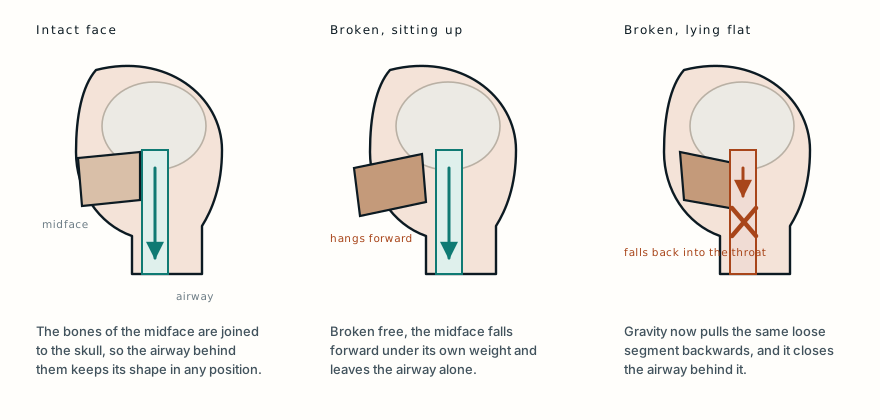
The midface hangs from the skull base. When the maxilla, the cheekbones and the nasal skeleton are all broken across, that block of bone is no longer attached to anything above it, and it goes wherever gravity takes it.
Sitting forward, gravity pulled the loose segment away from his throat and the airway behind it stayed open. Flat on his back, the same weight fell backwards into the pharynx and closed it.
Nothing was obstructing him in the ordinary sense. There was no foreign body and no swelling severe enough to matter yet. What had gone was the scaffolding, and he was holding his own airway open with posture.
He was also bleeding into that airway from the fractures, which is why suction was part of the initial management rather than an afterthought. Blood running into a pharynx that a patient cannot protect is the other half of the same problem.
Why they cut rather than intubated
A patient who cannot maintain his own airway needs one established for him, and the default is a tube through the mouth into the trachea. Here that route was closed off in several directions at once.
Intubating from above requires the patient to lie flat, which was the position that obstructed him. It requires a recognisable path through the mouth to the larynx, and the landmarks had been rearranged. It requires a view, and the pharynx was filling with blood.
The nasal route, sometimes used when the mouth is difficult, is specifically contraindicated in this pattern of injury. With the roof of the nose fractured there is a real possibility of passing a tube through the skull base and into the cranial cavity.
So the airway was secured surgically, through the front of the neck, below every part of the problem. A tracheostomy here is the first correct answer, not an escalation after other methods have failed.
What the scan showed, and what it did not
The CT of his head found no injury to the brain itself and no bleeding in any of the spaces around it.
The facial scan was the opposite. All four walls of both orbits were broken, both zygomatic arches were fractured in multiple places, and the maxilla and nasal skeleton were gone as intact structures. His right eye was no longer sitting in its socket. His left had been pushed upward and forward. On the left the jaw joint had lost its normal relationship entirely.
The contrast between those two scans is the thing worth carrying away. His face absorbed the collision and his brain did not, which is what a facial skeleton is partly for.
It is also why he was awake and answering questions with an injury that looks unsurvivable in photographs. Consciousness is a property of the brain, and his was intact.
What comes next
He went to plastic and reconstructive surgery once the airway was secure and he had been stabilised.
Rebuilding a face broken in this pattern is done by working from what is still attached and moving inward, restoring the vertical and horizontal struts of the facial skeleton in a fixed order so that each fixed segment gives the next one something to be fixed to. Both eyes needed repositioning into their sockets, which is time-critical for vision in a way the rest of the reconstruction is not.
Photographs taken after that operation show a reassembled face with both eyes in place and closed, and a long line of sutures where the midface had been opened up.
The part that did not have to happen
There is a version of this case that stops at the first sentence.
A belt does not make a crash survivable by absorbing force from the body. It works by keeping the occupant in the seat so that the car's own crumple zones and the airbag can do what they were designed to do, and by stopping the head from reaching the wheel at all.
The injuries here are the signature of an unrestrained driver: the face meeting the steering wheel at speed, with everything below it intact.
He was 23, he was conscious, and his brain came through unharmed. The rest of what happened to him was avoidable by a movement that takes two seconds.
What this case teaches
A saturation of 99% and a patient talking in full sentences described his condition accurately and predicted nothing. The midface is what holds the upper airway open, and once it has been broken away from the skull it follows gravity, so the same man was safe sitting forward and obstructed lying down. That is why the position he arrived in mattered more than any number on the monitor, why nobody could lay him flat to intubate him, and why the airway was cut into his neck instead. His brain was untouched because the bones in front of it absorbed the impact, which is the facial skeleton doing one of the jobs it exists for, at a price a seatbelt would have avoided entirely.
Written from a clinical account of a case seen in an emergency department, describing the presentation, imaging findings and airway management. The account could not be traced to a specific published case report, so the details used here are those given in it, and the explanation of midface anatomy, airway obstruction in panfacial fracture, contraindications to nasal intubation and the sequence of facial reconstruction is drawn from standard references. Photographs accompanying that account show an identifiable patient and are not reproduced here. The diagram is original to MedicaseHub and may be reused freely. This article is not medical advice. Read the full disclaimer.
One case, written up properly, when there is one worth sending
No schedule and no filler. When a case turns out to have something in it that is worth the time to explain, it goes out. Unsubscribe in one click.
Free · no spam · your address is never shared · built with KitRelated cases
- It was never cancer. It still had to come out.Another structure nobody notices until the bone beneath the eye is gone.
- He was a face transplant candidateJaws rebuilt from a leg, a nose from a forehead, and lips that decided everything.
- The hand arrived still inside the machineA welder freed him in theatre. The amputation was decided by something simpler than the damage.