They operated on the hand before they operated on him
A block-cutting machine took a 46-year-old man's right hand off through the forearm. It arrived at the hospital in an ice box, an hour behind him. While one team resuscitated him, another was already operating on the hand itself, on a side table, so that nothing would be waiting when the two were put back together.
- Specialty
- Plastic surgery, orthopaedics, anaesthesia
- Patient
- Man, 46, right-handed
- Mechanism
- Dominant hand caught in a block-cutting machine
- Level
- Radius and ulna divided in the distal third
- Arrival
- Within an hour, pale, blood pressure 90/60
- The part
- Carried in a bag inside a box of ice, then washed with 4 litres of saline
- Blood restored
- About 4 hours after the injury
- Repaired
- Both bones pinned, ulnar and radial arteries, median and ulnar nerves, three veins, tendons
- Operation
- Eight hours
- Discharged
- Three weeks, with a flicker of finger movement
- Still to come
- A year of physiotherapy and probably more operations
- 0 hthe machine
- 1 hthe hand arrives too
- decisionwhether to try at all
- benchthe hand goes first
- 4 hblood goes back in
- 8 hnerves, veins, tendons
- 3 weeksa flicker of movement
The hand he uses for everything
He was 46 and right-handed, and it was his right hand that went into the block-cutting machine he was working on.
Someone put a bandage and a splint on the stump and he was taken straight to the emergency department, arriving within an hour. He was awake and oriented. He was also pale, with a blood pressure of 90 over 60, and he was resuscitated before anything else was decided.
His forearm stump was crushed rather than cut cleanly, and that distinction matters more than it sounds. A guillotine injury divides tissue at one point. A crush damages it along a length that is hard to judge by eye, and replantation after a crush succeeds less often.
How a severed part should travel
The hand came in with him, in a polythene bag inside a plastic box filled with ice.
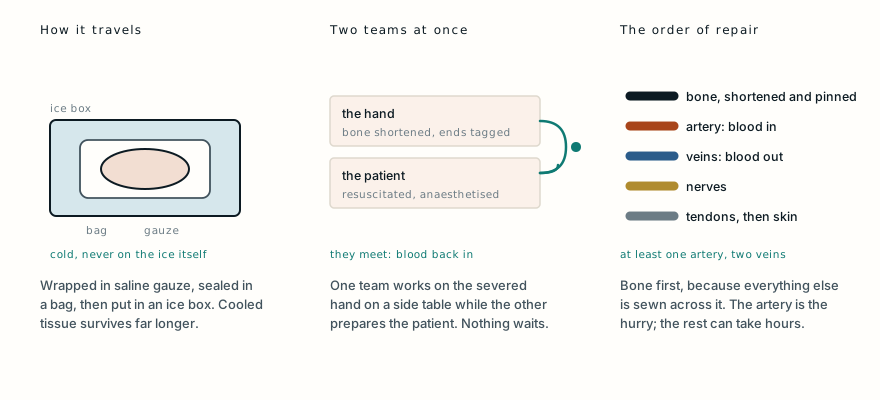
That is the correct method, and the detail that makes it correct is the bag. Tissue is not meant to sit against ice, which freezes and destroys it. It is meant to be wrapped in gauze moistened with saline, sealed in a bag, and then put on ice, so that it is cooled and not frozen.
Cooling is what buys the time for any of this. For an amputation between the shoulder and the wrist, the usual limits quoted are about six hours warm and about twelve hours cold, although longer has occasionally worked.
There is a second instruction that runs against instinct. Vessels bleeding in the stump should not be clamped. A clamp closes a vessel by crushing it, and that vessel is about to be sewn to another one. Pressure and elevation instead.
What makes a hand worth replanting
The amputated hand was washed with four litres of saline and examined. X-rays showed that both forearm bones, the radius and the ulna, had been divided in their lower third. The plastic surgeons and the orthopaedic team decided together to attempt it, and the patient consented after the case for and against was explained to him.
Replantation is not automatic. The things that argue against attempting it are other injuries or illnesses that make a long operation dangerous, damage to vessels and nerves at several levels rather than one, and a patient who is mentally unstable.
What argues for it is the part itself. A hand is worth the attempt in a way that a single finger often is not, and an amputation at this level, through the distal forearm, is one of those that can end with useful function.
Two operations at the same time
While the patient was being prepared for anaesthesia, a second team began operating on the hand, on its own table. This is called bench surgery, and it is the reason this case is worth reading.
On that table they shortened both bones of the hand's end by about 1.5 centimetres, cut away the crushed tissue, and found and tagged each artery, vein and nerve so that nothing would have to be searched for later. Ice packs stayed next to the hand throughout, until blood was flowing through it again.
Bone is shortened for a plain mechanical reason: two cut nerves or vessels cannot be sewn end to end under tension and expected to hold, and taking a centimetre of bone out of the gap lets the soft tissues meet without being stretched.
Which side you take it from is the elegant part. The rule is to shorten the amputated part rather than the stump. If the replantation fails and the hand has to be removed after all, the patient is left with the length he still had.
The stump was then prepared in the same way, with about a centimetre off each bone, the crushed tissue cut back and the structures tagged.
Bone, then the artery
The two halves were joined with a 3 mm wire passed through both the radius and the ulna, with extra wires between the bones for stability. Bone comes first because everything else is sewn across it: fix the skeleton last and every delicate repair you have already made moves.
The cut ends of the ulnar and radial arteries were trimmed back until they bled properly, which is the test that the vessel wall itself is healthy enough to join. The ulnar artery was repaired first, and good backflow appeared from the radial artery on the far side, showing that blood was now crossing the hand.
Blood was moving again about four hours after the injury, inside the six-hour window.
The rest of the eight hours
With the hand perfused, the team worked through everything else: the median and ulnar nerves, the radial artery, and three veins, two on the back of the hand and one on the palm side. The vessel joins were sewn with 10-0 nylon under an operating microscope, using thread far finer than a human hair.
The aim in any replantation is at least one artery in and two veins out. Blood arriving with no way to leave is its own emergency, which is the problem that a replanted scalp ran into.
An incision through the crease of the palm let them reach the structures beyond the wrist, and served at the same time as a carpal tunnel release, giving swelling somewhere to go instead of strangling the nerve. The tendons were repaired, some individually and some as a block to save time. The tourniquet was let down at intervals so the forearm was never starved for too long.
The operation took eight hours, and he woke from the anaesthetic without incident.
Keeping it alive, and what comes after
He was given a dose of low molecular weight heparin during the operation, then aspirin and dipyridamole for two weeks to make clotting less likely at the joins, and antibiotics for two weeks. His observations, his urine output and the colour of the hand were watched closely.
Those checks are looking for two opposite failures. If the artery blocks, the hand goes pale and empty. If the veins block, it becomes swollen, dark and tense. Either needs the patient taken back to theatre to redo the join, and quickly.
The wounds healed and he went home three weeks after the operation. At discharge there was a flicker of movement in the fingers.
That is a smaller sentence than the eight hours of surgery deserves, and it is the honest one. Nerves regrow slowly, and what he faces is a year of physiotherapy and, probably, further operations: releasing tendons that scar down, freeing nerves, fusing individual joints that will not work.
What replanted hands are like years later
Survival of the replanted part is the easiest thing to measure and the least interesting. Across large published series it runs from about 82% to 100%.
Function is the real question. In one series of 64 people whose hands or fingers were replanted after crush injuries and followed for about twelve years, nearly half needed further surgery. In another long-term series the result was good or very good in about two thirds, moderate in one in ten, and poor in the rest, with the worst results when the amputation was at or above the elbow, or when the limb had been torn off rather than cut.
Set against that, a review of major upper limb replantations found that 22 of 24 patients were satisfied with how their replanted limb looked and worked.
The first successful replantation of a severed thumb was reported in 1968, and the field has grown steadily more sophisticated since. What this case turns on is not the microscope but the organisation around it: knowing how a severed part should be cooled, and having a team ready to start on it within the hour.
What this case teaches
Almost everything that decided this outcome happened before the microscope came out. The hand was cooled correctly rather than packed against ice, the stump was dressed with pressure instead of having its vessels clamped, and the patient reached hospital within an hour. In theatre the work was split so that the hand was being shortened, debrided and tagged on one table while the patient was being resuscitated on another, and bone was taken from the amputated part rather than the stump so that failure would still leave him his length. Blood was crossing the hand four hours after the injury, inside the six hours that warm tissue allows. The rest of the operation took another four hours and is the part that decides whether the hand will work, but the part that decided whether there would be a hand at all was over by then.
Adapted from Nanda V, Jacob J, Alsafy T, Punnoose T, Sudhakar VR and Iyasere G, “Replantation of an Amputated Hand: A Rare Case Report and Acknowledgement of a Multidisciplinary Team Input,” Oman Medical Journal 2011;26(4):278-282, from the Departments of Plastic Surgery, Orthopedics and Anaesthesia at Sultan Qaboos Hospital, Salalah, Oman. The presentation, transport of the amputated part, operative sequence, timings, drugs and discharge findings are as reported there, summarised in the author’s own words rather than reproduced. The guidance on cooling and transporting a severed part, ischaemia limits, bone shortening, the one-artery-two-veins aim, postoperative monitoring and the long-term outcome figures is drawn from that paper’s own discussion and the series it cites, together with standard references on carpal tunnel release and microsurgical repair. The journal publishes under a Creative Commons Attribution Non-Commercial licence and the copy held by PubMed Central carries an all-rights-reserved notice, so the clinical photographs are not reproduced here. The diagram is original to MedicaseHub, is simplified, and may be reused freely under CC BY 4.0. This article is not medical advice. If a part is severed, call emergency services: wrap it in a clean cloth moistened with saline, seal it in a bag, keep the bag cold, and do not put the tissue directly on ice. Read the full disclaimer.
One case, written up properly, when there is one worth sending
No schedule and no filler. When a case turns out to have something in it that is worth the time to explain, it goes out. Unsubscribe in one click.
Free · no spam · your address is never shared · built with KitRelated cases
- Replanting an arm: the clock, and the harder questionThe same six-hour clock, and the question of whether to reattach a limb at all.
- The hand arrived still inside the machineAnother hand in another machine, where nothing below the wrist bled and nothing could be saved.
- The bleeding was the treatmentWhat happens when blood gets into replanted tissue faster than it can leave.