A stomach ache, no fever, and septic shock
She arrived by ambulance with a dull ache low in her abdomen, no fever, and nothing about her that looked alarming. Her blood pressure was 75 over 50 and her white cell count had almost disappeared. She was dead thirty-four hours later.
- Specialty
- Emergency medicine, infectious disease, critical care
- Patient
- Woman, 59, Florida Panhandle, June
- Background
- Cirrhosis, hepatitis C, alcohol use, advanced lung cancer
- Exposure
- Raw oysters, the previous day
- Complaint
- Dull lower abdominal ache. No fever, no vomiting
- On examination
- Not distressed, not toxic-looking, temperature 36.7°C
- The numbers
- BP 75/50, white cells 0.7, platelets 32
- Working diagnosis
- Sepsis from colitis, pneumonia and urinary infection
- Organism
- Edwardsiella tarda, on postmortem blood culture
- Died
- About 34 hours after arrival
- day beforea plate of oysters
- 0 ha dull ache, no fever
- 0 hthe numbers disagree
- hourstreated for the wrong organism
- 34 hdeath, then the culture
- afterwhy her and not others
What she ate, and why it usually does not matter
She ate raw oysters the day before she came in. Millions of people do that every year and almost none of them come to harm.
Oysters feed by filtering seawater, which concentrates whatever is in it, and warm coastal water in summer carries a specific set of organisms. The one everyone has heard of is Vibrio vulnificus. The one she had was Edwardsiella tarda, a relative that lives in warm brackish water along the Gulf coast, in ponds and rivers, and in the animals that live there.
In a healthy person it causes, at worst, a few days of gastroenteritis. It is not an organism that kills people. It killed her in a day and a half.
What she looked like
She arrived by ambulance complaining of a dull ache low in her abdomen that had started that morning. It did not radiate anywhere.
She had no fever and said so. No chills, no nausea, no vomiting. On examination she was not in distress, she did not look unwell, her chest was clear, and her abdomen was tender low down without the rigidity that signals a surgical catastrophe.
Her recorded temperature was 36.7 degrees, which is normal.
Everything a person in a waiting room would use to judge how sick she was pointed the same way, and all of it was wrong.
The two numbers that told a different story
Her blood pressure was 75 over 50.
That is not low-ish. That is a pressure at which organs are not being adequately perfused, in a woman sitting up and talking, describing her pain as a dull ache.
And her white cell count was 0.7, against a normal floor of about 3.8.
This is the finding that inverts what most people assume about infection. The expectation in sepsis is a high white count, because the body is mobilising. A count that low means the opposite: either the marrow cannot mount a response at all, or the cells are being consumed faster than they can be made. In severe infection it is a marker of a worse outcome, not a milder one.
Her platelets were 32 against a normal floor of 140. Her kidney function was impaired and her albumin was low, both long-standing consequences of her liver disease.
She was admitted to intensive care with septic shock, which is the correct reading of those numbers and not at all the impression she gave in person.
The right decision about the wrong bug
She was given fluid, four litres of it, and stayed hypotensive. Noradrenaline was started to hold her blood pressure up. Broad-spectrum antibiotics went in after cultures were taken, chosen to cover the chest and the abdomen.
Then the preliminary culture showed a gram-negative organism, and the team added doxycycline specifically to cover Vibrio vulnificus, on the reasoning that she had eaten raw oysters, in Florida, in June.
They were wrong about the organism. It was not Vibrio.
They were also right to do it. In that place, in that season, with that exposure, Vibrio is the organism that kills people and it needs covering within hours. Waiting for a culture to confirm it costs lives. Empirical treatment means acting on the most dangerous plausible answer before you know which answer is correct, and the fact that the guess missed does not make the reasoning wrong.
As it happens, Edwardsiella is generally susceptible to much of what she was already receiving. The antibiotics were probably not what failed.
Thirty-four hours
Overnight she developed respiratory failure and became progressively encephalopathic. She was intubated and ventilated. Her blood pressure kept failing despite the maximum support that could be given.
Nursing staff noted blisters and boils appearing on her arms and legs, which is the skin manifestation of an organism seeded throughout the bloodstream.
She died roughly thirty-four hours after walking into the emergency department with a stomach ache.
The blood cultures identifying Edwardsiella tarda came back after her death. That sequence is ordinary in fulminant sepsis rather than a failure: cultures take a day or two, and a day or two is longer than this kind of infection allows.
Why her
The answer is her liver, and it is worth understanding because it applies to a large number of people who do not know it applies to them.
Blood leaving the intestine does not go straight into the general circulation. It goes to the liver first, through the portal vein, and the liver is where bacteria that cross the gut wall are removed by resident immune cells before the blood carries on.
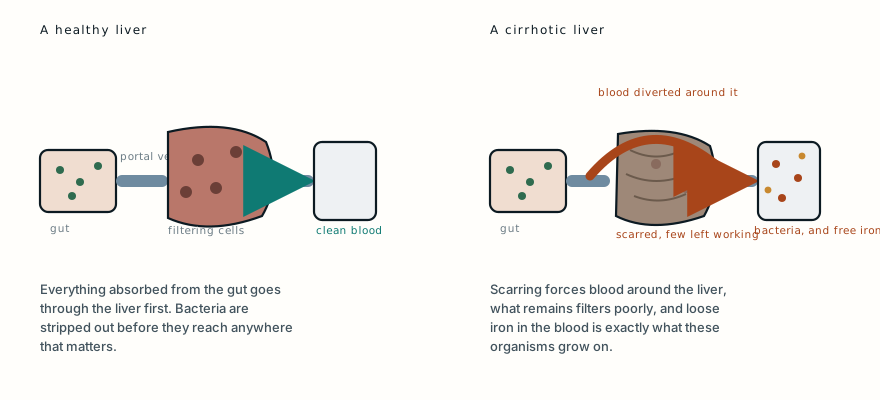
Cirrhosis breaks this in three ways at once. The scarring raises the pressure in the portal system, so blood finds routes around the liver instead of through it, which is the same process that produces the visible veins on the abdomen in another case here. The filtering cells that remain function poorly. And liver disease is associated with raised free iron in the blood, which these organisms grow on: several of them release a toxin that ruptures red cells, apparently to get at exactly that.
So the organism arrives, bypasses the filter, and lands in a bloodstream that happens to be rich in what it needs.
This is why the established risk factors for severe infection with these marine organisms are liver disease, cirrhosis, iron overload and immunosuppression, rather than anything about the seafood. Her case added a possible new one: she had advanced lung cancer, though she was not on chemotherapy, and the authors believe this is the first such case reported alongside it.
Why this is likely to become more common
The authors make an argument that extends past the one patient.
These organisms multiply in warm water, and Gulf water is warming. Florida's own figures show reported Vibrio vulnificus cases rising from 18 in 2008 to 42 in 2018. The number of people with cirrhosis from fatty liver disease is also rising as obesity does, which enlarges the group who cannot tolerate the exposure.
More organism, more susceptible hosts, and no vaccine. The practical protection is unglamorous and it is the only one available: people with liver disease, haemochromatosis or a suppressed immune system should not eat raw shellfish, and should keep open wounds out of warm coastal water.
For everybody else the risk from a plate of oysters remains very small, which is the part that gets lost when a case like this circulates.
What this case teaches
She had no fever, she was not distressed, and she described her pain as a dull ache, and she was in septic shock while she said it. The two findings that mattered were a blood pressure of 75 over 50 and a white cell count of 0.7, the second of which reverses the usual assumption that a high count means serious infection and a low one means none. The organism was ordinary and the exposure was ordinary. What made it fatal was that her liver had stopped doing the job of filtering bacteria out of blood arriving from her gut, which is why the risk from raw shellfish falls almost entirely on people with liver disease and hardly at all on everyone else.
Adapted from Healey KD, Rifai SM, Rifai AO, Edmond M, Baker DS and Rifai K, “Edwardsiella tarda: A Classic Presentation of a Rare Fatal Infection, with Possible New Background Risk Factors,” American Journal of Case Reports 2021;22:e934347. The clinical details, laboratory values and sequence of treatment are summarised in the author’s own words rather than reproduced. Background on the organism, on portal filtration and on the risk factors for severe marine infection is drawn from that paper and from standard references; the Florida surveillance figures are as cited in the original. That paper contains no clinical photographs. The diagram is original to MedicaseHub and may be reused freely. This article is not medical advice, and anyone with liver disease should discuss raw shellfish with their own doctor. Read the full disclaimer.
One case, written up properly, when there is one worth sending
No schedule and no filler. When a case turns out to have something in it that is worth the time to explain, it goes out. Unsubscribe in one click.
Free · no spam · your address is never shared · built with KitRelated cases
- A vein that closed at birth, reopened fifty years laterCaput medusae is the visible detour. The one that kills is in the oesophagus.
- It does not eat flesh. It cuts off the blood.Her IV antifungals were not working. The answer was to stop relying on the bloodstream entirely.
- It looked like a virus. It was the medication.He was taking lamotrigine. Much of the risk with that drug is in how fast the dose goes up.