The steroid was for his muscles. It killed the skin above them.
A 35-year-old bodybuilder injected a black-market steroid into both buttocks. Three weeks later the skin over each injection site was dead, in two patches several centimetres across. The surgeons cut the dead tissue away and then, deliberately, left the wounds open.
- Specialty
- Plastic and reconstructive surgery
- Patient
- Man, 35, previously healthy
- Drug
- Trenbolone from the black market, self-injected into both buttocks
- Background use
- Testosterone and other anabolic steroids for four years
- Interval
- Three weeks from the change of drug to referral
- On referral
- Painful dead skin, about 5 × 4 cm on the left and 6.5 × 4 cm on the right, with discharge
- Before referral
- Two courses of antibiotics from his own doctor, with no improvement
- Depth
- Skin, fat, and a small part of the gluteus maximus
- Wound culture
- Staphylococcus aureus
- Closure
- None. Left to heal by secondary intention
- Healed
- Two months after discharge, with no complications
- 4 yearsbefore any of this
- day 0pain on the needle
- 3 weeksdarkening, then discharge
- referralwhat was under the skin
- mechanismone artery, one territory
- the choicewhy they left it open
- 2 monthsclosed on its own
What he was already taking
He was 35, healthy, and a recreational bodybuilder. For four years he had been using testosterone and various anabolic steroids to build muscle faster, bought outside any pharmacy and used without a prescription.
Three weeks before he was referred, he added a new one: trenbolone.
Trenbolone is not a human medicine. It is an anabolic steroid used in the finishing phase of beef production, to improve the animals' performance and how efficiently they convert feed. It reaches gyms through the same black market as everything else on that list, and that market has a particular problem: the products are distributed without prescription, sometimes without any clinical approval at all, and clandestine laboratories frequently turn out material of low quality.
The scale is hard to measure, but one indication comes from what customs officers find. Among drugs seized in Germany in 2014, anabolic steroids made up the large majority of the pure raw material identified, and about a fifth of those findings were trenbolone.
The injection hurt, so he slowed down
He injected it into the upper part of the buttock, into the gluteus maximus, alternating sides.
It hurt going in. His response was reasonable and is what most people would do: he pushed the plunger more slowly, and kept alternating between the two sides.
Pain at the moment of injection is the part of this story worth keeping. In the syndrome he was about to develop, immediate and intense pain at the injection site is the first thing that happens, before there is anything to see.
Tenderness, then the skin went dark
What he noticed next was tenderness that did not settle and a firmness under the skin at both injection sites. Then the skin over them darkened. Then came severe pain, and discharge.
He saw his own doctor, who treated it as an infection. He was given a first-generation cephalosporin, and when that did nothing, a course of amoxicillin with clavulanic acid. Neither helped, and he was referred on to a plastic surgery unit.
Antibiotics were a reasonable first move, and they could not work, because the problem was not primarily infection. The tissue was not inflamed. It was dead.
Two wounds, and what lay beneath them
At the hospital there were two areas of painful dead skin, one over each buttock: about 5 by 4 centimetres on the left, and about 6.5 by 4 centimetres on the right, the right one discharging pus.
He was taken to theatre and the dead tissue was cut away. That is when the depth became clear. The necrosis went through the skin, through the fat beneath it, and into a small part of the gluteus maximus itself.
Cultures from the wound grew Staphylococcus aureus. That is worth stating precisely: the bacteria were growing in tissue that had already died, which is what open dead tissue does. It was treated locally, with mafenide acetate irrigation and dressings rather than with more oral antibiotics.
Nicolau syndrome
Tissue death after an intramuscular injection is rare, and it has been recognised for a century. It was first described in the 1920s, by Freudenthal and Nicolau, in patients given injections of bismuth salts for syphilis, and it still carries Nicolau's name.
The sequence is characteristic. Intense pain at the moment of injection, with the skin going pale. Then redness, which within hours becomes a bluish, net-like patch. That patch then becomes bloodstained and finally dies. Over the following days the dead area marks out its own border and forms a thick black crust, which either separates on its own and leaves an ulcer, or has to be cut away. Recovery takes months and usually leaves a sunken scar.
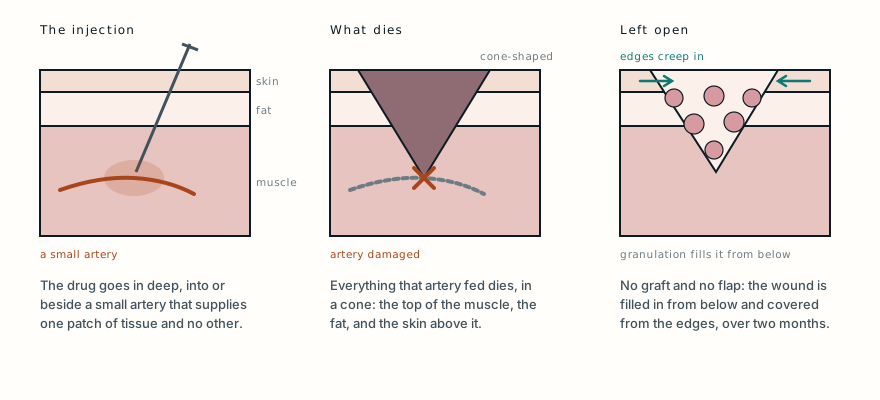
Why it happens is not settled. The leading explanation is that the drug, injected into or beside a small artery, sets off an inflammatory reaction that damages that artery. What it supplies then dies, all of it, because there is no second route in. Explanations based on allergy, on immune reaction, or on the drug simply plugging the vessel have been tested and rejected.
It is not a steroid problem as such. The same thing has followed injections of anti-inflammatory drugs, local anaesthetics, corticosteroids, antihistamines, penicillin and other antibiotics, interferon, vitamin B preparations, iodine, and several vaccines. The reported consequences run from an ulcer to nerve injury, extensive tissue loss, a limb losing its blood supply, sepsis from infection on top of the dead tissue, and, in children, death.
Once the tissue has died, there is no drug that reverses it. Treatments given early, including heparin under the skin, intravenous steroids and drugs that widen vessels, have been reported to help in scattered case reports, but there are no established guidelines. After necrosis and ulceration are established, cutting the dead tissue out and rebuilding may be the only option left.
Three ways to close a hole, and he chose none of them
With the dead tissue gone he had two clean, full-thickness holes over the buttocks, and the team set out the options.
A skin graft would cover them quickly, but it takes skin from somewhere else, which leaves a second wound at the donor site. A local flap moves neighbouring tissue in to fill the gap, with more scarring again. The third option is to do nothing surgical at all and let the wound close itself: healing by secondary intention, in which the hole fills from the bottom with granulation tissue while the skin edges grow inward across it.
He did not want more scars or a donor site, and those wounds were in a place that stays covered. The wounds were left open.
He went home seven days after admission, with the wounds clean and a hydrocolloid dressing on them.
What healing by itself looked like
Three weeks after discharge the wounds were filling with healthy granulation tissue and the edges were closing in. The left had gone from 5 by 4 centimetres down to 3.5 by 3, and the right from 6.5 by 4 down to 5 by 3.
At six weeks the dressings were changed to polyurethane and the surfaces were nearly covered with new skin. By two months after discharge they had closed completely. No complications were recorded.
It is a good outcome, and it is worth being clear about what it does not undo. Skin that grows across from the edges is not the skin that was there before, and the authors describe the typical late result of this syndrome as a sunken scar.
What the surgeons took from it
The authors' conclusion is aimed at clinicians, and it is simple: when an athlete turns up with a full-thickness wound and no obvious cause, ask about performance-enhancing drugs. Because the use is illegal, it will not be offered.
The treatment itself is not exotic. Cut away what is dead, treat infection where it exists, and then rebuild, or let the wound rebuild itself.
The authors add one more thing: that the experience itself is worth using as a deterrent from further drug use.
What this case teaches
An intramuscular injection can kill the tissue above it without any infection being involved. The best explanation is that the drug damages a small artery that supplies one territory and no other, so everything it feeds dies: a cone of muscle, fat and skin. That is why two courses of antibiotics did nothing and why the pain came at the moment of injection rather than days later. The organism grown from the wound was living in tissue that was already dead. It is described for bismuth, for anti-inflammatories, for antibiotics and for vaccines, so the drug here matters less than the mechanism, though a steroid bought on the black market and injected by the person taking it removes every check that might have caught it. Once the tissue has died there is nothing to reverse: it is cut away, and then closed, or left to close itself.
Adapted from Friedman O, Arad E and Ben Amotz O, “Body Builder’s Nightmare: Black Market Steroid Injection Gone Wrong: a Case Report,” Plastic and Reconstructive Surgery Global Open 2016;4(9):e1040, from the Department of Plastic and Reconstructive Surgery, Tel Aviv Sourasky Medical Center, Sackler Faculty of Medicine, Tel Aviv University. The history, wound measurements, operative findings, culture result, dressing choices and the healing timetable are as reported there, summarised in the author’s own words rather than reproduced. The account of Nicolau syndrome, of the drugs that have caused it, of the end-artery hypothesis and of the reported treatments is drawn from that paper’s own discussion and its cited sources; the seizure figures are as cited there. The paper is published under a Creative Commons Attribution Non-Commercial No-Derivatives licence, so its clinical photographs are not reproduced here. The diagram is original to MedicaseHub, is simplified, and may be reused freely under CC BY 4.0. This article is not medical advice and is not a guide to injecting anything. Anabolic steroids bought outside a pharmacy are unregulated and illegal in many countries. Pain at the moment of an injection, followed by skin that changes colour at the site, needs to be seen by a doctor the same day. Read the full disclaimer.
One case, written up properly, when there is one worth sending
No schedule and no filler. When a case turns out to have something in it that is worth the time to explain, it goes out. Unsubscribe in one click.
Free · no spam · your address is never shared · built with KitRelated cases
- It does not eat flesh. It cuts off the blood.Another injection site that died, where the drug could not reach the tissue that needed it.
- Purple ears: the adulterant, not the drugSkin dying in a net-like pattern, from something added to a drug bought on the street.
- The shark did not cause the contractureThe opposite decision about a wound: closed when it should have been left open.