He waited 17 months for a face that matched his own
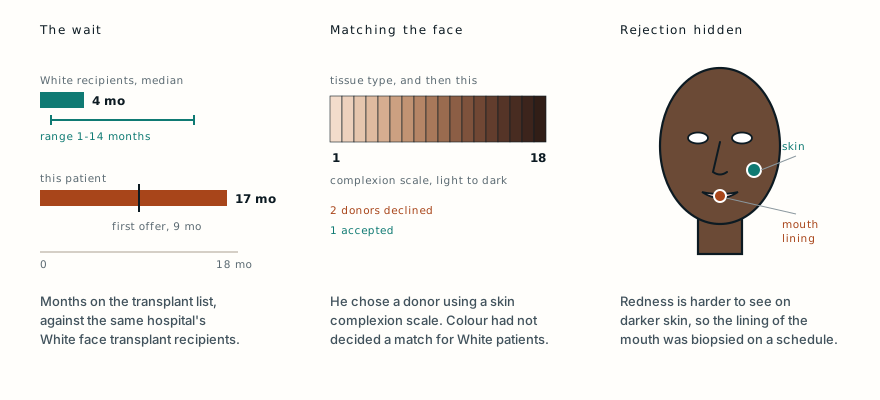
In 2013 a drunk driver hit Robert Chelsea’s car and it burst into flames. The burns took his lips, part of his nose and his left ear. Six years later he became the first Black patient to receive a full face transplant. The last 17 months of that wait were spent on the transplant list, far longer than the hospital’s usual wait, because the donor had to match his skin as well as his tissue type.
- Specialty
- Plastic surgery, transplant surgery
- Patient
- Robert Chelsea, 67 at the time of the transplant
- Injury
- 2013: his car was hit by a drunk driver and caught fire
- Burns
- Half of his body surface
- Lost
- His lips, part of his nose and his left ear
- Before
- More than 30 operations over six years
- Waiting list
- 17 months; first offer after 9
- Donor
- A 61-year-old Black man, chosen partly by skin tone; two others declined
- Operation
- July 2019, 16 hours, a team of more than 45
- First month
- An infected blood collection under the forehead; rejection found only on biopsy
- By 13 months
- Lips that close fully, clearer speech, more feeling
- 2013the crash
- 6 years30 operations
- 17 monthsthe list
- 16 hoursthe operation
- 1 monthrejection you cannot see
- 13 monthslips that close
A broken-down car on the side of the road
In August 2013 Robert Chelsea was sitting in his car on the side of a highway outside Los Angeles, its engine overheated, when a drunk driver crashed into it. The car caught fire.
He survived with burns over about half of his body. His surgeons later described the loss of critical facial structures; the hospital listed them: his lips, part of his nose and his left ear.
What reconstruction could not give back
Over the next six years he had more than 30 operations. They could close wounds and rebuild structure. They could not give him lips.
That is a bigger loss than it sounds. Lips seal the mouth, and without them he drank through a syringe and had to tilt his head back to eat. They also shape almost every sound in speech. Lips are one of the few parts of the face that nothing grafted from elsewhere on the body can properly replace, because they have to move, close and feel. The same reasoning has decided other face transplants on this site: a jaw that could be rebuilt when a face could not, and eyelids that had to blink.
Matching more than tissue type
He was placed on the waiting list at Brigham and Women’s Hospital in Boston. His first offer came nine months later, and he stayed on the list for 17 months in all. According to the surgeons’ report, the median wait for their White face transplant recipients was 4 months, with a range of 1 to 14.
Part of the reason is the same for any transplant. The donor has to be compatible immunologically, which means blood group and HLA, the tissue markers the immune system uses to recognise what belongs to the body. The surgeons also note that organ donation is less common among Black people, for several reasons including medical mistrust, which makes the pool of compatible donors smaller.
A face adds something no kidney does. It is seen. The surgeons describe patient-perceived skin colour compatibility as an important part of the assessment. Using a complexion scale from 1 to 18, he took an active part in choosing, and he declined two donors before accepting one he felt matched him. In news reports at the time he explained that he had turned down a face with a much lighter complexion because he did not want to become a completely different-looking person. In the team’s White patients, colour had never affected a transplant decision.
Want this diagram print-ready? It is in the diagram pack.
A full face, from a 61-year-old donor
The donor was a 61-year-old Black man who had been declared brain dead, with physical features and skin tone similar to his. The immunological match was workable rather than perfect: four HLA mismatches, but a negative crossmatch, the test that mixes the recipient’s blood with the donor’s cells to check that he had no ready-made antibodies against them.
The operation took place in July 2019. The hospital said it lasted 16 hours and involved more than 45 physicians, nurses, anaesthetists, residents and research fellows, led by Dr. Bohdan Pomahac. It was the ninth face transplant at the Brigham and the fifteenth in the United States, and the hospital said he was the oldest person to have one.
A transplanted face is a composite graft: skin, muscle, nerves, blood vessels and the lining of the mouth, all from the same donor. To stop his immune system destroying it, he was given antithymocyte globulin, an antibody treatment that depletes immune cells, at the time of the operation, and then three drugs to take for the rest of his life: mycophenolate mofetil, tacrolimus and prednisone.
Why redness was not enough
Twelve days after the operation a collection of blood was found under the tissue of his forehead, infected with aspergillus, a mould. It was cleaned out surgically and treated with the antifungal drug posaconazole.
The more instructive problem came at one month. On a face transplant, rejection is usually first suspected by looking: the skin turns red and swollen. The authors point out that colour changes like redness can be harder to detect on darker skin. So in addition to the usual skin biopsies, they took biopsies of the lining of his mouth on a schedule.
At one month those routine biopsies showed rejection, grade 2 in the skin and grade 3 in the lining of the mouth, on a scale where higher grades mean more severe rejection. There was no clinical sign of it: nothing anyone could see on his face. New antibodies against the donor’s tissue type, absent on day 3, had also appeared by one month. He was treated with high doses of steroids and a higher dose of tacrolimus.
Mucosa, the lining of the mouth, is part of the transplanted face, and inspecting and sampling it can show rejection when the skin alone is inconclusive. In his case, that is how it was found.
What the new face gave back
Between four and thirteen months after the transplant, his function kept improving. The surgeons report adequate recovery of movement, complete closure of the lips, speech that was easier to understand, and increased sensation.
Complete closure of the lips is the result that answers the six years before it. A mouth that seals is a mouth that can drink without a syringe and eat without tilting the head back. In statements at the time he talked about wanting to drink easily again, to speak clearly, and to be able to kiss his daughter on the cheek.
Over the same period, the number of rejection episodes, the infections and the functional recovery were similar to those of the team’s White patients. Photographs of him before the transplant and three months after it are published with the surgeons’ report in the New England Journal of Medicine, linked below.
What a first like this changes
He was not the first Black patient to receive any face transplant. A partial face transplant was performed in a Black patient in Paris in 2007. He was the first to receive a full face, and his case put two practical problems on the record.
The first is the donor pool. A transplant that is seen needs a donor who is not only compatible but acceptable to look at in the mirror for the rest of a life, and that narrows the pool further for anyone whose skin tone is less represented among donors. New England Donor Services said at the time that for grafts like faces and hands, unlike internal organs, the donor’s skin tone may matter to finding a match, and called on people of all races and ethnicities to consider donating.
The second is monitoring. Much of transplant follow-up relies on seeing changes in the skin, and those signs do not show the same way on every skin. Adding scheduled biopsies of the mouth lining is a simple change, and in this case it found rejection that looking alone had not.
The authors’ conclusion is deliberately plain: face transplantation is a viable reconstructive option, whatever the patient’s race.
What this case teaches
A drunk driver’s crash left Robert Chelsea with burns over half his body and without his lips, and more than 30 operations over six years could not give them back. A face transplant could, but finding the face took 17 months against a median of 4 for the hospital’s White recipients: fewer donors, and a donor who had to match his skin as well as his tissue type, chosen by him on a complexion scale after he declined two. After a 16-hour operation in July 2019, rejection appeared at one month with nothing visible on his face, and it was found because the team had added scheduled biopsies of the mouth lining for exactly that reason. By 13 months his lips closed fully and his speech and sensation had improved, and his outcomes matched those of the team’s White patients. The operation was the same. What had to change was the search for a donor and the way rejection was looked for.
Read the original paper: doi.org/10.1056/NEJMc2033961
Adapted from Kauke M, Panayi AC, Tchiloemba B, Diehm YF, Haug V, Kollar B, Perry B, Singhal D, Sinha I, Riella LV, Annino DJ and Pomahac B, “Face Transplantation in a Black Patient — Racial Considerations and Early Outcomes,” New England Journal of Medicine 2021;384(11):1075-1076, from Brigham and Women’s Hospital, Boston. The donor, immunology, immunosuppression, complications, rejection, biopsy strategy, waiting times, complexion scale and functional outcomes are as reported there, summarised in the author’s own words; where that report and news coverage differ (his age, the extent of his burns, the donor’s age), the report’s figures are used. His name, the circumstances of the crash, what he had lost, the number of earlier operations, his difficulty eating and drinking, and the length, team and place of the operation are from Brigham and Women’s Hospital’s announcement of October 2019 and contemporaneous reporting, including Boston.com and TIME; he spoke publicly about his transplant. The explanations of HLA, crossmatching, composite grafts and rejection grading are from standard references. The paper and its photographs are copyrighted and are not reproduced here. The diagram is original to MedicaseHub, is simplified, and may be reused freely under CC BY 4.0. This article is not medical advice. Read the full disclaimer.
Find these cases useful? Support MedicaseHub on Patreon.
One case, written up properly, when there is one worth sending
No schedule and no filler. When a case turns out to have something in it that is worth the time to explain, it goes out. Unsubscribe in one click.
Free · no spam · your address is never shared · built with KitRelated cases
- He was not going blind from the fireAnother man burned in the face, whose transplant was decided by what his eyelids could no longer do.
- Twenty operations rebuilt his jaw. None gave him a face.Years of reconstruction first, then a transplant, and what the immunosuppression cost him later.
- He was a face transplant candidateThe case for not doing a face transplant when enough of the patient’s own face survives.