He lived with it for 20 years. It weighed 20 kilograms.
A 90-year-old man in Switzerland had known about the painless lump on his right hip for more than two decades, and had always refused treatment. Only when it began to throw off his walking did he see a surgeon. It turned out to be a benign fatty tumour of 20 kilograms.
- Specialty
- General surgery
- Patient
- Man, 90
- Complaint
- Limping and unbalanced walking
- Growing for
- More than 20 years
- Mass
- Painless, slow-growing, on the right buttock and hip
- Scan
- Too large to fit in the CT scanner in full
- Removed
- 30 × 60 cm, 20 kg
- Pathology
- Benign
- After
- Walking independently at 5 weeks
- 20+ yearsthe lump
- referralthe walk
- the scantoo big to fit
- surgery20 kg
- 5 weekswalking
A lump he chose to live with
For more than 20 years, a lump had been growing slowly on this man’s right hip. It did not hurt. He was well aware of it, and of how slowly it was growing, and he refused any treatment for it.
That is not as strange as it sounds. Most lumps of this kind are lipomas, benign tumours made of ordinary fat cells. They are the most common benign tumours of the soft tissues, and the authors note that they affect men and women equally, most often between the ages of 40 and 60. A typical lipoma is soft, moves slightly under the skin and grows very slowly, if at all. Most stay small and cause no trouble for life.
Some do not stay small. A lipoma that keeps growing for decades simply keeps adding fat, and in a place like the buttock, where there is plenty of room under the skin, nothing stops it.
When it started to affect his walking
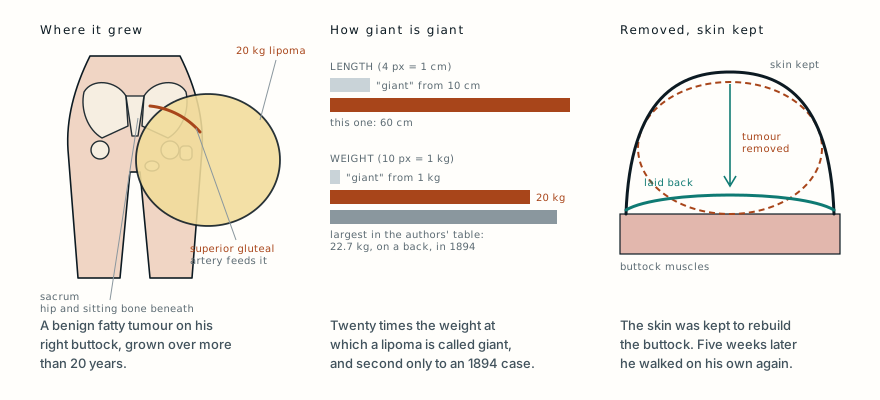
By the time he was 90, the mass on his hip had grown so large that it was changing the way he walked. His family doctor referred him to the surgical clinic of the HFR Fribourg cantonal hospital in Switzerland because of his limp and his unbalanced gait.
That is a common turning point for giant lipomas. The authors describe them as above all a cosmetic problem, until they grow large enough to become a functional one. A mass of this size changes the body’s centre of gravity, pulls on the skin and gets in the way of the leg, and at 90 a fall is dangerous in itself.
Too big for the scanner
The surgeons were fairly sure from its appearance that it was a benign lipoma. They still wanted a scan before operating, but the mass was so large that the CT scanner could not capture all of it.
What the scan did show was important for planning. The tumour seemed to reach right down to the bones of the pelvis and hip: the sacrum at the base of the spine, the ischial tuberosity, which is the bone you sit on, and the greater trochanter, the bony point on the outside of the hip. There was a suspicion that it had grown into the flexor muscles at the back of his right thigh. And it had its own blood supply, mainly from an enlarged superior gluteal artery, one of the main arteries of the buttock.
Large size is one of the features that makes doctors think about the possibility of a liposarcoma, a malignant tumour of fat cells. The authors point out that a large lipoma turning into a liposarcoma is rare, but the possibility is why big fatty tumours are imaged before surgery and examined under the microscope after removal. The authors recommend ultrasound as the first test for a lump that looks like a lipoma, with MRI added for large or deep ones.
Thirty by sixty centimetres
An operation on a 90-year-old is never a casual decision. The surgeons discussed the pros and cons with him and his family, and together they decided to remove the mass.
The whole tumour was removed. It measured 30 by 60 centimetres and weighed 20 kilograms, about the weight of a typical five-year-old child.
The surgeons deliberately kept the skin that had stretched over it, rather than cutting it away with the tumour, so that it could be used to rebuild the shape of the buttock. Wound care afterwards was simple, and the recovery went without complications.
The pathology report confirmed what everyone had hoped: the tumour was benign.
Walking on his own again
He then had intensive physiotherapy to learn to walk again without the weight he had carried on one side for so many years. After five weeks he was walking completely independently.
How big can a lipoma get?
Doctors call a lipoma “giant” when it is at least 10 centimetres in one dimension or weighs at least 1 kilogram, the cut-offs the authors take from Sanchez and colleagues. This one was six times longer and twenty times heavier than that.
The authors collected the largest lipomas reported in the English and French medical literature. On their list, this was the second largest lipoma under the skin ever described. The only heavier one was reported in 1894: a 22.7-kilogram lipoma on a patient’s back. Other entries include a 12.5-kilogram lipoma of the neck reported in 1928 and a 12.35-kilogram one on the back reported in 2004.
Not every fatty lump is a lipoma. The authors note that conditions such as lipomatosis, in which fat builds up in many places, and lipodystrophy, an abnormal distribution of body fat, can look similar and need to be told apart. Lipomas can be single or multiple, present from birth or appear after an injury, and some studies suggest a genetic component in more than half of them.
When a lipoma needs treatment, for appearance or for function, surgery is the standard, sometimes combined with other techniques such as suction or reconstruction of the soft tissues. For most people that means a small operation on a small lump. This case shows what can happen when one is left to grow for twenty years.
What this case teaches
A 90-year-old man had lived for more than 20 years with a painless, slow-growing lump on his right hip and had always refused treatment. When it began to affect his walking, he was referred to surgeons, who found it too large to fit in the CT scanner. It lay against the bones of his pelvis and hip, may have reached into the muscles of his thigh, and had its own enlarged artery. After a discussion with him and his family, they removed it: a benign lipoma of 30 by 60 centimetres and 20 kilograms, the second largest under the skin in the authors’ review of the literature. They kept his skin to rebuild the buttock, and after five weeks of physiotherapy he was walking on his own. Even a benign tumour can become a serious surgical problem if it is left long enough.
Was this case worth your time? Buy the next one a coffee ($3), or support MedicaseHub monthly.
Next case · MC-023 It was never cancer. It still had to come out.Benign and harmless are different words when the skull has no spare room.Read it →
Want the next case like this?
When a new case is written up, it comes to your inbox: the story, the diagram and what it teaches. No schedule and no filler. Unsubscribe in one click.
Free · no spam · your address is never shared · built with KitRead the original paper: doi.org/10.1136/bcr-2019-229842
Adapted from Litchinko A, Cherbanyk F, Menth M and Egger B, “Giant gluteal lipoma surgical management,” BMJ Case Reports 2019;12(8):e229842, from the Department of Surgery, HFR Fribourg Cantonal Hospital, Switzerland. The history, the scan findings, the operation, the pathology and the recovery are as reported there, summarised in the author’s own words; the definitions, the list of the largest reported lipomas and the points on diagnosis and treatment are those the authors give in their discussion, and the general description of lipomas and the comparison with a child’s weight are from standard references. The journal records that consent for publication was obtained from the patient. The paper is published under a Creative Commons Attribution Non-Commercial licence (CC BY-NC 4.0), so its photographs are not reproduced here; they can be seen in the original paper. The diagram is original to MedicaseHub, is simplified, and may be reused freely under CC BY 4.0. This article is not medical advice. Read the full disclaimer.