At 21, she became the youngest person in the United States to receive a new face.
Katie Stubblefield spent three years and more than a dozen operations getting ready. Then, in a 31-hour operation, surgeons at Cleveland Clinic replaced, in effect, all of her facial tissue with a donor's.
- Specialty
- Plastic and reconstructive surgery, transplantation
- Patient
- Katie Stubblefield, injured at 18, transplanted at 21
- Injury
- Severe facial trauma from a gunshot wound in March 2014
- Before
- Jaw rebuilt with bone from her leg and a metal plate; more than a dozen operations
- Transplant
- May 2017, Cleveland Clinic: 31 hours, 11 surgeons, experts from 15 specialties
- Replaced
- Scalp to jawline, with eyelids, nose, upper jaw, two-thirds of the lower jaw and teeth
- 1 year
- No sign of rejection
- Still
- Unable to see; learning Braille
- 2014the injury
- 3 yearsgetting ready
- May 201731 hours
- aftera new start
"Outside of a face transplant, I just don't know"
In March 2014, Katie Stubblefield, then 18, survived a self-inflicted gunshot wound to her face. The bullet passed through her mouth and nasal cavity and left her skull between her eyebrows, only grazing her brain. Paramedics found a pulse. She was intubated at a hospital in Oxford, Mississippi, and flown to a trauma centre in Memphis, where the first of many operations began.
Her father later recalled one of the surgeons there, an older man, telling the family it was the worst case he had ever seen, and then saying something they had never heard before: "Outside of a face transplant, I just don't know." He could not see any other way to repair her face.
Five weeks later, in May 2014, she was flown to Cleveland Clinic in Ohio. Her parents went with her and, by 2018, had been living at a Ronald McDonald House in Cleveland for four years.
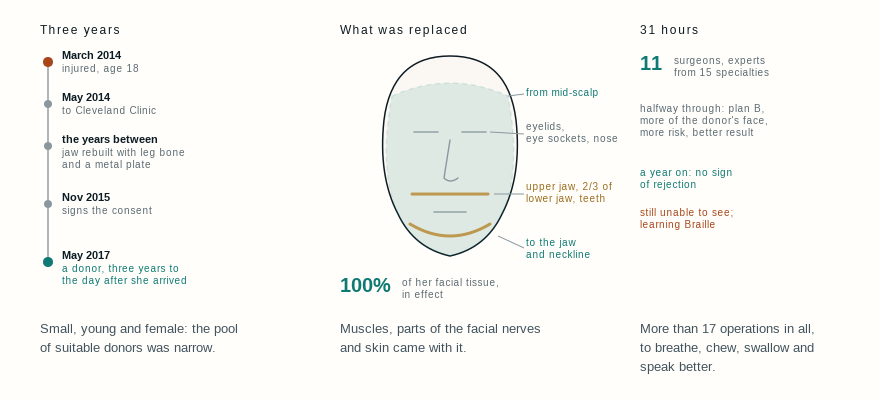
Years of operations before the big one
At Cleveland Clinic the long-term goal was a face transplant, but it was far off. First came a series of reconstructions, including rebuilding her jaw with bone from her leg and a metal prosthesis, planned on 3D models of her skull. Throughout, the surgeons protected blood vessels they might later need to connect a donor face.
A psychiatrist worked with her for months, making sure she understood the risks and that the transplant was what she wanted. Her mother remembered Katie listening to all of it and answering: she still wanted to do it. She wanted to be able to go out into the world and not be looked at the way she was.
She signed the consent forms in November 2015. It took another 18 months before she was physically and mentally ready and the search for a donor could begin, and that search was hard: she was small and young, most available donors are men, and a donor's other organs, which can save lives, take priority.
Plan B, halfway through
The call came three years to the day after she had arrived in Cleveland. Her donor was Adrea Schneider, whose grandmother agreed to donate her face after Adrea failed to recover from a drug overdose.
The operation lasted 31 hours and involved 11 surgeons and experts from 15 specialties; the team had rehearsed parts of it beforehand, including with a mixed-reality headset showing holograms of her skull. About halfway through, the surgeons changed course. They decided to use more of the donor's face than planned, which raised the risk but promised better form and function, and came out of the operating room to discuss it with her parents. Her father later said someone told them Katie would want them to go all the way.
The result replaced, in effect, all of her facial tissue, from mid-scalp to her jaw and neckline: scalp, forehead, upper and lower eyelids, eye sockets, nose, upper cheeks, facial muscles, parts of the facial nerves and skin. Her upper jaw and two-thirds of her lower jaw, and her teeth, are bone and teeth from the donor. It was Cleveland Clinic's third face transplant and its first total one. Katie later called the operation the longest nap of her life.
Four steps forward, two steps back
A year later the surgeons called the transplant a success. There had been no sign of rejection and no side effects from the immunosuppressant drugs she must take for life, and further operations, including on her tongue to improve her speech, had gone as planned. Including the transplant, she had had more than 17 operations at Cleveland Clinic, which together let her breathe, chew and swallow better and express emotion with her face.
The work was not over. She was still unable to see and was learning Braille, and she had speech therapy several times a week, because her mouth was now mostly the donor's. She said she hoped to go to college and become a counsellor or a teacher, and one day to walk down the street and blend in.
In a statement after the surgery she thanked the hospital, and her donor and her donor's family, for a gift she said words could not express.
When rebuilding is not enough
Most severe facial injuries are treated by reconstruction: moving the patient's own skin, muscle and bone from elsewhere to rebuild what was lost. It restores a great deal, but some structures cannot be rebuilt that way. Eyelids that blink, lips that close and move, a nose with its own shape and lining: tissue borrowed from a thigh or a back cannot do those jobs. When so much is lost that the face cannot function, a transplant is the only way to replace it with tissue that already has the right structure.
The price is permanent. A transplanted face is foreign tissue, and the body will reject it unless the immune system is suppressed with drugs every day for life, with risks of infection, kidney damage and cancer. That is why patients are assessed for years, psychologically as well as physically, before they are accepted.
Katie's case also shows what a transplant cannot do. It gave her a face that works and looks like a face, but it could not restore her sight, and the speech, strength and confidence still had to be rebuilt one therapy session at a time.
If you are struggling or thinking about harming yourself, please contact a local crisis line or emergency service. In the United States you can call or text 988.
What this case teaches
Katie Stubblefield survived a gunshot wound to her face at 18. Over three years at Cleveland Clinic she had more than a dozen operations, including a jaw rebuilt from her own leg bone, while the team prepared for a transplant and protected the blood vessels it would need. In May 2017, at 21, she received a donor face in a 31-hour operation that replaced, in effect, all of her facial tissue and much of her jaws. A year later there was no sign of rejection. She still could not see, and still had years of therapy ahead, but she had a face that let her breathe, eat, speak and go out into the world.
Was this case worth your time? Buy the next one a coffee ($3), or support MedicaseHub monthly.
Next case · MC-022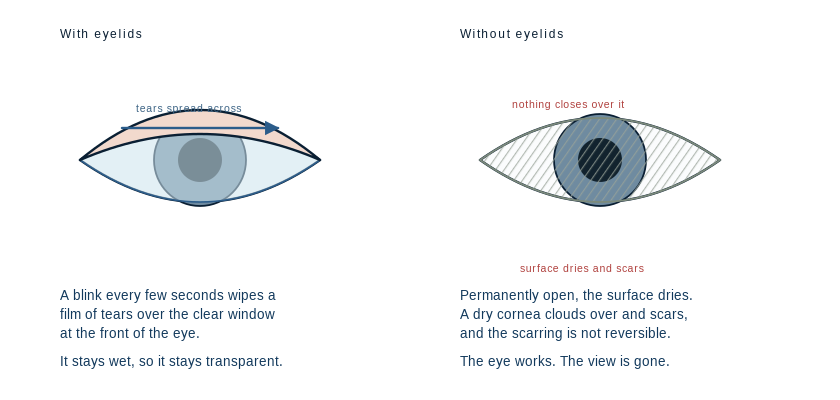 He was not going blind from the fireHis eyes survived the burns. His eyelids did not, and nothing grafted can be made to blink.Read it →
Want the next case like this?
When a new case is written up, it comes to your inbox: the story, the diagram and what it teaches. No schedule and no filler. Unsubscribe in one click.
Free · no spam · your address is never shared · built with KitBased on published reporting: the Cleveland Clinic newsroom (August 2018), including Drs Frank Papay and Brian Gastman and the patient's parents; and National Geographic, “The Story of a Face” by Joanna Connors (September 2018), for the donor and her recovery. The account is summarised in the author’s own words, and the background on facial reconstruction and transplantation is from standard references. No photographs are reproduced. The diagram is original to MedicaseHub, is simplified, and may be reused freely under CC BY 4.0. This article is not medical advice. Read the full disclaimer.
Related cases
- He was not going blind from the fireAnother face transplant, done to give a man back his eyelids.
- A gunshot took his face. Canada's first face transplant gave him a new one.Another gunshot injury, and another new face years later.
- He was a face transplant candidateThe case for and against a transplant when reconstruction is still possible.