The bone plate was screwed on outside his leg
A crocodile bit a 13-year-old boy in rural Sri Lanka and broke both bones of his lower leg through the skin. Working with limited resources, his surgeons sterilised a used bone plate, a piece of metal designed to sit on the bone under the skin, and screwed it on outside his leg instead.
- Specialty
- Orthopaedic surgery
- Patient
- Boy, 13
- Mechanism
- Crocodile bite to the lower limbs
- Injury
- Open fracture of the left shin bone and the bone beside it, with bone lost from the shin
- Grade
- Gustilo-Anderson type IIIA
- Admission
- Wounds cleaned in theatre; a locking plate fixed outside the leg
- 48 hours
- Back to theatre to check the wounds
- The plate
- A used plate, sterilised in an autoclave; six screws, none across the break
- 6 weeks
- Wounds healed; the outside plate removed
- 9 weeks
- A plate placed under the skin, then full weight on the leg
- 1 year
- Fracture completely united
- 0 hthe bite
- admissionan open fracture
- theatrea plate on the outside
- 48 ha second look
- 6 weeksthe plate comes off
- 1 yeara healed bone
A rare attack, and a common way it happens
He was 13 when a crocodile bit him on the legs, and he was taken to a base hospital in rural Sri Lanka.
Several species of crocodile live in Sri Lanka’s waters, but attacks on people are uncommon. The authors cite a survey from 2008 to 2012 that recorded 33 attacks in five years, most by saltwater crocodiles, eight of them fatal. They tended to happen during ordinary things done at the water: bathing, washing clothes and swimming.
A crocodile’s jaw closes with immense force, and its long rows of teeth do two kinds of damage at once: they crush, and they tear skin and tissue away from what lies beneath. Even a small puncture on the surface can hide damaged muscle and a broken bone underneath it.
Bone through the skin
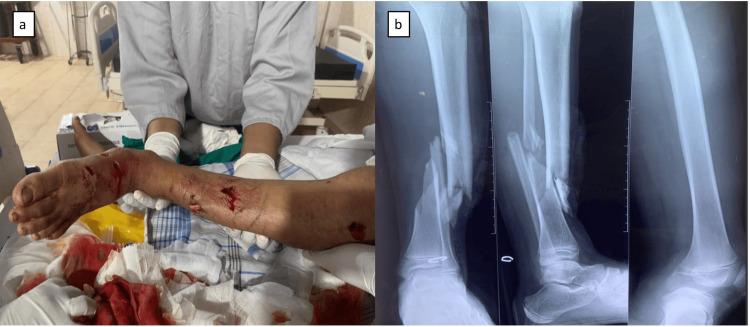
He was referred on from the general surgeons because of his fractures. He had bite marks and breaks in the skin, with bone protruding, and an obvious deformity of the left lower leg. X-rays showed an open fracture of both bones of the lower leg near the ankle: the tibia, the shin bone, and the fibula, the thin bone beside it. Part of the tibia was missing.
An open fracture is one where the broken bone is exposed through a wound, and it is graded by how much damage surrounds it. His was graded Gustilo-Anderson type IIIA: a high-energy injury with extensive damage to the soft tissue, but with enough of it left to cover the bone.
Bite wounds bring their own problem. A crocodile’s mouth carries an unusual mix of bacteria, which the authors note can cause serious local tissue damage and break down red blood cells, slowing healing further. The standard first steps they describe are resuscitation, protection against tetanus, broad-spectrum antibiotics, and cleaning the wound under general anaesthetic.
Clinical photograph and X-ray · graphicThe bite wounds on arrival, and the X-rays of the fracture. Tap to show.
An implant used where it was never meant to go
For a contaminated open fracture like his, the usual choice is an external fixator: pins through the skin into the bone, joined by a frame outside the leg. It holds the bones in line while keeping the hardware away from the wound, so the wound can be cleaned and dressed.
The surgeons used something else. They took a locking compression plate, the kind of metal plate normally screwed directly onto a bone beneath the skin, and used it as the frame. The plate had been used before and was sterilised in an autoclave. The authors are open that this was improvisation, the kind of off-label use of implants that surgeons in low-income settings are forced into by a lack of resources and difficult logistics.
Under general anaesthetic, on an operating table that X-rays can pass through, the bite wounds were opened up, cleaned of dead and contaminated tissue, and washed out under pressure. The plate was laid along the outside of the leg over the fracture, and its position checked with live X-ray imaging. Holes were drilled through small stab cuts in skin that was still intact, and six screws were passed through the plate into the bone, deliberately avoiding the fracture itself. Once X-rays confirmed the alignment, the remaining wound and the screw sites were dressed in the usual way.
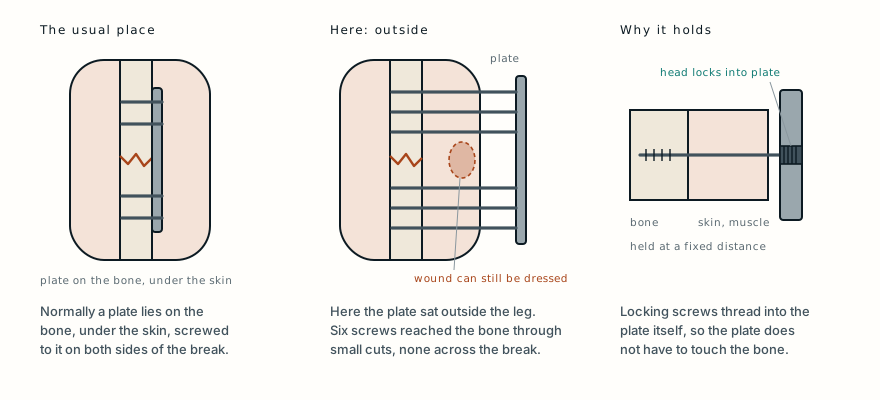
Why a plate can do this is the clever part. With ordinary screws, a plate holds by being pulled tight against the bone, so it has to be shaped to fit. A locking plate is different: the head of each screw is threaded and locks into the plate itself, fixing its angle. The bone is held in position relative to the plate rather than pressed against it, so the plate does not need to touch the bone or be contoured to it. In the authors’ words it behaves less like an internal plate and more like an external fixator placed inside the body, and that is the property they used.
Checking the wounds again
Two days later he went back to theatre for a second look at the wounds. A planned return like this is a routine part of treating contaminated wounds: tissue that looked alive at the first operation can declare itself dead a day or two later, and has to be removed before it becomes a source of infection.
Healed wounds, and a bone still at risk
After six weeks all his wounds had healed and the plate was taken off the outside of his leg. X-rays after its removal showed new bone, called callus, forming across both the tibia and the fibula, and by the time he was taking some weight on the leg with a walking aid the bone had united.
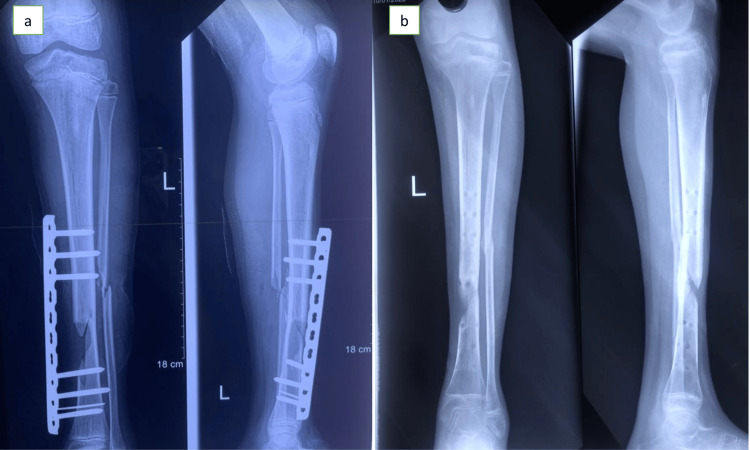
Because part of the tibia had been lost, the surgeons expected that it might break again. Three weeks after the outside plate came off, he had a second operation in which a locking plate was placed on the bone in the usual way, under the skin, through small incisions. After that he was allowed to put his full weight on the leg.
Fully mobile
He was discharged from follow-up once he was fully mobile. At one year the fracture was completely united.
The authors point out that the improvised technique achieved good alignment of the bone without any need for repeat surgery to correct it, and they describe the result as equivalent to standard practice.
Improvising well
Using a locking plate outside the body is not new. It has been described for open fractures, for bones that fail to heal, for infected joints, and to help lengthen bone. But it has never had the place in standard fracture textbooks that conventional external fixators have.
The authors set their case against a wider problem. In low-income settings, injuries like this are made harder by everything around them: delays in reaching a centre with orthopaedic facilities, shortages of equipment and supplies, fewer trained staff, and limited access to scans such as CT and MRI, so that surgeons may have to rely on simpler imaging or clinical examination alone. Their conclusion is a call for targeted support for these areas.
What the case shows is that understanding why a device works can matter as much as having the right one. A locking plate holds bone by locking its screws, not by touching the bone, and a surgeon who knows that can use it as a frame outside a leg when there is no frame to hand.
What this case teaches
A crocodile bite broke both bones of a 13-year-old’s lower leg through the skin, tore away part of his shin bone and left wounds contaminated with the bacteria of a crocodile’s mouth. The standard answer to an open fracture like that is to clean the wound and hold the bones with a frame outside the leg, so that the wound stays reachable. Without the usual equipment, his surgeons sterilised a used locking plate and screwed it on outside his leg, with six screws kept clear of the break, relying on the fact that a locking plate holds bone by locking its screws rather than by touching it. After a second look at 48 hours, the wounds healed by six weeks, the plate came off, and because bone had been lost, a plate was placed inside the leg three weeks later to protect it. He walked out fully mobile, and at a year the fracture had completely united.
Want the next case like this?
When a new case is written up, it comes to your inbox: the story, the diagram and what it teaches. No schedule and no filler. Unsubscribe in one click.
Free · no spam · your address is never shared · built with KitWas this case worth your time? Buy the next one a coffee ($3), or support MedicaseHub monthly.
Read the original paper: doi.org/10.7759/cureus.47511
Adapted from Mubarak FS and Kanagaratnam K, “Placing Locking Compression Plates as an External Fixator in Wild Animal (Crocodile) Bite Victim: A Case Report,” Cureus 2023;15(10):e47511, from the Department of Cardiothoracic Surgery, Hull University Teaching Hospital, the Ministry of Health, Sri Lanka, and the Department of Orthopaedic Surgery, Ashraff Memorial Hospital, Kalmunai, Sri Lanka. The presentation, fracture grade, operative technique, timeline and outcome are as reported there, summarised in the author’s own words. The crocodile attack figures for Sri Lanka, the description of crocodile bite wounds and their bacteria, the recommended first treatment, the mechanics of locking plates and the points on low-resource settings are drawn from that paper and the studies it cites; the explanations of open fractures, the Gustilo-Anderson grade, external fixators and planned second-look surgery are from standard references. The paper is published under a Creative Commons Attribution 4.0 licence, and the clinical photograph and X-rays are reproduced from it under that licence, unchanged; the authors state that consent was obtained or waived. A third figure in the paper is not reproduced because it shows hospital identification numbers. The diagram is original to MedicaseHub, is simplified, and may be reused freely under CC BY 4.0. This article is not medical advice. Any animal bite that breaks the skin needs medical care, and a bite over a possible broken bone needs it urgently. Where crocodiles live, the survey cited in the paper found that most attacks happened while people were bathing, washing clothes or swimming at the water. Read the full disclaimer.
Related cases
- The shark did not cause the contractureAnother attack from the water, and the harm that came after the bite itself.
- The hand arrived still inside the machineA crushing injury where the surgeons had to work with what they had in front of them.
- They cut the branch down. Nobody pulled it out.Another injury where knowing what not to do mattered as much as the operation.