A lightning pattern spread across his skin, and was gone within a day
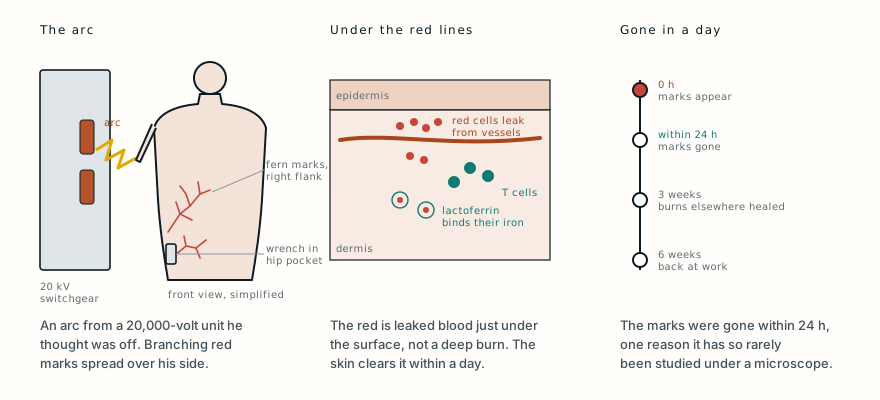
An electrician reached towards a 20,000-volt unit he believed was switched off. An electric arc struck him, and red, branching marks like the fronds of a fern appeared across his side. Within 24 hours they had vanished. Biopsies taken from the marks gave one of the first looks at what is happening in the skin underneath.
- Specialty
- Burns, plastic surgery, dermatology
- Patient
- Man, 47, electrician
- Mechanism
- Electric arc from a 20 kV switchgear
- Arrival
- Alert and walking, with burns to 7% of his body
- Skin sign
- Branching red marks on the right flank: Lichtenberg figures
- The marks
- Gone within 24 hours
- Biopsy
- Leaked red blood cells, T cells and the iron-binding protein lactoferrin
- Burns
- Healed within 3 weeks
- Work
- Back at 6 weeks
- 0 minthe arc
- arrivalburns, and a fern
- what they area lightning sign
- 24 hgone
- 3 monthsunder the microscope
- 6 weeksback at work
A unit he thought was switched off
He was 47, an otherwise healthy electrician, working inside an air-insulated high-voltage switchgear. The job was to extend one of its 20,000-volt outgoing units. He was examining the connections, believing that unit to be switched off, and directed his hand towards it. It was not off. Electricity arced to him.
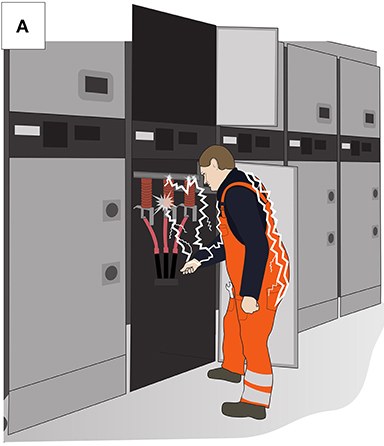
He had a large metal combination wrench in his right front hip pocket, which the authors think may have shaped where the current went. Marks inside the unit showed that the current had found its way to earth, at least partly, over a very short distance. He was able to walk out of the switchgear on his own.
Burns, and something that was not a burn
When the paramedics arrived he was alert and oriented, and said he had not fallen or lost consciousness. He walked to the ambulance. He had second-degree burns over 7% of his body, on his right elbow and arm, his lower back and his buttocks.
At the burn centre the doctors checked for the injuries that make electrical burns dangerous: damage to nerves, and damage to muscle deep under intact-looking skin. His nerves were working normally in all four limbs, and there were no signs of compartment syndrome. His blood showed only a slight rise in myoglobin and creatine kinase, the substances muscle releases when it is damaged, which ruled out a serious muscle injury. His white cell count was mildly raised, as expected after an acute injury, and within 24 hours it, the myoglobin and the creatine kinase were all back to normal.
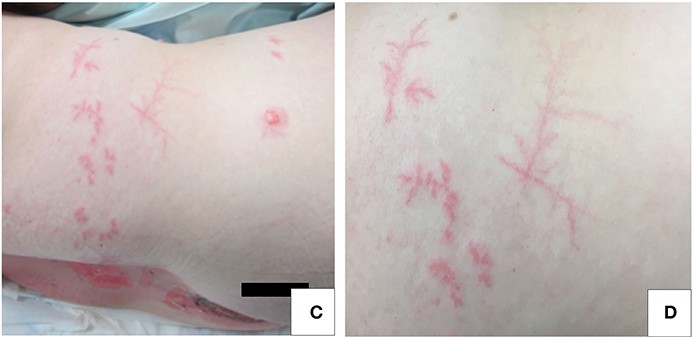
Over his right flank there was something else: several red marks that did not fade when pressed, spreading in branches like the fronds of a fern.
A sign of lightning, on a man who was not struck by lightning
The marks are called Lichtenberg figures, after Georg Christoph Lichtenberg, who first described the same branching pattern in 1777 while experimenting with static electricity. In medicine they are known as the skin sign of a lightning strike: when they are present, they point to lightning and almost nothing else. The authors could find only one earlier report of them after an electrical injury of this kind, rather than lightning.
They are not a burn in the usual sense. Earlier work cited by the authors showed that the fern pattern is a first-degree burn caused by a positive electrical discharge spreading across the skin. A negative discharge tends to leave a more even, less branching mark, and the authors suggest that the marks on the left of the photographs may be that kind, while the true fern on his lower right flank came from a positive one. They suggest that the alternating current in the switchgear, or the wrench in his pocket, could explain where a positive discharge came from.
Want this diagram print-ready? Get it for $5, or all 42 in the diagram pack.
Gone by the next day
He was watched for two days on a high-dependency unit and needed nothing stronger than ibuprofen and paracetamol. His burns were covered with a silver dressing, changed every three to five days.
The Lichtenberg figures disappeared completely within 24 hours. Photographs taken three days after the injury show the burns on his arm and back and no trace of the fern on his flank. That speed is part of why they are so poorly understood: they are rare, they fade fast, and they have mostly been described in scattered single case reports.
What was under the red lines
With his written consent, the team took a 4-millimetre punch biopsy from the marks on his flank when he arrived. Three months later they took a second one from healed skin next to the first biopsy scar, as a comparison. According to the authors, this was the first time a biopsy of Lichtenberg figures had been taken from a survivor and compared with his own healed skin.
Under the microscope the marked skin showed red blood cells that had leaked out of the small blood vessels in the upper dermis, just beneath the skin's surface layer, together with a gathering of white cells. The vessel walls themselves were intact, with no inflammation of the vessels. Most of the white cells were T cells, with only the occasional B cell.
The team then measured the proteins in the two samples. The one that stood out was lactoferrin, a protein that binds iron. There was much more of it in the marked skin, made by the skin's own surface cells and by the T cells. The authors' explanation is that the electrical discharge damaged the tiny surface vessels, red blood cells leaked out and gave the branches their colour, and the skin responded by making lactoferrin to soak up the iron released from those cells, raise the alarm, limit the damage and help repair. In their proposed sequence, this response is followed by the marks fading and the skin returning to normal.
A good outcome
His burns healed within three weeks, and he went back to work six weeks after the injury.
The same pattern, on purpose
The branching shape is not unique to skin. It is what electricity does when it spreads out through a material that resists it: each new branch splits again, in the same way as a bolt of lightning in the sky. Lichtenberg himself made the pattern in dust on charged plates. Today people make it deliberately, firing beams of electrons into blocks of clear acrylic to trap a glowing fern inside.
Some hobbyists also burn the pattern into wood, using high-voltage equipment such as the transformer from a microwave oven. This "fractal burning" has killed a number of people, and woodworking organisations warn against it. The voltages involved are lethal, and unlike this electrician, a hobbyist working at home has no safety rules, no training and no one nearby to switch the power off.
For doctors the lesson of this case is narrower. Lichtenberg figures are taken as near-proof of a lightning strike, but this man was never struck by lightning. They can follow a high-voltage electrical injury too, and because they disappear within hours, the only record may be a photograph taken on arrival.
What this case teaches
An electrician was struck by an arc from a 20,000-volt switchgear he believed was switched off. He walked out with second-degree burns to 7% of his body, and with a fern of branching red marks across his right flank: Lichtenberg figures, the classic skin sign of lightning, seen here after an electrical injury instead. The marks were gone within 24 hours. Biopsies taken on arrival and three months later showed red blood cells leaked from small surface vessels, a gathering of T cells, and a large rise in lactoferrin, a protein that binds iron, which the authors suggest helps the skin clear the leaked blood and limit the damage. His burns healed in three weeks and he was back at work in six. The figures are dramatic but harmless in themselves; what matters is the electricity that made them, and the deeper injuries it can cause.
Was this case worth your time? Buy the next one a coffee ($3), or support MedicaseHub monthly.
Next case · MC-003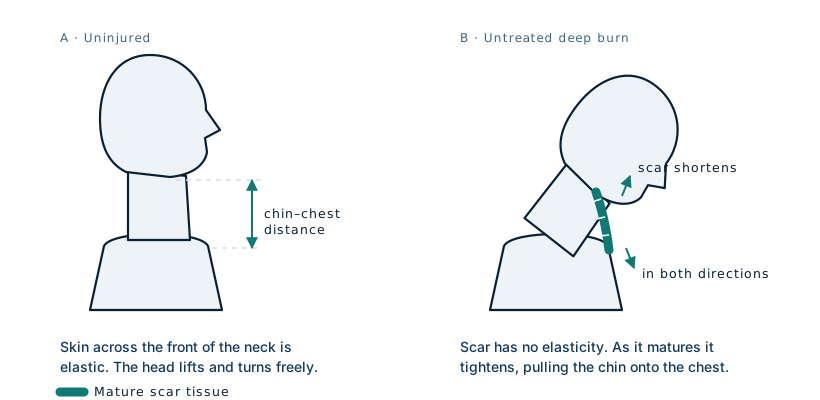 Burn scar contracture: face healed to the chestTen months without a surgeon turned a survivable burn into a disfigurement that took twelve operations to reverse.Read it →
Want the next case like this?
When a new case is written up, it comes to your inbox: the story, the diagram and what it teaches. No schedule and no filler. Unsubscribe in one click.
Free · no spam · your address is never shared · built with KitRead the original paper: doi.org/10.3389/fmed.2021.663807
Adapted from Lindford A, Juteau S, Jaks V, Klaas M, Lagus H, Vuola J and Kankuri E, “Case Report: Unravelling the Mysterious Lichtenberg Figure Skin Response in a Patient With a High-Voltage Electrical Injury,” Frontiers in Medicine 2021;8:663807, from the Helsinki Burn Centre, Helsinki University Hospital. The circumstances of the injury, the examination, the blood results, the treatment, the timeline, the biopsy findings and the authors’ proposed explanation are as reported there, summarised in the author’s own words. The history of Lichtenberg figures and the point about negative and positive discharges are drawn from the paper’s introduction and discussion; the explanations of the anatomy and tests, and the section on acrylic sculptures and fractal wood burning, are from general and public safety sources. The paper is published under a Creative Commons Attribution licence. The illustration and the two photographs are cropped from its Figure 1 and reproduced under that licence; the authors report written consent from the patient to publish his images. The photographs of his open burns in the same figure are not reproduced. The diagram is original to MedicaseHub, is simplified, and may be reused freely under CC BY 4.0. This article is not medical advice. Anyone who has had an electric shock from mains or high voltage, or been struck by lightning, should be checked by a doctor even if they feel well. Read the full disclaimer.
Related cases
- Burn scar contracture: face healed to the chestA burn that kept doing damage for months after the fire was out.
- Purple ears: the adulterant, not the drugAnother pattern on the skin that is really a picture of the blood vessels beneath it.
- The window stopped the sunburn, not the damageWhat the skin shows, and what it hides, after years of an invisible exposure.