His thumb lived on the back of his other hand for five months
A 38-year-old man’s right thumb was torn off, and the hand it came from was too damaged to take it back. So his surgeons sewed it onto the back of his left hand and kept it alive there. Five months later they moved it home, with a joint borrowed from his foot. Ten years on, he can pinch, write and feel with it.
- Specialty
- Hand surgery, microsurgery
- Patient
- Man, 38
- Injury
- Right thumb completely severed; the joint at its base destroyed; contaminated wound
- Stage 1
- Thumb attached to the back of the left hand; the stump covered with a flap from the groin
- Kept there
- 5 months
- Stage 2
- Thumb moved back, its base rebuilt with a joint from the second toe
- Follow-up
- 10 years
- Result
- Pinch, grip, writing; two-point discrimination about 8 mm
- Compared with
- A thumb sewn straight back: almost the same score
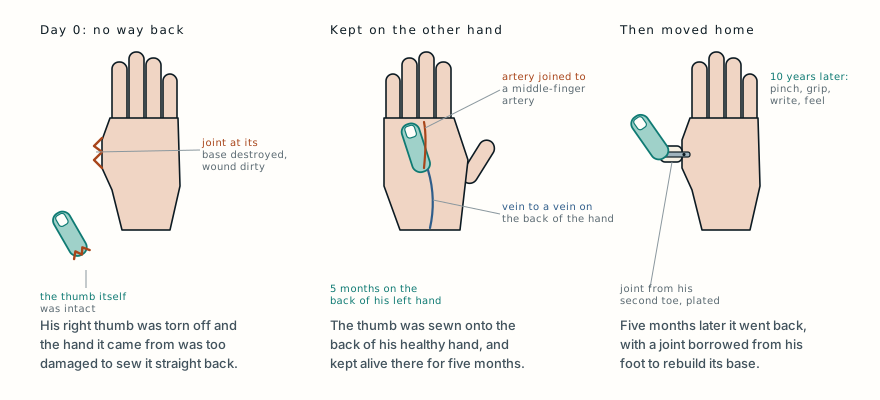
- day 0the injury
- day 0a temporary home
- 5 monthsmoving home
- 10 yearsthe thumb now
A thumb with nowhere to go
A 38-year-old man came to Qilu Hospital of Shandong University in Jinan, China, with his right thumb completely severed. The report does not say how it happened, only what it left behind.
The thumb itself had survived the injury in good enough shape to be saved. The problem was the hand. At the base of the thumb, the soft tissue was badly damaged, the wound edges were ragged and contaminated, and the metacarpophalangeal joint, the knuckle where the thumb meets the hand, was completely destroyed. There was nothing healthy to sew the thumb back onto. An emergency replantation, the usual operation for a severed finger, was not possible.
The thumb matters more than any other finger. Almost every grip, from holding a cup to writing, depends on the thumb pressing against the fingers. Losing it can take away much of what a hand can do.
Sewn onto the other hand
So the surgeons gave the thumb a temporary home. After cleaning the wound and the thumb, they attached it to the back of his healthy left hand. Under the microscope they joined the thumb’s artery to the radial digital artery of his left middle finger, one of the two small arteries that run along the side of each finger, and its vein to a vein on the back of the hand. The thumb had a blood supply again, and it began to heal in place.
This is called temporary heterotopic, or ectopic, replantation: a severed part is kept alive somewhere it does not belong until the place it does belong is ready for it. The idea was first described by the surgeon Marko Godina in 1986. It is meant for situations like this one, where the part is intact but the stump is too badly damaged or contaminated, or the patient too unwell, for it to go straight back.
The wound on his right hand still needed covering. For this the surgeons used a pedicled groin flap: a flap of skin and fat from the groin, left attached to its own blood supply, with the hand stitched to it so the flap can grow onto the wound. Once it has taken, the flap is cut free from the groin.
Keeping a reattached part alive takes careful nursing. He was given heparin and other drugs to stop the small vessels clotting or going into spasm, with blood tests to keep his clotting time a little above normal, and antibiotics for about a week. He stayed strictly in bed with the limb raised. After six days the thumb’s circulation was stable, the heparin was stopped and he moved to the general ward. Rehabilitation began a month after the operation.

A joint from his foot
Five months after the injury, the right hand had healed and the thumb could go home. But the joint at its base was still missing.
The surgeons replaced it with one from his left foot: the metatarsophalangeal joint of his second toe, the knuckle where the toe meets the foot, taken with a small patch of skin, its tendons, its artery, its veins and its nerve. They freed the thumb from the left hand, keeping a length of the vessels it had been living on, and set the borrowed joint between the thumb and the hand. A small metal plate fixed the joint to the bone of the hand, and a wire held the thumb to the joint.
Then came the plumbing. They repaired the tendons that bend and straighten the thumb, joined the arteries, the veins and the nerves of the thumb and of the toe joint to those of the right hand, and kept the hand in a plaster cast for a month.
Almost as good as sewing it straight back
The authors followed him for ten years. His rebuilt right thumb was slightly shorter than his left, the pad at its tip had partly wasted, and the skin flap on the palm side looked bulky. But the nail grew normally, the flap was soft, and the blood supply was good.
The borrowed joint worked. It moved through about 60 to 65 degrees, and he could move the thumb towards and away from the hand. The joint nearer the tip moved poorly. He could oppose the thumb to his fingers, pinch, grip, pick up a needle, write and hold a cup. Feeling had largely returned: he could tell two points apart about 8 millimetres apart on the thumb.
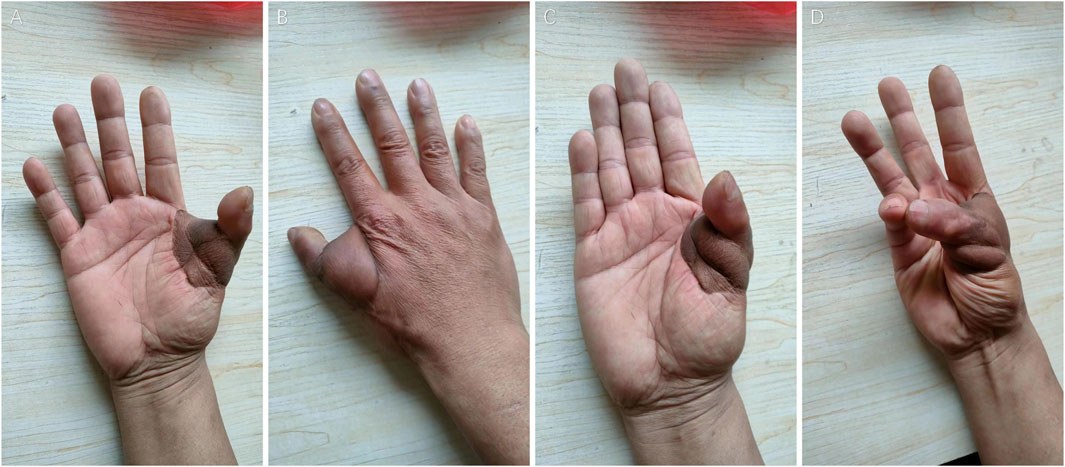
The authors compared him with another man from the same period, 44, whose right thumb had been severed in a similar place but could be sewn straight back. On the hand surgery society’s scoring system his thumb scored 82 out of 100; the thumb that had lived on the other hand scored 80. Both fell in the scale’s top grade. The main difference was in returning to work, where the directly replanted thumb did better.
In a second patient, a 22-year-old soldier with severe injuries to his right hand, his severed fingers were also kept on the back of his left hand, and moved back a year or more later together with a skin flap from the thigh. A third patient decided not to go on to the second stage.
Parking a body part
Keeping a severed part alive on another part of the body sounds improbable, but it has been used for fingers, hands, forearms, feet, a penis, testicles and a scalp. The opposite arm or hand is a common choice, because it has vessels of the right size and keeps the part close to where it will eventually go. Freezing a severed finger to sew back later has worked in a handful of cases, but it works poorly for larger parts.
The authors list when the technique makes sense: when the injured limb is so damaged that it is hard to tell at first what will survive, when the patient has other serious injuries or is too unstable for a long replantation, or when the stump is heavily contaminated or has lost too much tissue. It needs the severed part itself to be in good condition.
It has costs. It means at least two major operations, with the risks of clots in the small vessels, infection and failure each time, more expense, and the strain of living for months with a thumb on the wrong hand. The authors also note that their result, while good, came from one patient, and that a thumb kept this way did slightly less well than one that could be sewn straight back. When straight replantation is possible, it remains the better choice. When it is not, this can save a thumb that would otherwise be lost.
What this case teaches
A 38-year-old man’s right thumb was severed, and the joint at its base and the tissue around it were too badly damaged for it to be sewn back. His surgeons attached the intact thumb to the back of his left hand, joining its artery to one of his middle finger’s and its vein to a vein of the hand, and covered the stump with a flap from his groin. Five months later they moved the thumb home, rebuilding its base with the joint from his second toe. Ten years later he could pinch, grip, write and feel with it, and it scored almost the same as a thumb sewn straight back. When a severed part is healthy but there is nowhere to put it, it can sometimes wait somewhere else.
Was this case worth your time? Buy the next one a coffee ($3), or support MedicaseHub monthly.
Next case · MC-045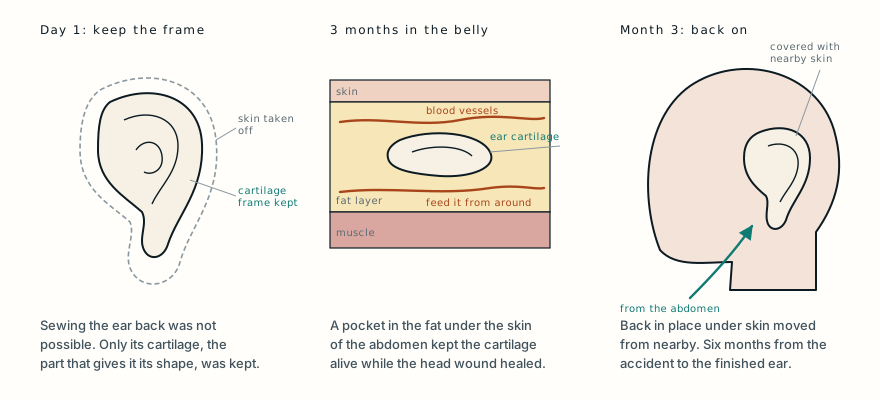 They saved his ear by keeping it inside his bellyA road accident tore off a 22-year-old's ear, and the wound was too damaged to sew it back. Surgeons buried its cartilage under the skin of his abdomen and brought it back to his head three months later.Read it →
Want the next case like this?
When a new case is written up, it comes to your inbox: the story, the diagram and what it teaches. No schedule and no filler. Unsubscribe in one click.
Free · no spam · your address is never shared · built with KitRead the original paper: doi.org/10.3389/fbioe.2024.1465108
Adapted from Ma Z, Zhang X, Wang G, Zhu L, Pei Y, Sun Y and Liu B, “Long-term follow-up of thumb reconstruction with a heterotopic replanted finger: case report and literature review,” Frontiers in Bioengineering and Biotechnology 2024;12:1465108, from Qilu Hospital of Shandong University, Jinan, China. The injury, the two operations, the aftercare, the ten-year findings and the comparison case are as reported there, summarised in the author’s own words; the paper names the rebuilt joint at the base of the thumb in different ways in different places, and it is described here as the joint at the base of the thumb. The history and indications of heterotopic replantation are those the authors give in their discussion, and the explanations of the anatomy and of the groin flap are from standard references. The paper is published under the Creative Commons Attribution licence (CC BY), and the authors report written consent for publication. The two photographs here are reproduced from Figures 2 and 3 under that licence, one of them cropped. The photographs of the injury and of the operations are not reproduced. The diagram is original to MedicaseHub, is simplified, and may be reused freely under CC BY 4.0. This article is not medical advice. Read the full disclaimer.
Related cases
- They saved his ear by keeping it inside his bellyAnother body part kept alive somewhere else until it could go home.
- Her lost arm gave its nerve to her leg, and her toe became a thumbAnother thumb rebuilt with help from the foot.
- Replanting an arm: the clock, and the harder questionWhen a severed part can go straight back, and what decides it.