The machine pulled the skin off four fingers like a glove
A 35-year-old factory worker’s right hand was caught and crushed in a hot belt machine. When he pulled it free, the skin of four fingers came off in one piece, like a glove, and the back of his hand was burned. Amputation is the usual answer. His surgeons tried to sew the fingers back on instead.
- Specialty
- Hand surgery, microsurgery
- Patient
- Man, 35
- Mechanism
- Compression and pulling in a hot belt manufacturing machine
- Injury
- Index, middle, ring and little fingers degloved and avulsed from just above the knuckles; burn on the back of the hand and forearm
- To hospital
- 4 h
- Surgery
- 5 h after the injury
- Rejoined
- 3 arteries (one through a vein graft), 1 nerve, 4 veins
- Day 4
- Ring and little fingers lost
- At 4 months
- Grasp and pinch with the thumb, the index stump and the middle finger
- 0 hthe machine
- 5 hreplantation
- day 4the burn
- 4 monthsa grip
A glove made of skin
The 35-year-old was working in a factory that makes hot belts when his right hand was caught in a machine, compressed and pulled. He arrived at the emergency department four hours later. His four fingers had been torn away from just above the knuckles, leaving only his thumb. The torn-off part had been kept in suitable conditions on the way. A large second-degree burn covered the back of his hand and forearm.
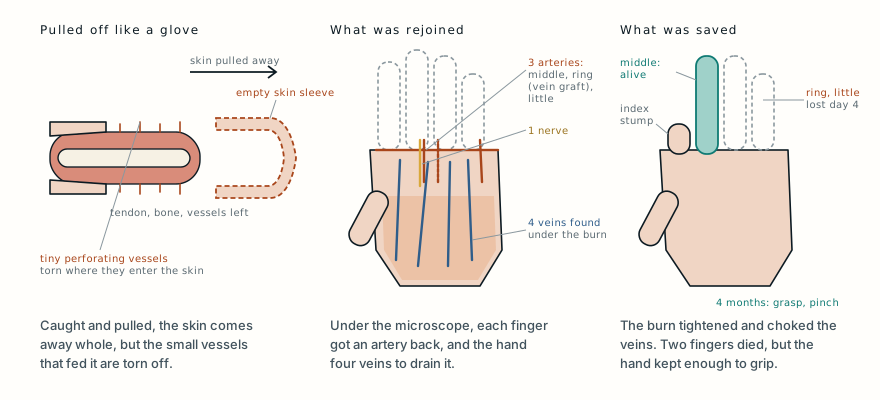
This kind of injury is called degloving, and the name is literal. It typically happens when a hand is squeezed between rollers or in a press and the person pulls back by reflex. The skin is attached to the deeper tissues by countless tiny blood vessels, the perforators, which pass up from below to feed it. A strong pull shears the skin away at that level, and it slides off whole. What is left underneath is a hand of tendons, vessels, nerves and bone; what comes away is a sleeve of skin with its blood supply torn out.
Looking at the torn-off part, the surgeons found the middle, ring and little fingers degloved from just above the knuckles. Bruised patches on the skin showed where its perforators had been torn, and the ring finger had a second injury to its artery further along. On the hand itself, the index finger was partly torn away, with a fracture of its first bone and injuries at several levels, and a lot of skin was missing. The bundles of artery and nerve in the fingers were damaged at more than one level. X-rays showed the index finger torn off through its first bone and the other three fingers separated at the joints near their tips.
For a complete avulsion like this, the established classifications and most surgeons recommend amputation. But losing four fingers takes away most of what a hand can do, and the alternative of covering the hand with skin flaps tends to leave thick, clumsy fingers that do little better. The surgeons decided to try replantation, sewing the fingers back on and reconnecting their blood supply, knowing it might fail.
Finger by finger
Five hours after the injury he was in theatre under general anaesthesia. The index finger was too badly damaged at too many levels, so the surgeons decided at the start to amputate it through its first bone and close the stump.
Under the microscope they then looked for vessels that could be rejoined in the other three fingers. The main artery on the little-finger side of the middle finger was usable. The main artery on the thumb side of the ring finger was usable too, but it had been damaged along a stretch, so it was bridged with a vein graft, a short length of vein taken from elsewhere. The artery on the little-finger side of the little finger could be repaired directly. When all three were joined, blood flowed into all three fingers.
They repaired one nerve, on the little-finger side of the middle finger, so that it could later carry feeling. The bones were not fixed. A replanted part also needs veins to drain blood away, or it swells and dies. The surgeons found four usable veins on the back of the hand, underneath the burn, and joined all four. The fingers were then closed with the skin that was there. There was blood flow through the replanted part and no sign of congestion when the operation ended.
Afterwards he was given antibiotics and blood thinners to keep the small joins open: low-molecular-weight heparin twice a day, a continuous infusion of dextran and aspirin, with pain relief stepped up as needed.
What the burn did
For four days the fingers stayed alive. Then, on day 4, severe venous congestion set in. The burn on the back of his hand was turning into eschar, the hard, tight crust that forms over burned skin, and its pressure squeezed the four veins the surgeons had joined beneath it. Blood could still get in but could no longer drain out.
He went back to theatre. The ring and little fingers had died, and were amputated. The middle finger was still alive. The surgeons removed dead tissue from the front and back of the hand where skin had been lost in the injury.
The burn had also limited their options from the start. Many of the vessels they would have used to bring in a flap of tissue ran beneath the burned skin, and there was little healthy tissue nearby to move. That, they write, was part of why replantation was the best choice for this patient rather than a flap.
Enough to grip
He went home on the fourth day after the second operation, on an antibiotic and a low dose of aspirin. At weekly checks the remaining tissue stayed alive. A month later, physiotherapists began exercises to move his joints.
At four months, he could grasp and pinch, using the stump of his index finger and the replanted middle finger against his thumb. The authors call the result favourable but limited: two of the four fingers were lost, but the hand kept a working middle finger, and its back was preserved, which is more than amputation or a bulky flap would have left him.
The photographs of the injury in the paper are among the most striking in hand surgery, and they are not reproduced here. The original paper, linked below, shows the injury, the repair and the result.
Why degloved fingers are so hard to save
Most hand injuries come from work accidents, followed by simple accidents at home, and amputations of the hand and fingers cause long, often permanent loss of work. Degloving is less common than a clean amputation, and it is much harder to treat.
The central problem is the perforators. Even when the main arteries of a finger are rejoined perfectly, the skin that was pulled off has lost the small vessels that connected it to the tissue beneath, and it may not get enough blood to survive. Surgeons cannot tell in advance how much of a replanted part will live. That is why the established recommendation is amputation, and why some authors consider repairing the vessels pointless in these injuries.
The authors argue the other way: that tissue should be given a chance. Flaps from the groin or free flaps can cover a degloved hand, but they produce thick tissue that is far from a working finger. In a study they cite comparing the two, replantation was less likely to succeed, but when it did, the function and appearance were better. Their advice is to try replantation first where possible, and if it fails, to move quickly to the next step, removing dead tissue before it damages the tendons, muscles and bone beneath, and then covering the hand with flaps or grafts.
The obvious lesson is prevention. Degloving injuries happen when hands go near rollers, belts and presses, and most machine guarding and lock-out rules exist for exactly this reason.
What this case teaches
A 35-year-old’s right hand was caught in a hot belt machine and the skin of four fingers was pulled off like a glove, with a burn across the back of his hand. Instead of amputating, his surgeons shortened the ruined index finger and replanted the other three, joining three arteries, one through a vein graft, one nerve and four veins found beneath the burn. The fingers lived for four days until the tightening burn squeezed the veins shut; the ring and little fingers died and were removed, but the middle finger survived. Four months later he could grasp and pinch against his thumb. In degloving injuries, rejoined arteries do not guarantee survival, but trying to save the tissue can leave a hand that works better than amputation would.
Was this case worth your time? Buy the next one a coffee ($3), or support MedicaseHub monthly.
Next case · MC-026 The hand arrived still inside the machineA welder freed him in theatre. The amputation was decided by something much simpler than the damage.Read it →
Want the next case like this?
When a new case is written up, it comes to your inbox: the story, the diagram and what it teaches. No schedule and no filler. Unsubscribe in one click.
Free · no spam · your address is never shared · built with KitRead the original paper: doi.org/10.52312/jdrs.2025.2131
Adapted from Pamuk Ç, Uğurlar M and Moralar Ü, “Glove-like hand: A case of severe-circumferential hand degloving injury,” Joint Diseases and Related Surgery 2025;36(2):472–478, from Silivri Anadolu Private Hospital and Nişantaşı University, Istanbul. The injury, the findings, the operations, the aftercare and the four-month result are as reported there, summarised in the author’s own words; the points on degloving, perforators and treatment choices are those the authors make in their discussion, and the explanations of the anatomy and the note on machine safety are from standard references. The authors report written consent from the patient. The paper is published under a Creative Commons Attribution Non-Commercial licence (CC BY-NC), so its photographs are not reproduced here; they can be seen in the original paper. The diagram is original to MedicaseHub, is simplified, and may be reused freely under CC BY 4.0. This article is not medical advice. Read the full disclaimer.
Related cases
- The hand arrived still inside the machineAnother hand caught in a machine, and the decision about what could be saved.
- His thumb lived on the back of his other hand for five monthsAnother severed digit, saved by an unusual route.
- Replanting an arm: the clock, and the harder questionWhen replantation is worth trying, and what decides it.