She played the violin while surgeons removed her brain tumour. It was how they knew where to stop.
Dagmar Turner, a violinist from the Isle of Wight, had a tumour next to the part of her brain that moves her left hand. Her surgeons woke her in the middle of the operation and asked her to play.
- Specialty
- Neurosurgery
- Patient
- Dagmar Turner, 53, a former management consultant and orchestral violinist
- Condition
- Glioma in the right frontal lobe, slow-growing since 2013, more aggressive in 2019
- Risk
- Close to the areas for language and fine movement of the left hand
- Operation
- Awake craniotomy at King's College Hospital, London, 31 January 2020
- Result
- Over 90% removed; full function of the left hand kept
- 3 days
- Home from hospital
- 3 years
- Playing in her orchestra; tiredness; regular scans
- 2013a seizure
- Jan 2020awake
- 3 dayshome
- 2023still playing
A tumour on the wrong side for a violinist
Dagmar Turner had played the violin since she was ten. A former management consultant, she played in the Isle of Wight Symphony Orchestra. In 2013 she had a seizure while playing, and was found to have a glioma, a tumour that grows from the brain's supporting cells. It was slow-growing, and she was treated with radiotherapy.
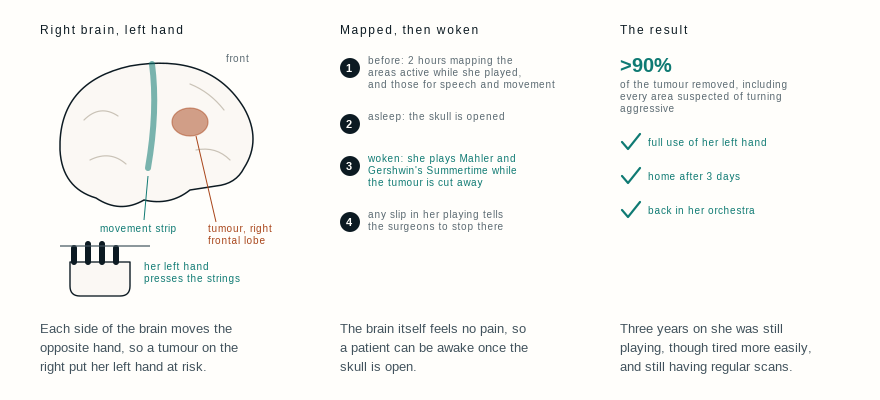
In 2019 scans showed that it had become more aggressive, and she decided to have it removed. The tumour lay in the right frontal lobe, close to the areas that control language and the fine movements of her left hand. Each side of the brain moves the opposite side of the body, and for a violinist the left hand is the one that presses the strings. She later recalled being told that the tumour would affect her left side, and her reaction: that was the most important part of her.
Mahler, Gershwin, and a surgeon who plays the piano
Her neurosurgeon at King's College Hospital in London, Professor Keyoumars Ashkan, is himself a pianist, and he understood what she stood to lose. The plan was an awake craniotomy: an operation in which the patient is woken once the skull is open, so that the brain can be tested while the surgeons work. The brain itself has no pain receptors, so this is possible without pain once the scalp and skull have been numbed.
Before the operation the team spent two hours mapping her brain, identifying the areas that were active when she played the violin and those responsible for language and movement. On 31 January 2020 they opened her skull while she was asleep, then woke her and asked her to play. With a violin under her chin, she played music by Mahler, Gershwin's Summertime and songs by Julio Iglesias, while the surgeons removed the tumour behind a plastic sheet. Any change in her playing would have warned them that they were reaching tissue she needed.
Ashkan said it was the first time he had had a patient play an instrument during surgery.
Over 90 percent, and a working left hand
The team removed more than 90 percent of the tumour, including all the areas suspected of aggressive activity, while keeping full function in her left hand. She went home three days after the operation.
Within days and weeks, she said later, she felt fit and went straight back to rehearsals, to the surprise of her conductor.
Back with her orchestra
In August 2023, aged 57, she met Ashkan again at the Hunterian Museum in London to rewatch the operation. She was still playing with her orchestra and had recently performed for three hours.
It had not all been easy. After the first weeks came side effects: fatigue, feeling constantly tired and short of energy, and she still had it. Ashkan said long-term fatigue is common after brain tumour surgery and needs more research. She continued to be monitored with regular scans, and he said that so far things were going well.
Why some brain surgery is done awake
When a tumour lies close to the parts of the brain that control speech or movement, the surgeon faces a trade-off. Removing more of the tumour gives the patient more time; removing too much can take away the ability to speak or move a hand. Scans before surgery show roughly where those functions are, but every brain is arranged a little differently, and the boundary has to be found during the operation itself.
The answer is to ask the brain directly. With the patient awake, the team can test the function at risk and stop the moment it falters. For most patients the tests are simple: naming pictures, counting, moving fingers. For Turner, whose life revolved around fine control of her left hand, the most sensitive test was the one she knew best.
The same principle has been used with a saxophonist and with an accountant asked to do sums during surgery. What made this case memorable was the image: a woman playing Summertime while her skull was open.
What this case teaches
Dagmar Turner, a violinist, had a glioma in the right frontal lobe, close to the areas that move her left hand. In January 2020 surgeons at King's College Hospital mapped her brain, opened her skull, then woke her and had her play the violin while they removed the tumour, so that any change in her playing would tell them where to stop. They removed more than 90 percent of it and kept full function in her left hand. She went home three days later, went back to her orchestra, and three years on was still playing, despite lasting fatigue.
Was this case worth your time? Buy the next one a coffee ($3), or support MedicaseHub monthly.
Next case · MC-071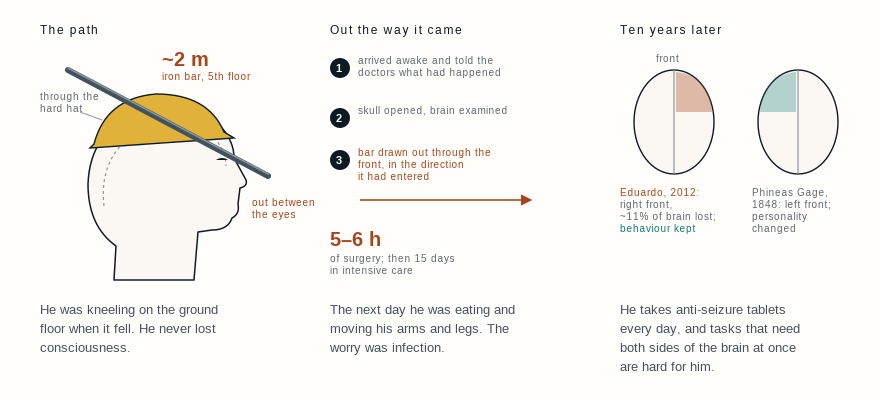 An iron bar fell five floors and went through his head. He arrived at hospital awake and talking.Eduardo Leite survived a bar through the front of his brain in 2012. He lost about 11% of it, and unlike Phineas Gage, his personality did not change.Read it →
Want the next case like this?
When a new case is written up, it comes to your inbox: the story, the diagram and what it teaches. No schedule and no filler. Unsubscribe in one click.
Free · no spam · your address is never shared · built with KitMain source: NPR, “Musician plays her violin during brain surgery,” February 2020
Based on published reporting: NPR (February 2020), quoting the King's College Hospital press release; Global News (February 2020), with files from Reuters and the Associated Press; and ITV News London (August 2023). The account is summarised in the author’s own words, and the background on awake craniotomy is from standard references and the comments of the neuroscientist Brad Mahon quoted by NPR. No photographs are reproduced. The diagram is original to MedicaseHub, is simplified, and may be reused freely under CC BY 4.0. This article is not medical advice. Read the full disclaimer.
Related cases
- An iron bar fell five floors and went through his head. He arrived at hospital awake and talking.Another frontal lobe, and what a brain can keep after losing part of it.
- A twin inside a skull, benign and still fatalAnother brain tumour where location mattered more than type.
- The abscesses in his brain came from his teethAnother case where surgeons had to work around what the brain needs.