An iron bar fell five floors and went through his head. He arrived at hospital awake and talking.
Eduardo Leite, a 24-year-old construction worker in Rio de Janeiro, survived a bar that entered the back of his skull and came out between his eyes. Ten years later, scientists were still studying how his brain made up for what it lost.
- Specialty
- Neurosurgery, emergency medicine
- Patient
- Eduardo Leite, 24, a construction worker in Rio de Janeiro
- Injury
- Iron bar dropped from the fifth floor, through his hard hat, in at the back of the skull and out between the eyes
- On arrival
- Conscious; described the accident himself
- Surgery
- Skull opened and the bar drawn out through the front; five to six hours
- Damage
- Right frontal lobe; about 11% of his brain tissue lost
- 15 days
- In intensive care
- 10 years
- Retired; daily anti-seizure medicine; personality and relationships intact
- Aug 2012the bar
- surgeryout the way it came
- 15 daysintensive care
- 10 yearsthe study
Kneeling on the ground floor
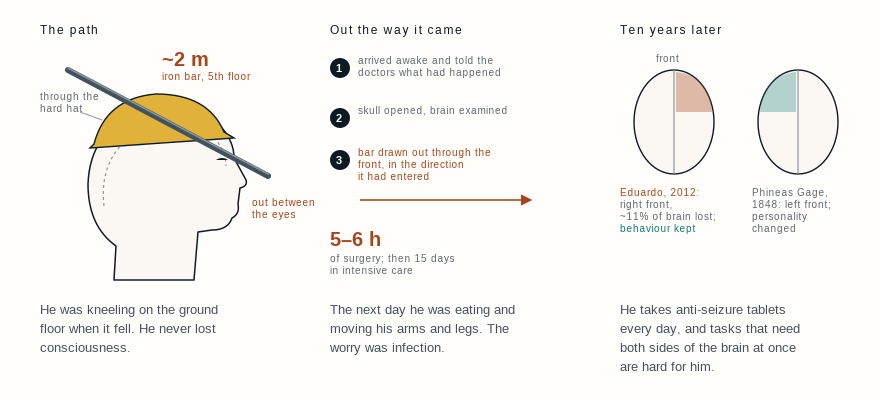
In August 2012, Eduardo Leite, 24, was working on a building site in the south of Rio de Janeiro. He was kneeling on the ground floor handling tools, wearing a hard hat, when an iron bar fell from the fifth floor, about 15 metres above him.
It went through the hard hat and into the back of his skull, passed through his brain and came out between his eyes. Reports of its length differ: international agencies described a bar of about six feet, or 1.8 metres, while later Brazilian reports gave 2.5 metres.
He did not lose consciousness. A surgeon took a photo on his phone in the ambulance, and Leite's wife later described it: her husband lying down with the bar pointing upwards, holding it, his face covered in blood, looking as if nothing had happened. When he reached Miguel Couto Hospital, he told the doctors himself what had happened, and said he felt no pain.
Pulled forwards, not back
The hospital's chief of staff, Dr Luiz Alexandre Essinger, said what impressed him most was that Leite arrived awake and able to tell him what had happened. He described the bar's path plainly: in through the back and side of the skull, through the bone, across the core of the brain, and out through the front between the eyes.
In the operating room the surgeons opened the skull and examined the brain. The surgeon then decided to draw the bar out through the front, in the same direction it had gone in, rather than pulling it back along its path. The operation took about five hours according to the first reports, and about six in later Brazilian accounts.
The head of neurosurgery said the bar had missed a critical area of the brain, and that Leite had come within a few centimetres of losing an eye and of being paralysed on the left side of his body. Neurologists noted that it had spared the regions that control speech and movement, which is why survival without obvious disability was possible.
Eating the next day
By the following day he was conscious, eating normally, moving his arms and legs, and said he felt little pain. Essinger described him as lucid and in good spirits, and said the risk in the days ahead was infection, the main danger when a dirty object has passed through the brain.
He spent 15 days in intensive care before going home.
The brain that compensated
The bar had destroyed about 11 percent of his brain tissue, in the prefrontal cortex on the right side: the front part of the brain involved in planning and decisions. Doctors expected his behaviour to change. Researchers in Brazil and the United States began following him to find out.
The comparison everyone reached for was Phineas Gage, the American railway foreman who in 1848 survived an iron rod blown through the front of his skull, on the left side, and whose personality changed so much that friends said he was no longer himself. A researcher at Fiocruz, Brazil's national public health institute, said in 2022 that they had expected to find something similar in Leite, but that from the moment he left the operating room he appeared highly compensated. Over ten years, he said, Leite kept his performance and his relationships with family and friends.
He was not untouched. By 2022 he was retired, carried scars on his face and head, and took medicine every day to prevent seizures, which are common after brain injuries. If he forgot it, he said, a seizure came, and came hard. One of his few lasting difficulties was with tasks that need both sides of the brain to work together at once. The researchers said they planned to publish their findings on how one side of his brain had compensated for the other.
How a person survives a bar through the brain
Survival depends on what the object misses as much as what it hits. The brain's largest blood vessels, the brainstem that keeps breathing and heartbeat going, and the strips of cortex that control movement and speech are concentrated in particular places. A path through the front of the brain can avoid all of them, while one a few centimetres further back or lower might not.
The front of the brain is also where the effects of damage are hardest to see at first. Someone can walk, talk and remember after losing part of the prefrontal cortex, and the changes, if they come, show up in judgement, planning and personality. That is why Gage became famous, and why Leite was studied for a decade afterwards.
Two practical points from his treatment hold for any object stuck in the head: it was left in place until he was in the operating room with the skull open, and once it was out, the main risk was infection.
What this case teaches
In August 2012 an iron bar fell five floors on a Rio de Janeiro building site, went through Eduardo Leite's hard hat and skull, crossed his brain and came out between his eyes. He arrived at hospital conscious and described what had happened. Surgeons opened his skull and drew the bar out through the front, and after 15 days in intensive care he went home. He had lost about 11 percent of his brain, in the right frontal lobe. Ten years later he was retired and on daily anti-seizure medicine, but unlike Phineas Gage, whose similar injury changed his personality, his behaviour and relationships had stayed the same.
Was this case worth your time? Buy the next one a coffee ($3), or support MedicaseHub monthly.
Next case · MC-043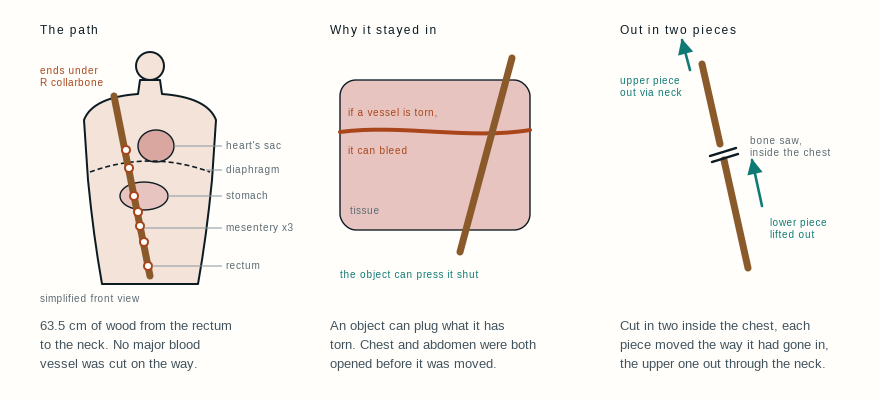 It ran from his pelvis to his neck and missed every major vesselA 45-year-old man arrived stable, with abdominal pain. The scans showed a wooden rod running from his rectum to the right side of his neck, without cutting a single major blood vessel on the way.Read it →
Want the next case like this?
When a new case is written up, it comes to your inbox: the story, the diagram and what it teaches. No schedule and no filler. Unsubscribe in one click.
Free · no spam · your address is never shared · built with KitMain source: Channel 4 News, “Man survives horrific ‘brain skewer’ injury,” August 2012
Based on published reporting: Channel 4 News (August 2012), including Dr Luiz Essinger and Leite's wife; Associated Press via Fox News and UPI (August 2012); and, for the ten-year follow-up, Folhapress via A Gazeta and Canaltech (August 2022), citing an interview with TV Globo's Fantástico and the Fiocruz researcher Renato Rozental. The reports differ on the length of the bar and the length of the operation; both versions are given. The account is summarised in the author’s own words, and the background on Phineas Gage and on brain anatomy is from standard references. No photographs are reproduced. The diagram is original to MedicaseHub, is simplified, and may be reused freely under CC BY 4.0. This article is not medical advice. Read the full disclaimer.
Related cases
- It ran from his pelvis to his neck and missed every major vesselAnother metal rod that crossed the body and missed what would have killed him.
- An arrow bounced off a target and went through his neck. It was holding his artery shut.Another object left in place until the operating room.
- They cut the branch down. Nobody pulled it out.Another impalement where the object came out only in surgery.