A new face and two new hands, from one donor, in one operation.
Joe DiMeo was burned over 80% of his body in a car crash. Two years later, surgeons in New York gave him what had never worked before: a face and both hands transplanted together, successfully.
- Specialty
- Plastic and reconstructive surgery, transplantation
- Patient
- Joe DiMeo, New Jersey, 22 at the announcement
- Injury
- Third-degree burns over 80% of his body, car crash, July 2018
- Before
- About 20 reconstructive operations; fingertips amputated, no lips or eyelids
- Obstacle
- Highly sensitised immune system: about a 6% chance of a compatible donor
- Transplant
- August 2020, NYU Langone: about 23 hours, more than 140 staff
- Replaced
- Full face with ears, eyelids, lips and bone; both hands to mid-forearm
- 6 months
- No rejection episodes; dressing and feeding himself
- 2018the crash
- 2 yearsthe search
- Aug 202023 hours
- afterlearning again
Asleep at the wheel after a night shift
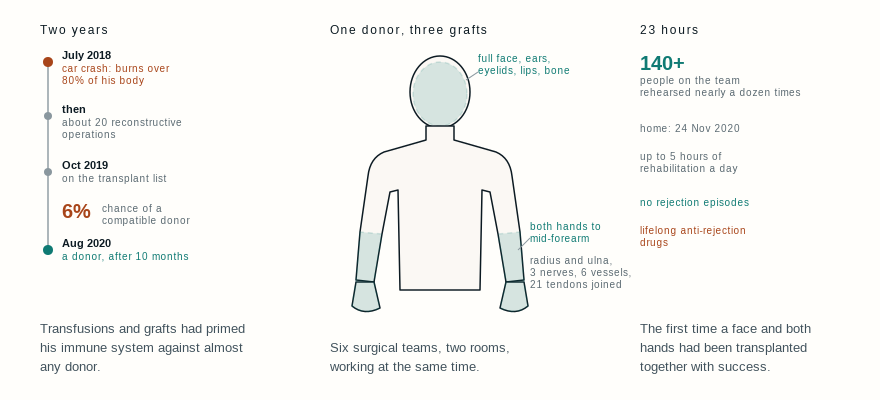
In July 2018, Joe DiMeo, from New Jersey, fell asleep while driving after a night shift as a product tester for a drug company. His car hit a curb and a utility pole, flipped over and caught fire. Another driver who saw the crash stopped and pulled him out.
He had third-degree burns over 80% of his body. He spent months in a medically induced coma and then went through about 20 reconstructive operations and multiple skin grafts. They saved his life, but left him with amputated fingertips, severe scarring of his face, and no lips or eyelids, which affected his sight. Conventional surgery could not give him back full vision or the use of his hands.
A needle in a haystack
DiMeo was referred to Dr. Eduardo Rodriguez at NYU Langone Health in New York, who had already led three face transplants there. The plan was unusually ambitious: replace his face and both hands at once. Only two such operations were known to have been tried before, and both had gone badly. One patient died of infection; in the other, the transplanted hands failed and had to be removed.
He was put on the national transplant waiting list in October 2019. Finding a donor was the hardest part. The many blood transfusions and skin grafts that had saved him had also primed his immune system to attack foreign tissue: a test of his antibodies came back at 94%, meaning only about a 6% chance that any given donor would be compatible. The donor also had to match his sex, skin tone, bone structure and hand dominance. Rodriguez compared the search to finding a needle in a haystack.
While they waited, the team rehearsed. Over about a year they practised the operation nearly a dozen times, including during the COVID-19 pandemic, and planned the bone cuts on the computer, with 3D-printed cutting guides to make the donor's bones fit his.
Six teams, two operating rooms
After ten months on the list, a donor was found through the organ procurement organisation in Delaware. The operation began on the morning of 12 August 2020 and took about 23 hours. More than 140 doctors, nurses and other staff were involved, including a surgical team of 16, and they worked as six teams at the same time across the donor's and the recipient's operating rooms.
The hands were transplanted to the middle of the forearm, including the two forearm bones, the radius and ulna. Three main nerves, six blood vessels and 21 tendons had to be joined. The face was a full one: forehead, eyebrows, both ears, nose, eyelids and lips, with segments of the underlying skull, cheek, nose and chin bones.
3D-printed replicas of the donor's face and hands were made for the donor's family. DiMeo called the transplant a once-in-a-lifetime gift and said he hoped the family could take some comfort from knowing that part of the donor lived on with him.
Thumbs up, zipping a jacket, whistling
He spent several weeks in intensive care and then in inpatient rehabilitation, and went home from hospital on 24 November 2020, at first to an apartment provided by myFace, a charity that supports people with facial differences. He did up to five hours of physical, occupational and speech therapy a day.
When the operation was announced in February 2021, about six months on, he had had no rejection episodes. He was practising raising his eyebrows, opening and closing his eyes, puckering his lips, giving a thumbs up and whistling. He could feel cold on his new forehead and hands. He could dress and feed himself, zip a jacket, put on his shoes, play pool and play with his dog, and he was back in the gym, practising his golf swing and bench-pressing 50 pounds.
He will need drugs to suppress his immune system for the rest of his life, and more rehabilitation to gain sensation and function. His message to others with severe injuries was short: if he could do it, so could they.
Why face and hands together had failed
A face transplant and a hand transplant are each among the most complex operations in surgery. Both are composite grafts: not a single organ but skin, fat, muscle, bone, nerves, tendons and blood vessels, all of which must be joined and survive. Skin is also one of the tissues the immune system attacks most readily, so these grafts are at high risk of rejection.
Doing both at once multiplies the problems. The operation is far longer, the amount of foreign tissue is larger, and the drugs needed to prevent rejection leave a badly injured patient open to infection, which is what ended one of the earlier attempts. Hands also only become useful after months of therapy, as nerves slowly grow into them.
For a patient with severe burns, finding a donor is harder still. Every transfusion and skin graft exposes the immune system to other people's tissue, and the antibodies it makes can rule out most donors. DiMeo's case showed that careful matching, rehearsal and monitoring can make even this combination work.
What this case teaches
Joe DiMeo survived a car fire in 2018 with burns over 80% of his body, but was left without lips or eyelids and with badly damaged hands. His own immune system, sensitised by the treatment that saved him, gave him only about a 6% chance of a compatible donor. In August 2020, after ten months of waiting and a year of rehearsals, a team of more than 140 at NYU Langone transplanted a face and both hands from one donor in about 23 hours. Two earlier attempts at the same operation had failed. Six months later he had had no rejection and was dressing himself, feeding himself and lifting weights.
Was this case worth your time? Buy the next one a coffee ($3), or support MedicaseHub monthly.
Next case · MC-075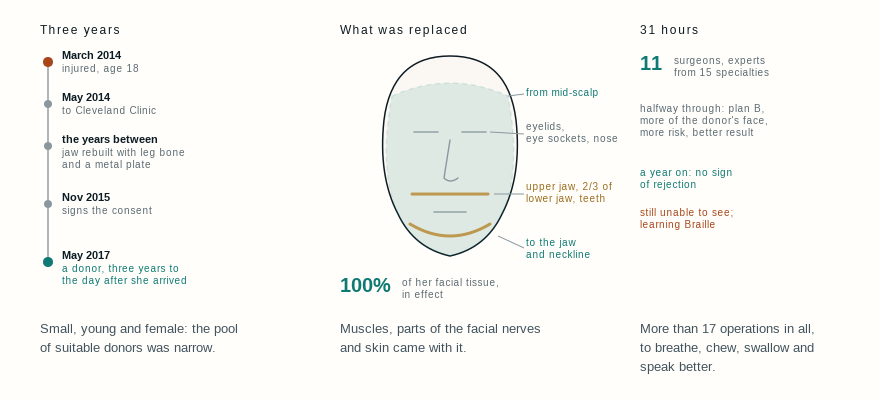 At 21, she became the youngest person in the United States to receive a new face.After a devastating facial injury at 18, Katie Stubblefield spent three years preparing for a 31-hour transplant that replaced, in effect, all of her facial tissue.Read it →
Want the next case like this?
When a new case is written up, it comes to your inbox: the story, the diagram and what it teaches. No schedule and no filler. Unsubscribe in one click.
Free · no spam · your address is never shared · built with KitBased on published reporting: the NYU Langone Health announcement (February 2021), including Dr. Eduardo D. Rodriguez and the patient; and the Associated Press report carried by CBS News (February 2021), for the accident and his recovery. The account is summarised in the author’s own words, and the background on composite tissue transplantation is from standard references. No photographs are reproduced. The diagram is original to MedicaseHub, is simplified, and may be reused freely under CC BY 4.0. This article is not medical advice. Read the full disclaimer.
Related cases
- At 21, she became the youngest person in the United States to receive a new face.Another full face transplant, after three years of preparation.
- He was not going blind from the fireA burned man who also lost his eyelids, and a face transplant to save his sight.
- Burn scar contracture: face healed to the chestWhat severe burns can do as they heal, and how surgery releases it.