He fell face-first onto a meat skewer. It went through his head and missed everything vital.
Ten-year-old Xavier Cunningham arrived at hospital awake and talking, with a metal skewer running from his cheek to the back of his head. The hard part was taking it out.
- Specialty
- Neurosurgery, otolaryngology, emergency care
- Patient
- Xavier Cunningham, 10, Harrisonville, Missouri
- Injury
- Metal rotisserie skewer through the face to the back of the head, September 2018
- Missed
- Brain, eye, spinal cord and the large arteries of the neck
- On arrival
- Awake, talking and not in pain
- Removal
- Planned by a team of about 100; 10 to 15 minutes in the operating room
- 5 years
- Complete recovery; in high school and the marching band
- 2018the fall
- the nightthe wait
- surgery15 minutes
- 5 yearsafter
"I thought it was an arrow"
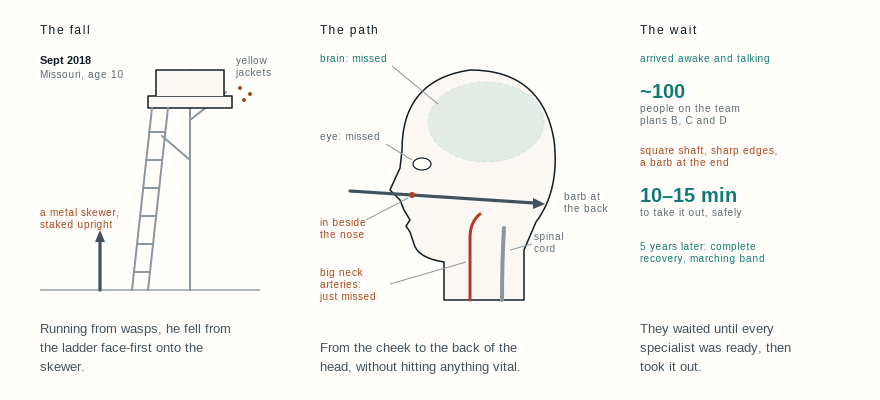
In September 2018, Xavier Cunningham, 10, was playing with friends at a treehouse near his home in Harrisonville, Missouri. Earlier, the boys had found a long metal rotisserie skewer and staked it upright in the ground, so nobody would step on it. Then a swarm of yellow jackets chased them out of the treehouse. Xavier fell from the ladder and landed face-first on the skewer.
It went in through his cheek, just below his eye and beside his nose, and ran all the way to the back of his head, where its barbed tip could be felt under the skin. When his mother saw him, her first thought was that someone had shot him with an arrow. According to his family, he was more worried about the yellow jackets than the skewer.
X-rays at the local emergency department showed how far it had gone. He was taken by ambulance to a children's hospital in Kansas City, and from there transferred to The University of Kansas Hospital, arriving late at night. He was wide awake, could talk, and was not in pain.
Plan B, plan C, plan D
The scans went to Dr. Koji Ebersole, the hospital's director of endovascular neurosurgery. He later said he was amazed the boy was alive, let alone awake and talking. The skewer had avoided his eyes and brain, and had come to rest immediately beside the major arteries of his neck. The head and neck surgeon on the team, Dr. Kiran Kakarala, said it was as close as it could be to those vessels without damaging them.
Taking it out was the dangerous part. The shaft was not round but square, with sharp edges and a barb at the end, and nobody knew whether it would slide out freely or had become firmly lodged. On the way out, it could tear one of those arteries. It had also gone through his jaw muscle, so he could not open his mouth wide enough for a normal breathing tube to be placed for the anaesthetic.
Because Xavier had arrived so late, Ebersole made a difficult decision: to wait, so that experts from several specialties could be there and plan the removal together. They prepared not only a plan but a plan B, a plan C and a plan D. In all, about 100 people were involved in his care.
Replicating a one-in-a-million shot
The removal was done in the hospital's interventional radiology suite, which has biplane X-ray imaging: two cameras that show blood vessels from two angles at once, so a damaged vessel can be seen and treated straight away. Kakarala described the skewer's path as a one-in-a-million shot, and said the team's job was to replicate that shot as they took it out.
They did. The operation took 10 to 15 minutes, and the skewer came out without any further damage. Shortly afterwards Xavier was sitting up in bed playing video games, with only a small bandage beside his nose. "I'm so happy to be alive," he said. Within days doctors said they expected a full recovery, and that he would be going home that week.
High school and the marching band
His mother said that hearing the story from the doctors' point of view made it seem even more of a miracle. Five years later, the hospital reported that Xavier had made a complete recovery. He was in high school, played in the marching band, and hoped one day to become an actor.
Why you leave it in
The first rule with an impaled object is not to pull it out at the scene. An object lodged in the body may be pressing on a torn vessel and holding back the bleeding; it may also lie right against a vessel it has not damaged, as in Xavier's case, and could tear it on the way out. Paramedics instead keep it still, padding and securing it so it cannot move, and take the patient to hospital with it in place.
In hospital, imaging such as CT, and often CT angiography of the blood vessels, shows exactly where the object lies and what it is touching. The removal is then planned like any other operation: in an operating room or interventional suite, with surgeons able to control bleeding immediately, blood ready for transfusion, and a safe way to keep the airway open.
The shape of the object matters too. A smooth, round rod can often be withdrawn along the path it took. Edges, barbs or a bent tip can tear tissue on the way out, which is why Xavier's team treated a 15-minute operation with so much care.
What this case teaches
Xavier Cunningham fell from a treehouse ladder onto a skewer staked in the ground, and it passed from his cheek to the back of his head without damaging his brain, eye, spinal cord or the large arteries of his neck. He arrived awake and talking, and nobody pulled the skewer out. Instead, a team of about 100 waited until every specialist was ready, planned for what could go wrong, and took it out in 10 to 15 minutes without further harm. Five years later he had made a complete recovery.
Was this case worth your time? Buy the next one a coffee ($3), or support MedicaseHub monthly.
Next case · MC-071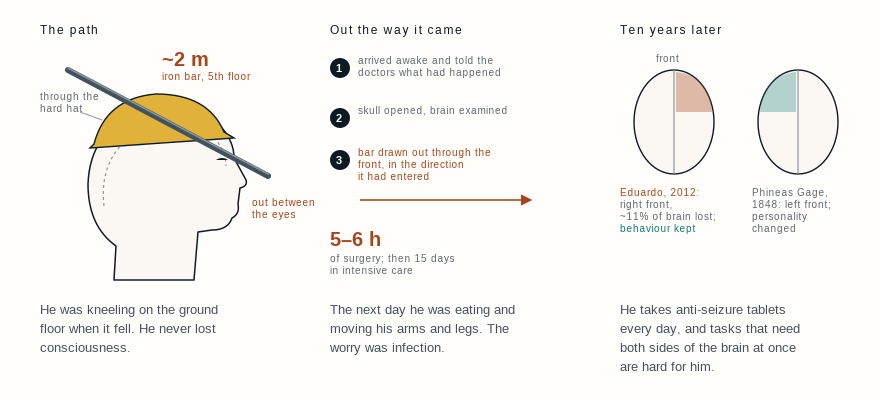 An iron bar fell five floors and went through his head. He arrived at hospital awake and talking.Eduardo Leite survived a bar through the front of his brain in 2012. He lost about 11% of it, and unlike Phineas Gage, his personality did not change.Read it →
Want the next case like this?
When a new case is written up, it comes to your inbox: the story, the diagram and what it teaches. No schedule and no filler. Unsubscribe in one click.
Free · no spam · your address is never shared · built with KitMain source: The University of Kansas Health System, “Teamwork enables safe removal of skewer from child’s face,” April 2019
Based on published reporting: The University of Kansas Health System (April 2019, and its later report “A miraculous recovery”), including Drs Koji Ebersole and Kiran Kakarala and the patient’s mother; and NBC News (September 2018). The account is summarised in the author’s own words, and the background on impalement injuries is from standard references. No photographs are reproduced. The diagram is original to MedicaseHub, is simplified, and may be reused freely under CC BY 4.0. This article is not medical advice. Read the full disclaimer.
Related cases
- An iron bar fell five floors and went through his head. He arrived at hospital awake and talking.Another object through the head, and another patient who could talk.
- A fish leapt out of the sea and speared him through the neck. He walked home holding it.A boy impaled through the neck, and why the object stayed in.
- The bull's horn went in under his chin and came out of his mouth. Ten weeks later he was back in the ring.Another path that just missed the big vessels of the neck.