His arm was hanging on by a strip of skin when he reached the operating room
A 26-year-old's car hit a barrier and rolled over. He arrived in shock with no measurable blood pressure, bleeding around his brain and his right shoulder torn open. Only once he was on the operating table did the surgeons see how little was still holding his arm on.
- Specialty
- Trauma surgery, orthopaedics, vascular surgery, neurosurgery
- Patient
- Man, 26
- Accident
- Car hit a barrier, then rolled over
- On arrival
- No measurable blood pressure; shoulder torn open with the shoulder blade exposed
- Other injuries
- Bleeding around the brain; a torn liver
- Operation
- The whole right arm removed with the shoulder blade (scapulothoracic disarticulation)
- Day 15
- Home, after 10 days in intensive care
- 7 months
- Healed, phantom pain eased, managing daily life; no prosthesis yet
- the crasha rollover
- ERno blood pressure
- theatrethree teams
- day 15home
- 7 monthsdischarged
Into a barrier, then over
The man, 26, was in a car that crashed into a barrier and then rolled over. He was conscious when the ambulance crew reached him, but his level of consciousness began to fall, so they put a breathing tube in before bringing him in.
He was taken to a public trauma referral hospital in Curitiba, in the state of Paraná, Brazil. The authors note that in Paraná alone, more than 6,000 people aged 20 to 29 were admitted to public hospitals after traffic accidents in 2022 and 2023, and more than 1,100 of them died.
No blood pressure to measure
In the emergency room his blood pressure could not be measured at all, and his heart was racing: he was in shock from blood loss. He was on a ventilator. His right shoulder and arm were badly torn open, with the shoulder blade exposed and the soft tissue around it destroyed.
PhotographHis right shoulder on arrival, torn open, with a chest drain in place. Very graphic. Tap to show.
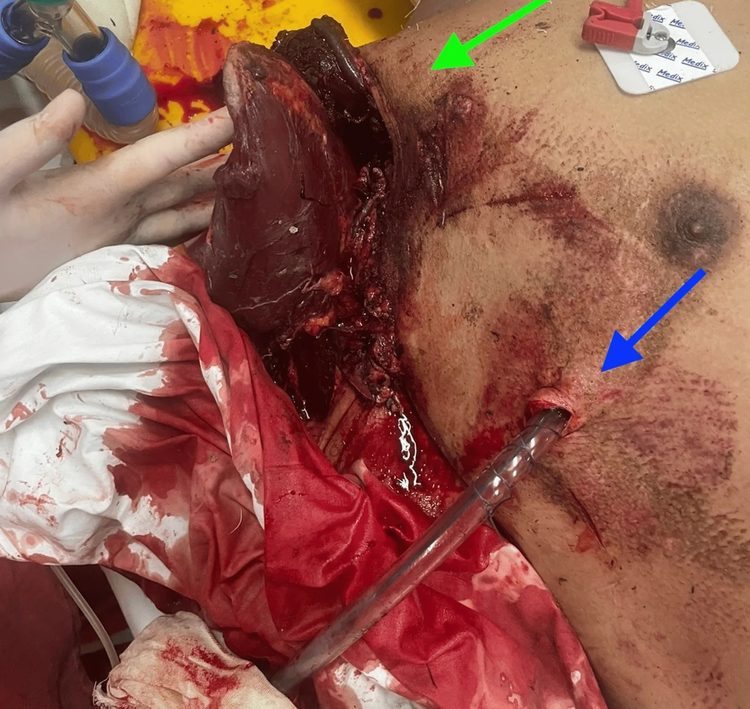
A quick bedside ultrasound showed no lung sliding on either side, a sign that can mean air or blood has collected around the lungs, so drains were put into both sides of his chest. A massive transfusion protocol was started: three units each of red blood cells, platelets and plasma, and tranexamic acid, a drug that slows the breakdown of blood clots.
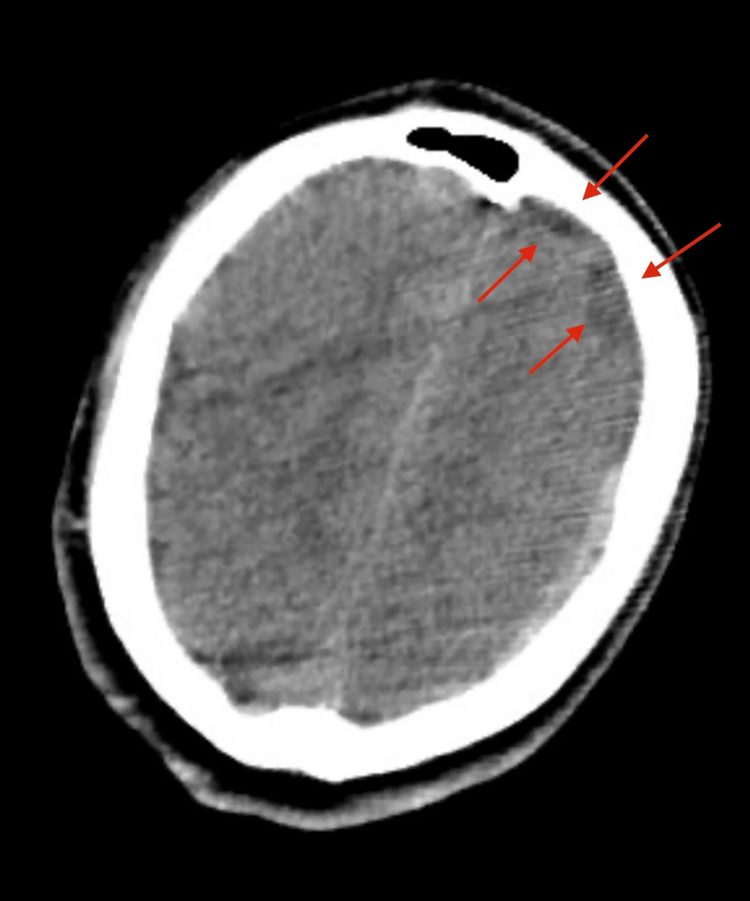
Once he was stable enough to be scanned, the CT showed an acute subdural haematoma, a collection of blood between the brain and its outer covering, pressing on the left side of the brain. His spine was not injured.
The brain, the abdomen, then the arm
Several teams operated in turn. The neurosurgeons drained the large haematoma and placed a catheter to monitor the pressure inside his skull. The general surgeons opened his abdomen and found a moderate amount of blood, a tear in the liver that was no longer bleeding, and a contained collection of blood behind the abdominal cavity on the right. Nothing else was injured, and they closed.
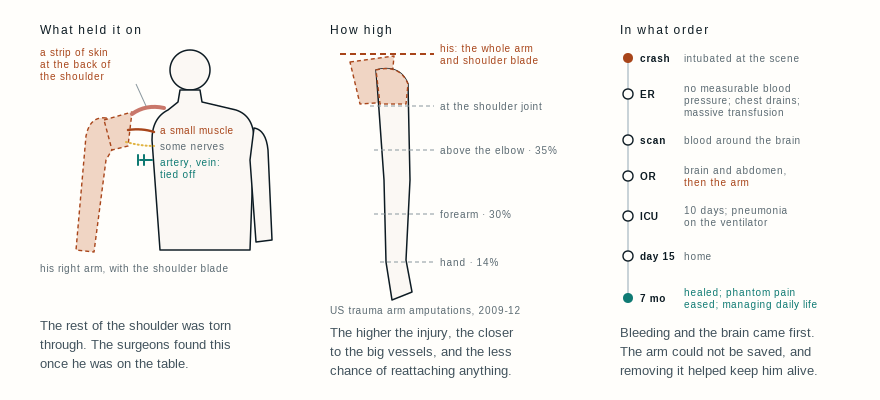
Then the team turned to the arm. Once he had been positioned on the table, they could see that his right arm was attached to his body only by a strip of skin at the back and top of the shoulder, one small shoulder muscle, the teres minor, and part of the brachial plexus, the bundle of nerves that runs from the neck into the arm.
The vascular surgeons tied off the subclavian artery and vein, the main vessels that carry blood to and from the arm. The orthopaedic surgeons then completed the removal of the limb. To give the stump a cushion of soft tissue and to let the skin close over it, they also removed the deltoid, the large rounded muscle of the shoulder, cut away the outer half of the collarbone, and attached the big chest muscle, the pectoralis major, to what was left of it.
PhotographThe whole arm after it was removed, with the shoulder blade still attached. Very graphic. Tap to show.
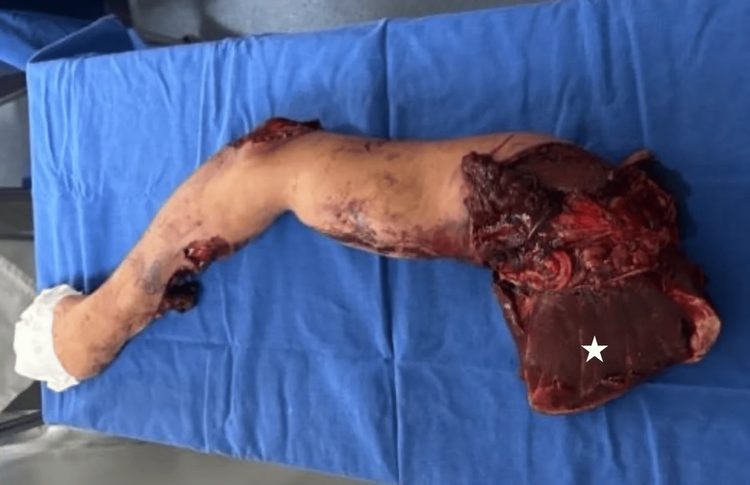
Reattaching it was never an option. The soft tissue, blood vessels and nerves were too badly destroyed, and he was too unstable. The authors also scored the injury with the Mangled Extremity Severity Score, a checklist used to judge whether a crushed limb can be saved. He scored 9: points for the high-energy crash, for an arm that was cold, paralysed and numb, and for blood pressure that stayed low. A score that high points towards amputation, though the authors stress that the score only supports the decision, which rests on the surgeons' judgement.
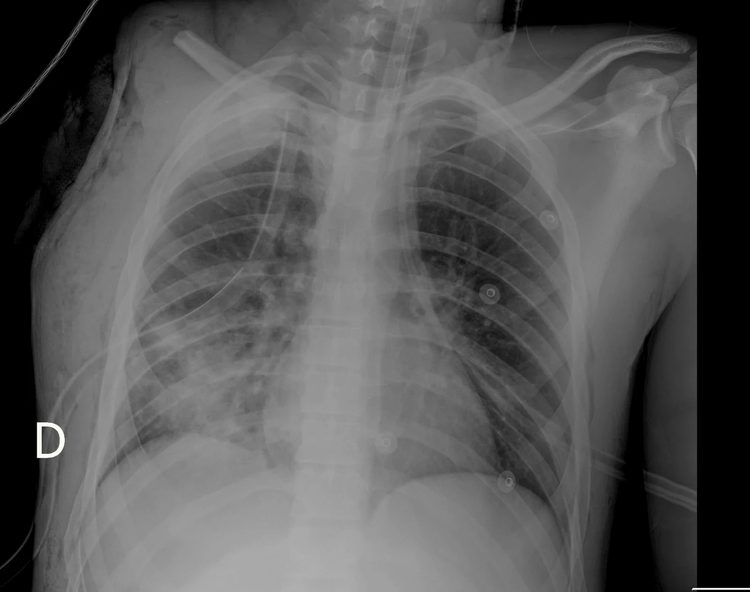
Ten days in intensive care
He went from theatre to the intensive care unit. There he developed pneumonia linked to the ventilator, which was treated with six days of antibiotics. After ten days he had improved enough to move to a ward.
He went home 15 days after he was admitted. He had phantom limb pain, pain felt in an arm that is no longer there, and was sent home on two medicines used for nerve pain, amitriptyline and gabapentin, along with a short, tapering course of diazepam. He was referred to the orthopaedic, vascular, neurosurgical and general surgery clinics and to a rehabilitation hospital.
Adapted, without an arm
At his first clinic visits the phantom pain was still there. He stayed on the medicines and started physiotherapy, and the pain gradually improved. None of the other specialties found any complications.
Seven months after the crash his wound had healed well, he had no significant pain, and he was discharged from follow-up. He had not yet been fitted with a prosthetic arm, but he was doing his everyday activities himself and, the authors write, had adapted to the amputation.
When an arm cannot be saved
Injuries that take off an arm are uncommon. The authors cite a United States study that found 1,386 major arm amputations after trauma between 2009 and 2012, about 46 for every 100,000 trauma admissions. The commonest level was above the elbow, in 35%, then the forearm, in 30%, and the hand, in 14%. Losing the whole arm at the shoulder is rarer still, and usually takes a high-energy force such as a car crash, an explosion or industrial machinery.
Reattaching an arm is attempted far less often than people imagine. Of 2,305 traumatic arm amputations in another North American analysis, only 22.3% had a replantation attempt, and most of those, 87.4%, were at the forearm. The closer an injury is to the shoulder, the bigger the vessels and nerves involved and the harder it is to reattach anything. In a patient who is bleeding heavily and has other life-threatening injuries, trying to save the limb can itself be dangerous, and removing it helps keep the patient alive.
The recovery is not only physical. The authors cite figures showing that at least one in three military amputees has depression and one in four has post-traumatic stress disorder, with even higher rates reported in civilians. They argue that psychologists, psychiatrists, occupational therapists and physiotherapists belong in the care of these patients from the start.
What this case teaches
A 26-year-old's car hit a barrier and rolled. He arrived with no measurable blood pressure, bleeding around the brain and a torn liver, and his right shoulder torn open. The teams dealt with the bleeding and the brain first. Only when he was on the operating table did they see that his arm was held on by a strip of skin, one small muscle and some of its nerves. They tied off the main vessels and removed the whole arm with the shoulder blade. He spent ten days in intensive care, went home on day 15, and seven months later had healed, with his phantom pain eased and his daily life back in his own hands. In severe trauma the order matters: the life comes before the limb, and when a limb cannot be saved, removing it is part of saving the patient.
Was this case worth your time? Buy the next one a coffee ($3), or support MedicaseHub monthly.
Next case · MC-049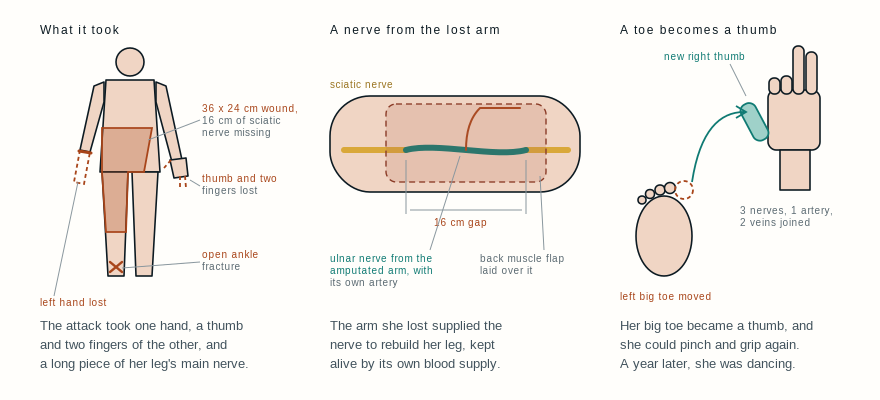 Her lost arm gave its nerve to her leg, and her toe became a thumbA shark attack took a woman's left hand, the thumb and two fingers of her right, and 16 cm of her sciatic nerve. Her surgeons rebuilt what they could from what the attack had left.Read it →
Want the next case like this?
When a new case is written up, it comes to your inbox: the story, the diagram and what it teaches. No schedule and no filler. Unsubscribe in one click.
Free · no spam · your address is never shared · built with KitRead the original paper: doi.org/10.7759/cureus.116815
Adapted from Augustini Farinazzo AC, Rodrigues Pasetto V, Cassilha B, Rocha A and colleagues, “Scapulothoracic disarticulation of the right upper limb after a car-to-obstacle collision: a case report,” Cureus 2026;18(9):e116815, from the Hospital Universitário Cajuru, Curitiba, Brazil. The crash, the emergency treatment, the operations, the hospital course and the seven-month result are as reported there, summarised in the author’s own words; the statistics, the scoring and the discussion of replantation and mental health are those the authors give in their introduction and discussion, and the anatomical explanations are from standard references. The photographs, CT and X-ray are reproduced from the paper under its Creative Commons Attribution licence (CC BY 4.0), resized; the first photograph has been cropped to remove part of the patient’s face. The diagram is original to MedicaseHub, is simplified, and may be reused freely under CC BY 4.0. This article is not medical advice. Read the full disclaimer.
Related cases
- Her lost arm gave its nerve to her leg, and her toe became a thumbAnother arm that could not be saved, and what surgeons made of what was left.
- They operated on the hand before they operated on himWhen a severed limb can be reattached, and the race against time to do it.
- The firework didn't go off, so he picked it up to fix itAnother limb injury where surgeons had to decide what could be kept.