The firework didn't go off, so he picked it up to fix it
A 21-year-old lit a firework and nothing happened. He went back to adjust it, and it exploded while it was still in his right hand. The blast split the hand down the middle. He was warned he could lose all of it. Surgeons saved two fingers.
- Specialty
- Hand surgery, trauma
- Patient
- Man, 21, right-handed
- Injury
- Firework blast to the right hand after a failed first ignition
- Damage
- Index, middle and ring fingers stripped to the bone; hand split; thumb dislocated at its base
- Wait for surgery
- 10 hours
- Operation
- Three fingers amputated at their bases; thumb put back and wired; little finger kept
- After surgery
- Stiffness, tingling, phantom pain in the missing fingers
- Day 12
- Home, with outpatient physiotherapy
- the blasta second try
- arrivala mangled hand
- 10 hourstheatre
- day 12home
The second attempt
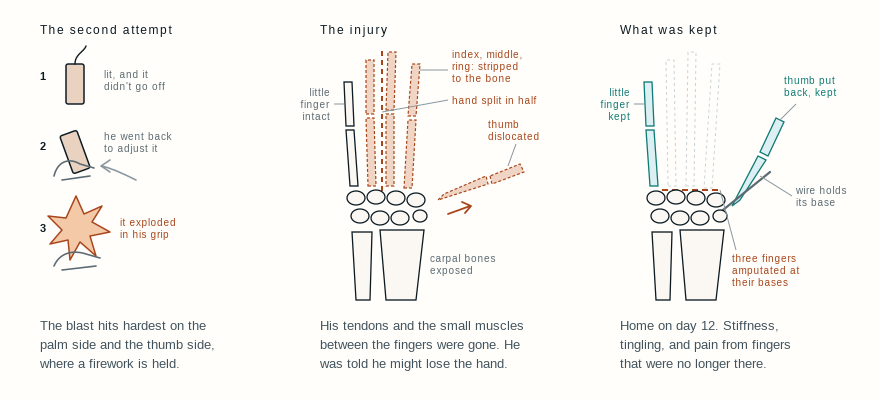
The man was 21, healthy and right-handed. He lit a firework and it failed to go off. He went back and tried to adjust it, and it exploded while he was still holding it in his right hand. The report is titled “Fourth of July hazards.”
Hands take most firework injuries, and the authors explain why a blast in the grip is so destructive. The explosion does damage three ways at once: heat burns the tissue, chemicals from the device contaminate it, and the force of the blast tears it apart and can throw debris faster than a bullet. The thumb and index finger are usually hit before the hand can let go, and the thumb can be forced backwards and outwards so hard that the web of skin between it and the index finger splits open.
A hand split in half
He came into the emergency department in severe pain, his right hand wrapped in gauze. He had no other injuries.
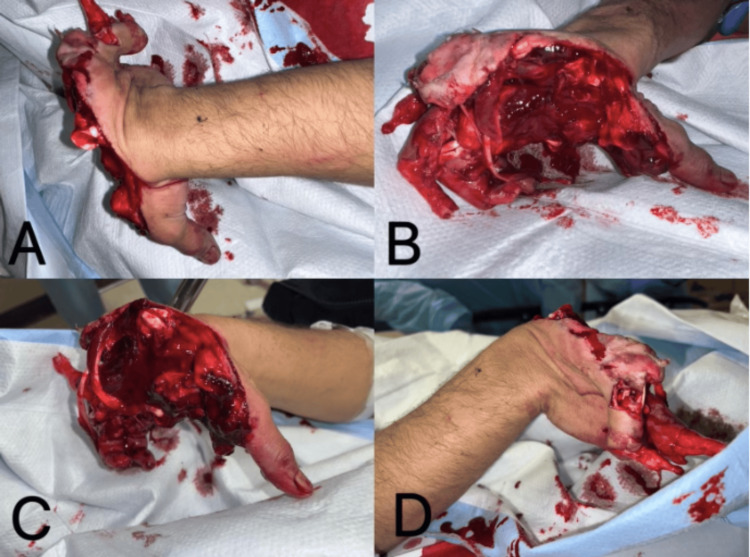
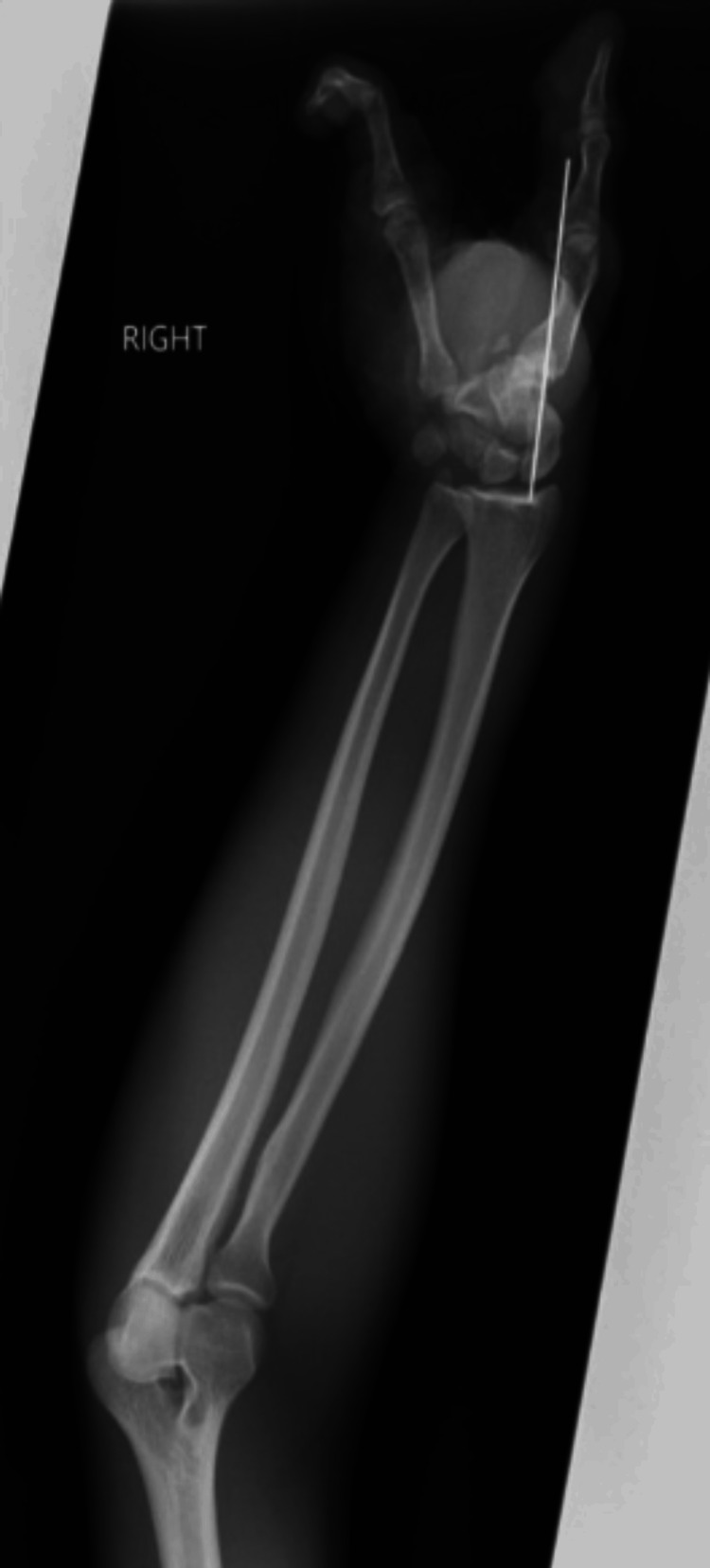
The doctors described a mangled extremity. The blast had split the hand in half. The index, middle and ring fingers were skeletonised, stripped down to the bone. Their tendons, both those that bend the fingers and those that straighten them, were partly missing and could not be repaired, and so were the small muscles that sit between the long bones of the hand and fine-tune finger movement. The rest of the hand was swollen and bleeding heavily.
The little finger and its metacarpal, the long bone in the palm that it sits on, were intact. The thumb was dislocated and pushed out to the side. The small bones of the wrist were exposed and out of their normal arrangement.
PhotographsHis hand on arrival, from four angles. Very graphic. Tap to show.
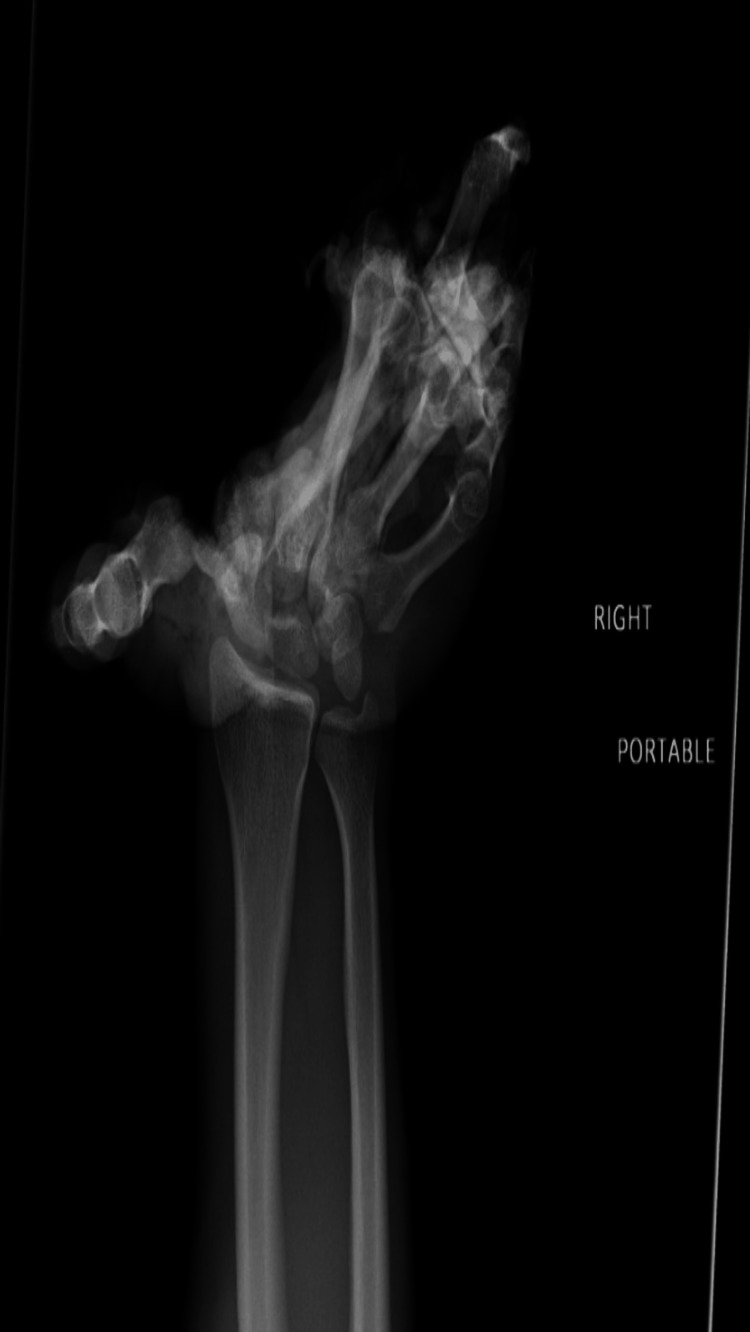
X-rays showed the thumb bent outwards at an extreme angle, a suspected dislocation at the base of its metacarpal, and disruption of the row of wrist bones where the metacarpals join them.
With that much tissue lost and the hand not working at all, the examination suggested he might need the whole hand amputated. He gave his consent knowing he could lose his dominant hand.
What could be kept
He reached the operating room after a ten-hour wait. The paper does not say why.
The three skeletonised fingers were amputated at the carpometacarpal joints, where the metacarpals meet the wrist. The torn tendons were trimmed away, and a flap of skin on the back of the hand was kept to close the wound. The hand was washed out with a pulsed jet of fluid. On the palm side, damaged tissue was cut away and bleeding was stopped with cautery.
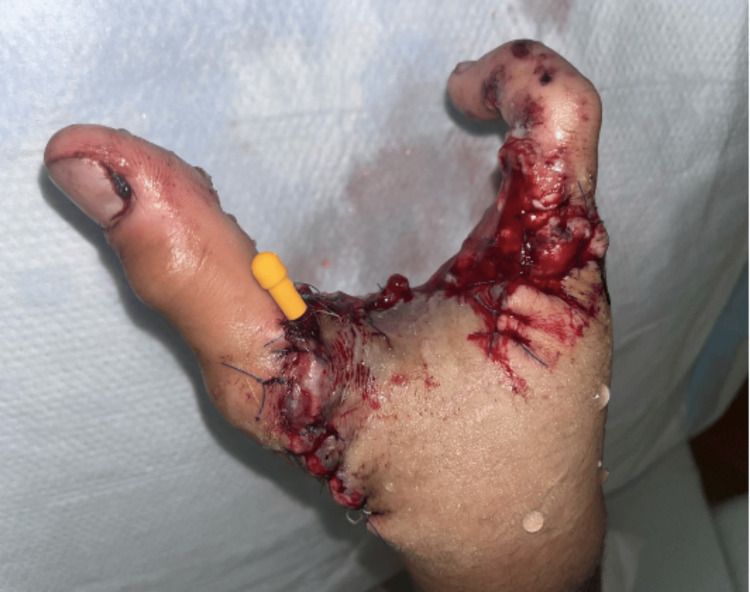
The thumb was saved. Its dislocated base was repaired with stitches, and Kirschner wires, thin steel pins drilled through the bone, were placed to hold the joint steady while it healed. The skin was closed with mattress stitches, a technique that spreads tension along the edges of a wound under strain. He was left with a thumb and a little finger. He was also given intravenous antibiotics, pain relief and fluids.
PhotographThe hand after surgery, with the thumb and little finger and the stitched wounds. Graphic. Tap to show.
Pain from fingers that were gone
After the operation he had pins and needles in what was left of his hand, and pain that came and went in the three fingers that had been amputated. That is phantom pain: pain felt in a part of the body that is no longer there. The authors cite a review estimating that about 60% of people who have an amputation experience it.
By the second day the hand was stiff and he could move his wrist only a little, and that stayed the same for the rest of his time in hospital. A physiotherapist started working with him. He went home on the twelfth day after surgery, with outpatient physiotherapy arranged. The report ends there; it gives no later result.
Why the first weeks decide the hand
Firework injuries mostly happen to the hand, and the authors cite figures showing they rose between 2018 and 2022, with males making up about two-thirds of the injured. This case followed the typical blast pattern: damage to the muscles at the base of the thumb, a dislocated thumb joint, and fingers torn off at their joints. The worst damage is usually on the palm side and the thumb side of the hand, the parts closest to the device.
The aim of surgery is set out in three words: debridement, revascularisation and bony stabilisation. Cut away dead and contaminated tissue, keep blood flowing to what is left, and hold the remaining bones in line so the hand can be rehabilitated. When the blood supply cannot be restored, amputation is what allows the wound to be closed and cared for.
Then comes stiffness. As injured hands heal, scar tissue forms in the joint capsules and around the tendons and can lock them in place. The authors stress splinting the hand in a position that keeps the ligaments stretched, and starting gentle movement early so the tendons keep gliding through their sheaths instead of sticking. Early surgery followed by early rehabilitation, they write, gives the best chance of a useful hand.
They also point to a possible link between how long damaged tissue is left in place and how often phantom pain develops, which they use to argue for early amputation and cleaning of the wound when a limb clearly cannot be saved. This patient still developed phantom pain.
What this case teaches
A 21-year-old lit a firework that failed to go off, went back to adjust it, and it exploded in his right hand. The blast split the hand, stripped three fingers to the bone and dislocated the thumb, and he was warned he might lose the whole hand. After a ten-hour wait, surgeons amputated the index, middle and ring fingers at their bases, put the thumb back and pinned it, and kept the little finger. He went home on day 12 with a stiff hand, pins and needles, and pain in fingers he no longer had, to continue physiotherapy. A firework that does not go off has not necessarily failed; it may simply not have gone off yet. And when a hand is badly damaged, what surgeons can save in the first operation is only the start: the outcome depends on months of rehabilitation afterwards.
Was this case worth your time? Buy the next one a coffee ($3), or support MedicaseHub monthly.
Next case · MC-059 His hand was still inside the meat grinder when he reached the operating roomA six-year-old's hand was pulled into a household meat grinder. Nobody could free it, so surgeons called the fire department to the operating room.Read it →
Want the next case like this?
When a new case is written up, it comes to your inbox: the story, the diagram and what it teaches. No schedule and no filler. Unsubscribe in one click.
Free · no spam · your address is never shared · built with KitRead the original paper: doi.org/10.7759/cureus.70657
Adapted from Saad G, Besada D, Capobianco J, Pagé J and Ahmad N, “Fourth of July hazards: a case report on a blast injury to the right hand in a 21-year-old male,” Cureus 2024;16(10):e70657, by authors from St. George’s University and hospitals in New York and New Jersey. The injury, the findings, the operation and the hospital course are as reported there, summarised in the author’s own words; the injury pattern, surgical principles, rehabilitation advice and phantom pain figures are those the authors give in their discussion, and the anatomical explanations are from standard references. Some drug doses in the paper appear to contain errors and are not repeated here. The photographs and X-rays are reproduced unchanged from the paper under its Creative Commons Attribution licence (CC BY 4.0). The diagram is original to MedicaseHub, is simplified, and may be reused freely under CC BY 4.0. This article is not medical advice. Never go back to a firework that has failed to go off: wait, keep away from it, and soak it in water before handling. Read the full disclaimer.
Related cases
- His hand was still inside the meat grinder when he reached the operating roomAnother hand that could not be saved in full, and an amputation planned around what was left.
- The machine pulled the skin off four fingers like a gloveAnother badly damaged hand, and what surgeons could keep.
- The chainsaw kicked back and cut him a second mouthAnother everyday tool, and the split second when it turned on its user.