The chainsaw kicked back and cut him a second mouth
A 36-year-old man was using a chainsaw when it kicked back into his face. The cut ran from his right eye down across his cheek and opened into his mouth, so wide that it looked like a second mouth. His anaesthetist had to get a breathing tube in safely, and ended up using the wound itself to give him oxygen.
- Specialty
- Anaesthesia, maxillofacial trauma
- Patient
- Man, 36
- Mechanism
- Chainsaw kickback into the face
- Wound
- Deep cuts of the right eyelid, inner corner of the eye, cheek and jaw, open into the mouth
- Fractures
- Right frontal bone, cheekbone, upper jaw and lower jaw
- Airway
- Awake intubation through the mouth, second attempt; oxygen through the wound
- First operation
- 106 min, blood loss 20 mL
- Jaw fixed
- Day 12
- Home
- Day 21, no complications
- arrivalthe wound
- theatrethe airway
- day 12the jaw
- day 21home
A second mouth
A 36-year-old man was referred to the Nagano Red Cross Hospital in Japan with facial injuries from chainsaw kickback.
Kickback is the most notorious way a chainsaw injures its user. If the moving chain at the upper part of the tip of the bar touches the wood, or something else, it can grab, and the saw is thrown violently up and back in an arc towards the person holding it. That arc ends at the head and face.
On arrival his blood pressure was 100/60, his pulse 60 and his oxygen saturation 99% on room air. The cut had laid open his right eyelid, the inner corner of his right eye, his cheek and his jaw, and the wounds were bleeding steadily from veins. The cut through the cheek went all the way into his mouth, and to the team it looked like a second mouth.
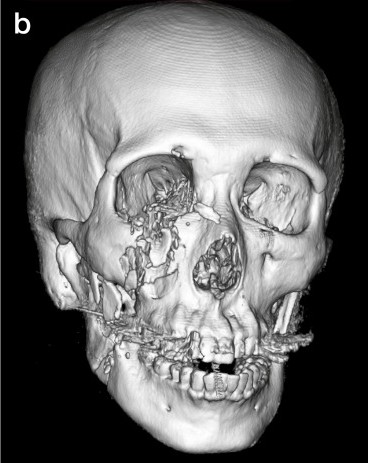
A CT scan showed that the saw had gone through bone as well as skin. The right frontal bone of the forehead, the right cheekbone, the maxilla, the bone of the upper jaw, and the mandible, the lower jaw, were all broken. There was no fracture of the base of the skull, no air inside the skull and no injury to the neck. He could open his mouth about 3 centimetres, although it hurt.
The anaesthetist’s problem
The wounds had to be repaired urgently under general anaesthetic. That meant first getting a breathing tube into his windpipe, and this is where the injury made things dangerous.
His anaesthetist listed three risks. Blood in the mouth and throat could make it hard to see the vocal cords and pass the tube. The hole through his cheek meant that the usual way of breathing for a patient with a mask, by sealing it over the face and squeezing a bag, might not work, because the air would leak out through the wound. And with fractures all through the middle of his face, it was uncertain whether it was safe to pass anything through his nose, the route normally used to give extra oxygen during a difficult intubation.
The answer to the first two risks was to intubate him awake. Under light sedation with a short-acting opioid, remifentanil, he kept breathing for himself and kept his own airway open while the tube went in. His throat and larynx were numbed with a lidocaine spray. The tube went through the mouth rather than the nose, and the anaesthetist used a video laryngoscope, a blade with a camera at its tip, to see past the blood.
The answer to the third risk was the wound. Instead of giving oxygen through the nose, the anaesthetist passed a thin suction catheter into the “second mouth” and ran oxygen through it at 10 litres a minute throughout. The view of the larynx was poor and there was blood around it, but the tube went in on the second attempt. His oxygen saturation stayed at 99 to 100% the whole time, and he did not inhale any stomach contents.
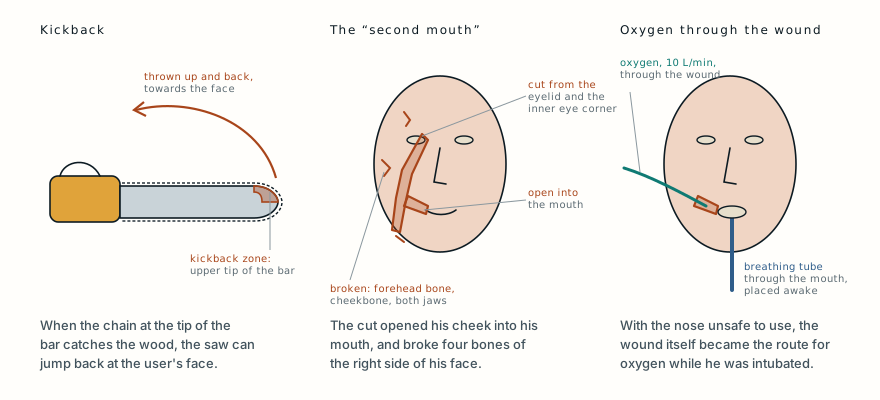
Once the tube was in, he was put fully to sleep and the surgeons repaired the lacerations. The operation took 106 minutes, and he lost only about 20 millilitres of blood.
Fixing the jaw
Twelve days after the first operation he had a second operation to set his broken right lower jaw and fix it with plates and screws, an open reduction and internal fixation.
Three weeks
He went home on the 21st day after the first operation, with no complications.
The report, written by his anaesthetist, is about getting him safely through those first minutes, and it does not include photographs of how his face healed or describe the long-term result for his eye and his facial nerve.
Chainsaws and faces
Most injuries of the face and jaws come from road accidents and assaults. Chainsaw injuries to the face are uncommon, and the author found very few reports of them. When they do happen, they typically cause deep soft-tissue cuts, sometimes with tissue torn away, along with fractures of the facial bones and damage to the teeth, which is the pattern this man had.
Awake intubation is the approach recommended by current guidelines whenever a difficult airway is expected, because the patient goes on breathing and protecting their own airway until the tube is safely in place. The author cites success rates of 88 to 100%, and evidence that a video laryngoscope does about as well for it as a flexible bronchoscope, with an advantage when there is blood in the airway. With low-flow oxygen during awake intubation, between 12 and 16% of patients see their oxygen saturation fall to 90% or below. Here, with oxygen running through the wound, his never fell.
The injury itself is largely preventable. Chainsaw safety guidance is consistent: modern saws have a chain brake designed to stop the chain when kickback happens, the tip of the bar should not be used to cut, the saw should be held firmly with both hands and kept below shoulder height, and users should wear a helmet with a face shield or visor, eye protection and cut-resistant clothing.
What this case teaches
A 36-year-old man’s chainsaw kicked back into his face, cutting his right eyelid, the inner corner of his eye, his cheek and his jaw, opening his cheek into his mouth like a second mouth and breaking his forehead bone, cheekbone and both jaws. To get a breathing tube in for surgery, his anaesthetist kept him awake and breathing, numbed his throat, used a video laryngoscope to see past the blood, and, because his nose was not safe to use, ran oxygen through a catheter in the cheek wound. The tube went in on the second try with his oxygen never falling, the wounds were repaired with almost no blood loss, his jaw was fixed on day 12 and he went home on day 21. The most dangerous moment after a face injury is often not the repair but the airway, and the best fix is the one that uses what the injury has left.
Was this case worth your time? Buy the next one a coffee ($3), or support MedicaseHub monthly.
Next case · MC-031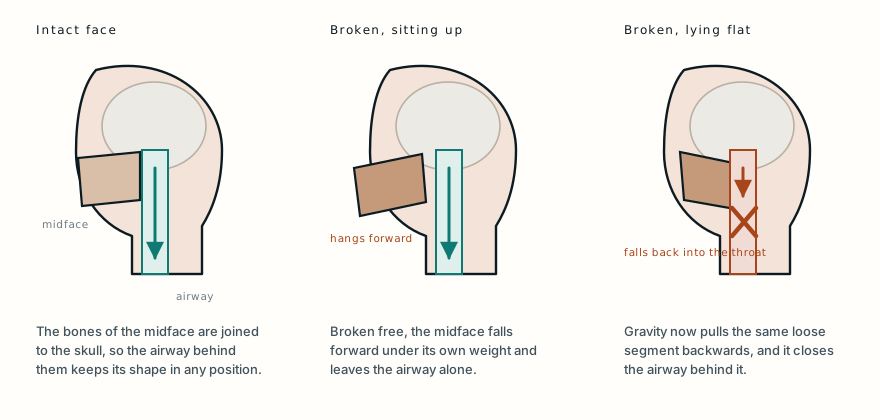 He could breathe sitting up, but not lying downHis face hit the steering wheel and the midface came away from the skull. The position he was holding on arrival was the finding that mattered most.Read it →
Want the next case like this?
When a new case is written up, it comes to your inbox: the story, the diagram and what it teaches. No schedule and no filler. Unsubscribe in one click.
Free · no spam · your address is never shared · built with KitRead the original paper: doi.org/10.7759/cureus.45064
Adapted from Wakabayashi R, “Airway Management of a Patient With Penetrating Maxillofacial Trauma Caused by Chainsaw Kickback: A Case Report,” Cureus 2023;15(9):e45064, from the Nagano Red Cross Hospital, Japan. The injuries, scan findings, airway plan and technique, the operations and the hospital course are as reported there, summarised in the author’s own words; the figures on awake intubation are those the author cites, and the explanations of kickback, the anatomy and chainsaw safety are from standard references. The paper is published under the Creative Commons Attribution licence (CC BY 4.0), and the author reports written consent from the patient. The CT image here is cropped from Figure 1 under that licence; the photograph of the wound in the same figure is not reproduced. The diagram is original to MedicaseHub, is simplified, and may be reused freely under CC BY 4.0. This article is not medical advice. Read the full disclaimer.
Related cases
- He could breathe sitting up, but not lying downAnother broken face where the airway was the first problem.
- The bear went for his face, and left its tooth marks in his skullAnother face torn open, and the bones broken beneath it.
- Half his face was torn away. It was all put back in one operation.Another face injury repaired in one sitting.