His hand was still inside the meat grinder when he reached the operating room
A six-year-old boy was helping his father prepare food when his right hand was pulled into a household meat grinder. Paramedics could not free it, and neither could the surgeons. Three and a half hours after the accident, it took the fire department, called to the hospital, to get his hand out.
- Specialty
- Plastic surgery, paediatric trauma
- Patient
- Boy, 6, right-handed
- Where
- At home, helping his father prepare food
- Injury
- Right hand trapped in a household meat grinder
- Trapped for
- About three and a half hours, 19:00 to 22:30
- Freed by
- The fire department, turning the grinder's screw forwards with a large wrench
- Operation
- Amputation at the carpometacarpal joints; the wrist was kept
- 72 hours
- Home
- 3 months
- Fitted with a prosthesis; riding a bike and an ATV
- 19:00the kitchen
- 20:10still attached
- 21:40calling 911
- 22:40the hand
- 3 monthsa prosthesis
Helping his father
The boy was six, healthy and right-handed. At about seven in the evening he was helping his father prepare food at home when his right hand became caught in a household meat grinder.
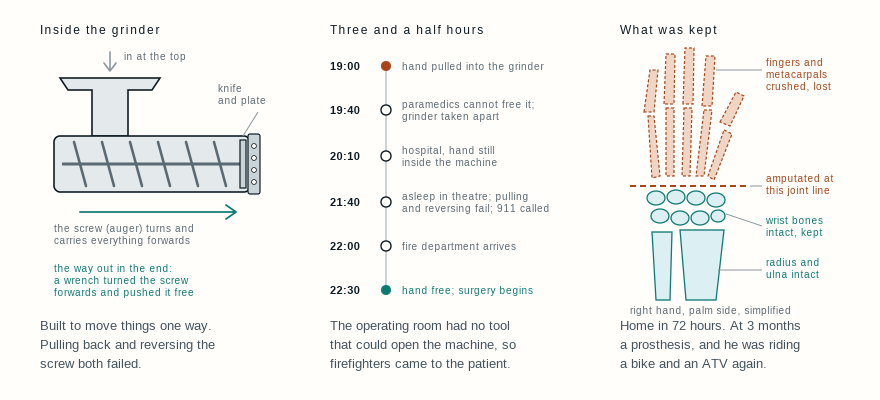
A meat grinder is built to move things one way. Food goes down a feed tube into a barrel, where a turning screw, called the auger, carries it forward to a knife and a metal plate full of holes at the far end, which cut it and push it out. The authors note that children are especially at risk: a smaller hand can be drawn further into the mechanism.
Paramedics reached the house twenty minutes later. At 19:40 they tried to free his hand and could not. The grinder was taken apart, and he was taken to hospital with his hand still lodged inside it.
The machine was holding back the bleeding
He arrived at 20:10. The trauma team was activated and the plastic surgeons were paged. He was stable, and a full check found no other injuries.
He was bleeding very little. The authors put that down to the grinder itself: clamped around his hand, it was pressing hard on the injured tissue.
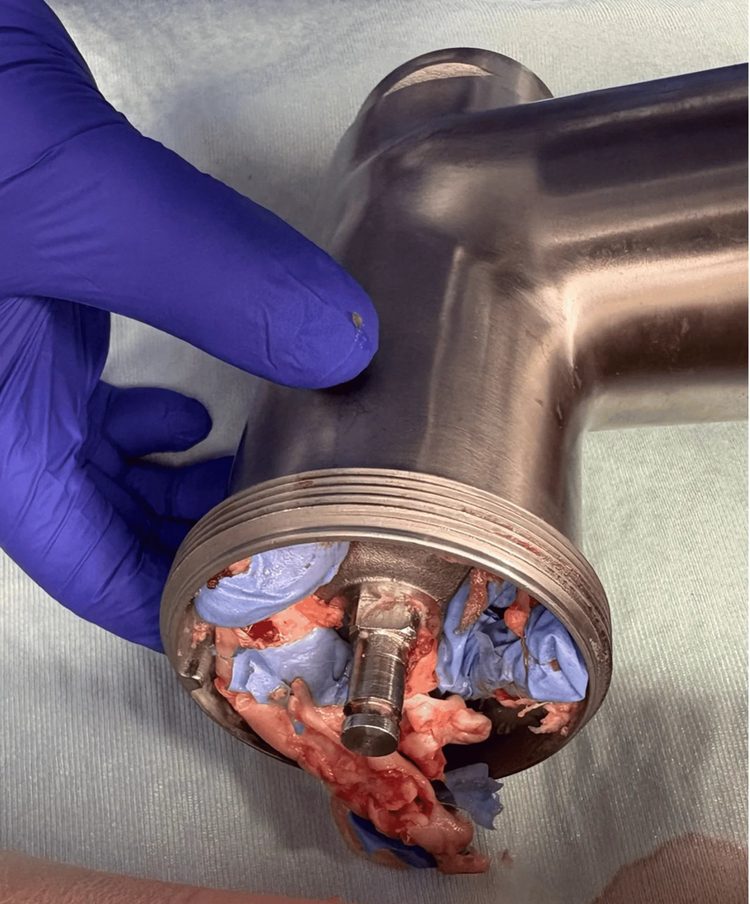
There was no safe way to free him in the emergency department, so he was booked for the operating room as the most urgent category of case. At 21:20 he was put under general anaesthesia and given intravenous antibiotics. Only then could the surgeons examine the device properly. A mangled part of his hand was sticking out of the far end of the grinder, and how badly the rest was hurt could not be seen.
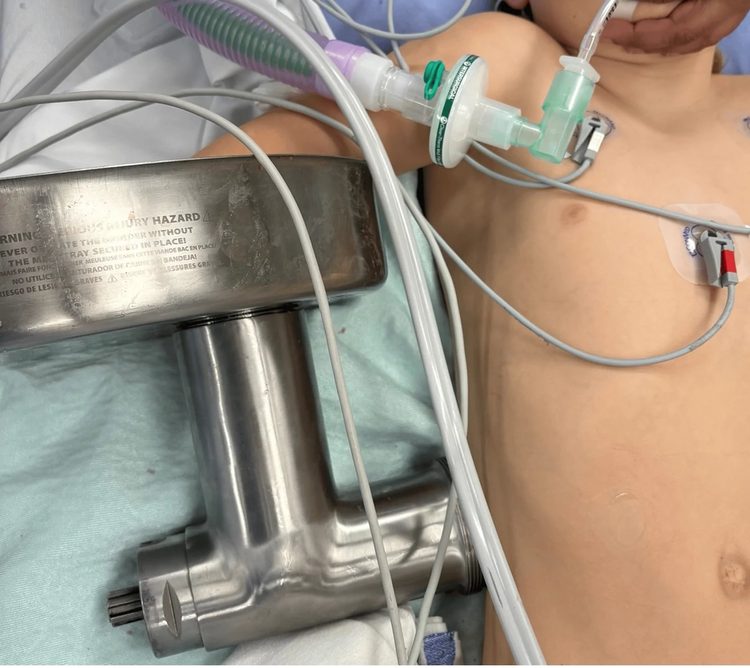
PhotographThe far end of the grinder, with crushed tissue from the hand pushed through it. Graphic. Tap to show.
The surgeons called the fire department
The first attempts were gentle. The surgeons tried pulling the hand out slowly and tried turning the grinder's mechanism backwards. Neither worked. Pulling harder risked crushing and tearing more of what was left.
The next step would have been to cut the grinder open, and the operating room had no tool that could do it. So at 21:40 the team called 911 from the operating room.
Firefighters arrived at 22:00. The boy, still asleep with a breathing tube in and fully monitored, was moved to a procedure room next door so they could assess the machine and bring their equipment in. The options discussed included pulling with much more force, or welding the grinder and prying it open.
In the end they did what the machine was designed to do. Using a large wrench, with the firefighters' help, they turned the auger forwards, and at 22:30 the turning screw pushed his hand free. The stump bled, but the tissue beyond it barely oozed at all, a sign that it was no longer alive.
Nothing beyond the wrist could be saved
He was taken straight back into the operating room. With a tourniquet on his upper arm to control bleeding, the wound was washed out thoroughly.
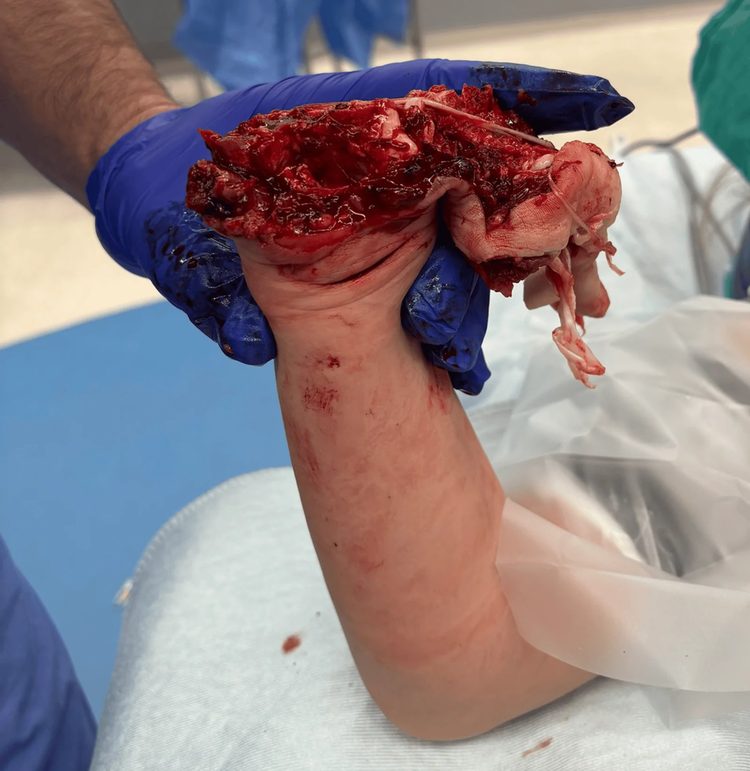
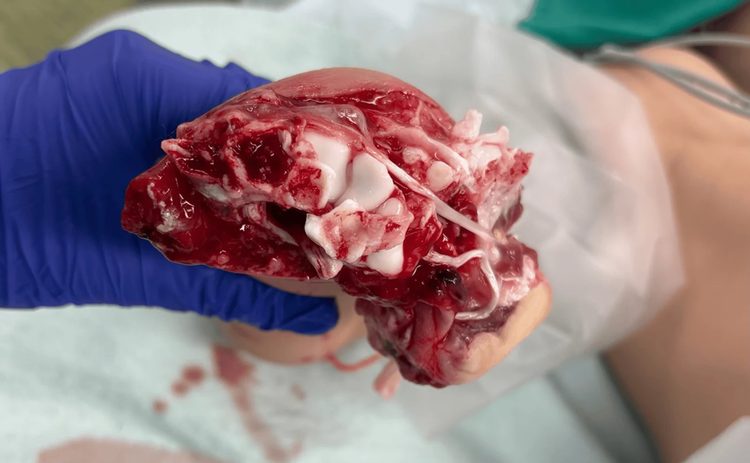
The hand had been destroyed back to the carpometacarpal joints, where the long bones of the palm, the metacarpals, meet the small bones of the wrist. The soft tissue was not viable and the bones were broken into many pieces. There was also a shallow cut across the palm side of the wrist.
PhotographsHis hand after it was freed from the grinder. Very graphic. Tap to show.
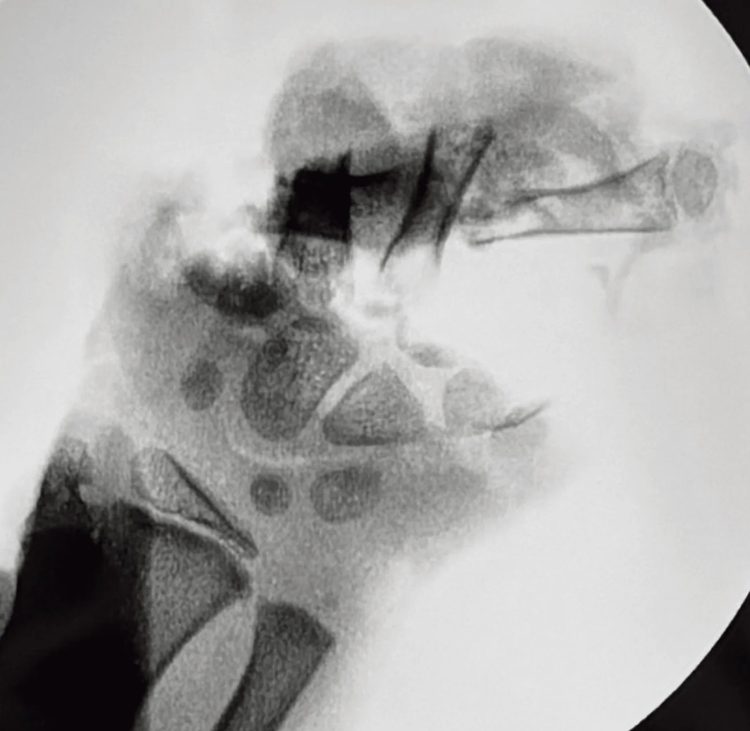
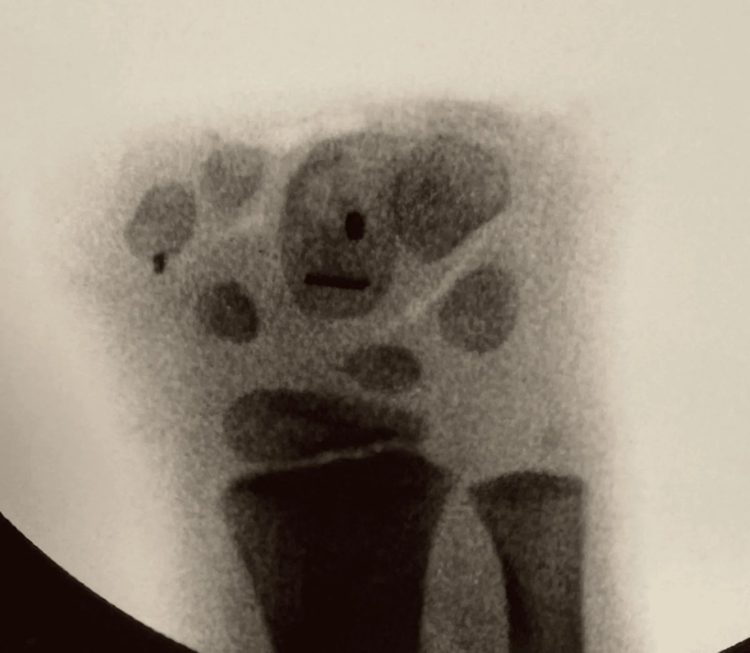
X-rays taken during the operation showed what could be kept. The carpal bones of the wrist were intact, and the joint between the two forearm bones at the wrist was stable. The destruction stopped at the metacarpals.
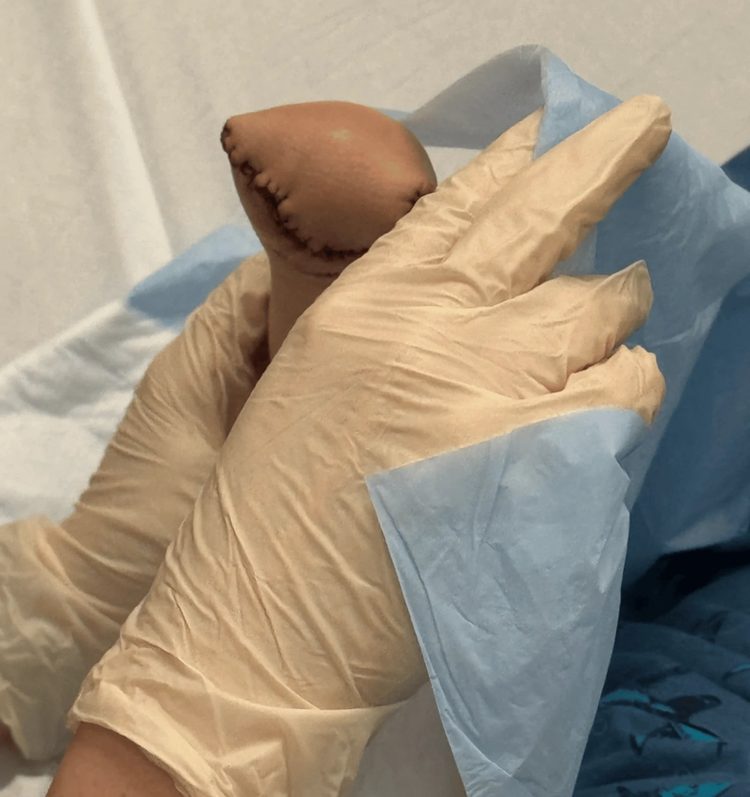
Reconstruction was not possible, so the surgeons amputated at the carpometacarpal level. They removed the dead bone and cleaned away damaged tissue. The nerves they could see were pulled gently, cut and allowed to slip back out of the wound, a technique meant to lower the risk of a painful nerve swelling, a neuroma, at the stump. They kept the healthy skin from the back of the hand and brought it over the end to close the wound with his own skin.
The operation ended at 00:15. He lost very little blood, needed no transfusion, and had his breathing tube removed in the operating room. A nerve block was placed to control pain afterwards.
Back on a bike
He was admitted for observation, and psychologists, occupational therapists, rehabilitation doctors and the prosthetics team were involved from the start. He went home 72 hours after the operation. Scar massage and desensitisation, gradually getting the stump used to touch, began early.
Three months after the operation he was fitted with a general-purpose prosthesis, and with it he went back to riding his bicycle and an all-terrain vehicle. He was also given a sport-specific "broomstick" prosthesis so he could play hockey and lacrosse. Adapted equipment, changes at school and modified clothing helped him do everyday things on his own.
At his most recent check-up he had no phantom limb pain and no painful neuroma. He had adapted well, and his surgeons do not expect him to need any further operation on the stump.
Why meat grinders do so much damage
Meat grinder injuries to the hand are rare. A recent systematic review the authors cite found only a small number of published patients over fifty years. They are among the most destructive hand injuries there are, because the machine crushes, tears, twists and shears at the same time. Most patients in the published reports needed extensive removal of damaged tissue or an amputation; reattaching or rebuilding the hand with microsurgery was possible only in carefully chosen cases.
Children's hands are drawn in further, so their injuries often reach past the fingers into the palm and the wrist. Earlier reports describe freeing a trapped hand by running the auger backwards, partly taking the grinder apart, or cutting through its housing with special equipment. What makes this case unusual, the authors write, is that the hardest part was not the surgery but getting the machine off once those methods had failed, with no suitable tools in the operating room.
Their lessons are practical. Do not keep pulling when a trapped limb resists, because that adds crushing and tearing to the injury. Recognise early when rescue equipment or expertise will be needed and call for it, rather than repeating attempts that are not working. Leave decisions about what can be saved until the limb is free and can be seen. And prevent it in the first place: supervise children while food is being prepared, and keep pushing for safer grinder designs.
What this case teaches
A six-year-old boy's right hand was pulled into a household meat grinder while he helped his father cook. Paramedics could not free it, and he reached hospital with the grinder still on his hand. In the operating room, gentle pulling and reversing the mechanism both failed, and there was no tool that could cut the machine open, so the surgeons called 911. With the fire department's help, a large wrench turned the screw forwards and pushed the hand out, three and a half hours after the accident. Nothing beyond the wrist could be saved, and he had an amputation at the carpometacarpal joints, keeping his wrist. He went home after three days, and three months later he was riding a bike with a prosthesis. Sometimes the hardest part of an emergency operation is getting a machine off the patient, and knowing when to call for help from outside the hospital.
Was this case worth your time? Buy the next one a coffee ($3), or support MedicaseHub monthly.
Next case · MC-056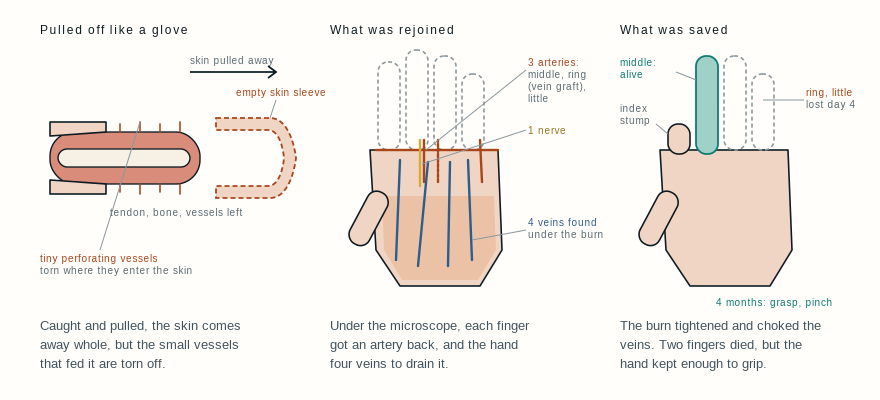 The machine pulled the skin off four fingers like a gloveA factory machine caught a man's hand and stripped the skin off four fingers in one piece. His surgeons replanted them rather than amputate, and a burn decided the rest.Read it →
Want the next case like this?
When a new case is written up, it comes to your inbox: the story, the diagram and what it teaches. No schedule and no filler. Unsubscribe in one click.
Free · no spam · your address is never shared · built with KitRead the original paper: doi.org/10.7759/cureus.114658
Adapted from Ross K, Carruthers C and Leblanc M, “Intraoperative extrication of a pediatric hand entrapped within a household meat grinder: a case report,” Cureus 2026;18(8):e114658, from the Division of Plastic and Reconstructive Surgery at Dalhousie University, Halifax, Canada. The timeline, the attempts to free the hand, the operation, the recovery and the lessons are as reported there, summarised in the author’s own words; the description of how a meat grinder works and the anatomical explanations are from standard references. The photographs and X-rays are reproduced from the paper, resized but otherwise unchanged, under its Creative Commons Attribution licence (CC BY 4.0). The diagram is original to MedicaseHub, is simplified, and may be reused freely under CC BY 4.0. This article is not medical advice. If a hand is caught in a machine, switch it off and unplug it, do not try to pull the hand out, and call emergency services. Read the full disclaimer.
Related cases
- The machine pulled the skin off four fingers like a gloveAnother hand caught in a machine, and what surgeons could save.
- They operated on the hand before they operated on himA severed hand that could be reattached, and the race against time to do it.
- His thumb lived on the back of his other hand for five monthsAnother hand injury, and an unusual way to keep a part alive.