He fell 20 metres, and a piece of wood ended up completely inside his chest
An arborist fell about 20 metres while cutting down a tree. On the outside he had one small hole in his chest and a swelling on his back. Inside, a piece of wood 24 centimetres long was lying in his left lung.
- Specialty
- Trauma surgery, thoracic surgery
- Patient
- Man, 39, arborist
- Accident
- Fell about 20 m when his harness stayed attached to the section of tree being felled
- On the outside
- A small hole in the left chest; a swelling on the back
- On CT
- A 24 × 3 cm piece of wood inside the left lung; broken ribs; blood in the chest
- Operation
- Chest opened; lung divided along the track with a stapler; wood lifted out; both lobes kept
- Day 18
- Home
- 1 year
- Back at full-time work, no limitations
- the fall20 metres
- arrivalone small hole
- theatregetting it out
- 1 yearback at work
Tied to the part of the tree that fell
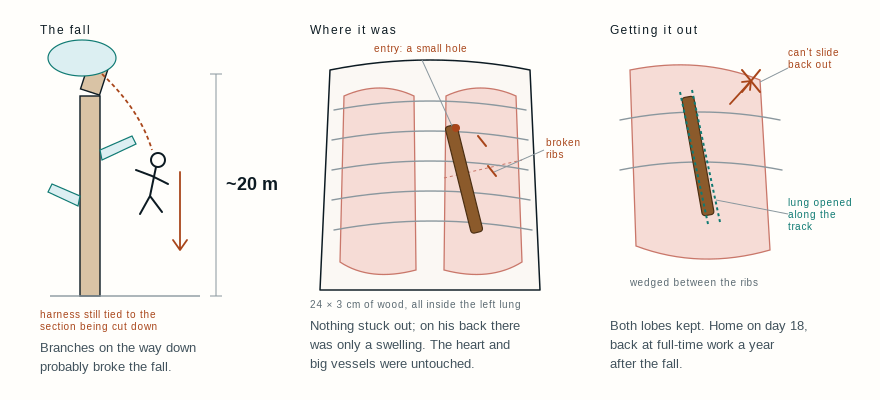
The man was 39, healthy, and worked as an arborist. He was cutting down a tree when part of his two-point safety harness stayed attached to the section of trunk he was felling. When that section came down, it took him with it, and he fell about 20 metres. The authors think it probably hit other branches on the way down, which took some of the energy out of the fall.
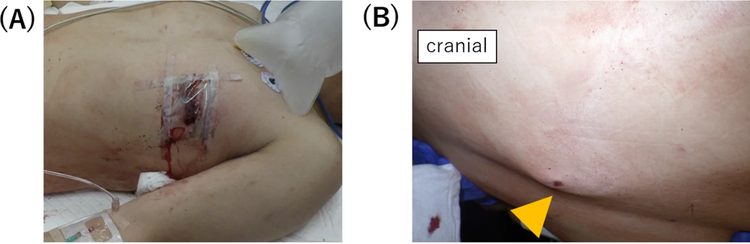
At the scene, the paramedics found a small open wound on the front of the left side of his chest, with air leaking through it. They covered it with a dressing taped on three sides, which lets air escape from the chest but stops more air being sucked in. He stayed stable and was flown by helicopter to the Advanced Critical Care Center at Gifu University Hospital in Japan.
Nothing sticking out
He arrived fully alert, breathing and with a stable circulation. On the front of his chest there was the small wound, with a little air trapped under the skin around it. On the left side of his back there was a tender swelling. There was no object to be seen anywhere.
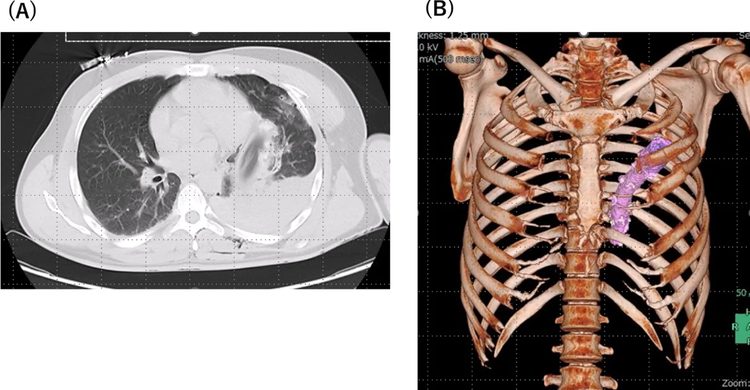
The CT scan showed what the outside did not. A piece of wood 24 centimetres long and 3 centimetres across was lying completely inside his left lung. Three ribs were broken, the fourth and fifth at the front and the ninth at the back, the upper lobe of the lung was bruised, and there was a moderate amount of blood in the chest. A scan with contrast showed no bleeding vessel and no injury to the heart or the great vessels.
A three-dimensional reconstruction explained the puzzle. The wood had gone in through the small hole at the front and then lay along a different line inside the chest, which is why nothing could be seen or felt from the outside. Wood is also hard to see on an ordinary X-ray, because it lets X-rays through almost as easily as soft tissue.
It could not go back the way it came
An object stuck in the body is never pulled out at the scene, because it may be plugging a damaged blood vessel. Wood brings a second danger: it carries soil, bark and bacteria, so it has to come out completely and the wound has to be cleaned thoroughly. The team took him to theatre and opened the left side of his chest between the ribs, positioned and prepared in case of heavy bleeding.
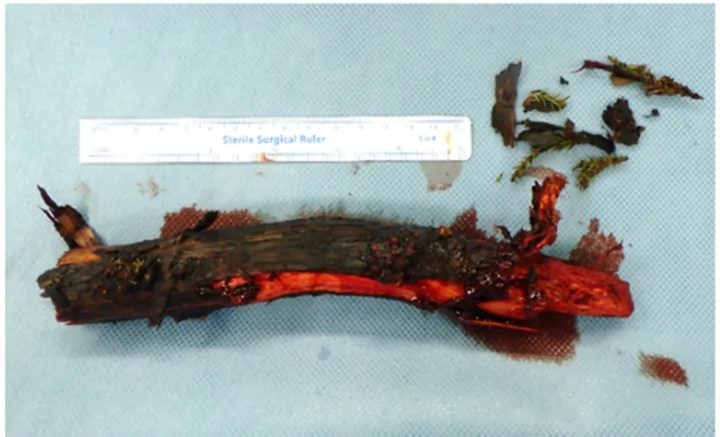
Inside, the wood ran from the bottom of the upper lobe of the left lung into the middle of the lower lobe, and it was wedged firmly between the ribs. It could not be slid back out along the line it had gone in.
PhotographThe open chest during the operation, with a stapler along the track of the wood. Graphic. Tap to show.
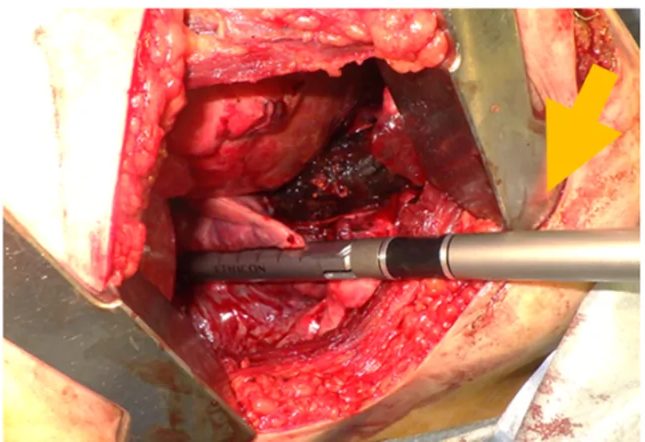
So instead of pulling it, they opened the lung along the track. This is called a tractotomy: a long surgical stapler is passed along the path of the object and fired, dividing the lung tissue over it and sealing the cut edges at the same time. That laid the wood open so it could be lifted out under direct vision, and let the surgeons look at the airways and vessels along the track. The alternative, cutting out part or all of a lobe, would have taken healthy lung with it.
The wood came out in one piece, with bits of plant and soil still stuck to it. The chest was washed out with large amounts of warm saline until no visible dirt was left, and every remaining fragment of wood and plant was picked out.
Back at full-time work
Because wood is so heavily contaminated, he was given strong intravenous antibiotics for two weeks and then antibiotic tablets for two more. His breathing tube came out on the second day after surgery and his chest drain on the third. He went home on day 18 with no complications.
CT scans at 1, 4, 16 and 32 weeks showed the bruising in his lung clearing completely, with no abscess, no pus around the lung and no collapsed lung. A year after the fall one rib had still not knitted together, but there was no sign of infection. He had no limitations in daily life and had gone back to work full time.
Why wood is different
Impalement injuries are rare, about 0.14% of all trauma cases in the figures the authors cite, and most come from falls from a height or industrial accidents. Wood inside the chest is rarer still, and it brings problems that metal does not.
The first is seeing it. Metal shows up brightly on X-rays and CT. Wood does not, and how it looks on CT changes with how wet it is, so a piece of wood can be missed or its size underestimated. In this case the small skin wound gave no clue to what lay inside; only a CT with a three-dimensional reconstruction showed the full length and the path it had taken.
The second is infection. Wood carries bacteria and fungi from soil and bark, and fragments left behind can cause an abscess or pus around the lung weeks later. That is why the authors stress long courses of broad-spectrum antibiotics, washing the chest out thoroughly and removing every visible fragment.
The third is getting it out without losing lung. Tractotomy was first used as a lung-saving alternative to lobectomy for gunshot and stab wounds of the lung. In this patient it let the surgeons remove a large, wedged object and keep both lobes of a healthy lung.
What this case teaches
A 39-year-old arborist fell about 20 metres when his harness stayed attached to the section of tree he was cutting. He arrived with a small hole in his chest and a swelling on his back, and no object in sight, but CT showed a 24-centimetre piece of wood lying completely inside his left lung. It was wedged between his ribs, so the surgeons opened the lung along its track with a stapler, lifted it out, washed the chest clean and kept both lobes. He went home on day 18 and was back at full-time work a year later. A small wound can hide a very large object, especially when the object is wood, and what is stuck in the body stays there until surgeons can take it out under direct vision.
Was this case worth your time? Buy the next one a coffee ($3), or support MedicaseHub monthly.
Next case · MC-057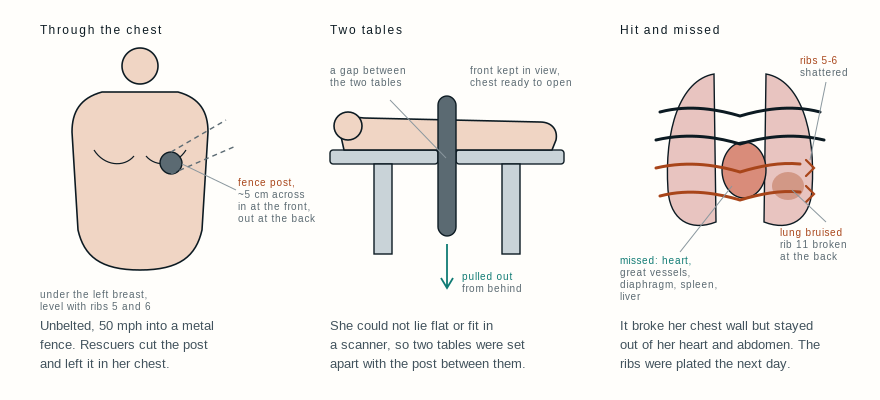 She arrived with a fence post through her chestAn unbelted driver hit a metal fence and a post went through her lower chest. Rescuers cut it and left it in. Removing it took two operating tables.Read it →
Want the next case like this?
When a new case is written up, it comes to your inbox: the story, the diagram and what it teaches. No schedule and no filler. Unsubscribe in one click.
Free · no spam · your address is never shared · built with KitRead the original paper: doi.org/10.1186/s12245-026-01310-1
Adapted from Wakayama Y, Fukuta T, Makigano H and colleagues, “Successful lung-preserving tractotomy to treat intrathoracic wood impalement after high-fall trauma: a case report,” International Journal of Emergency Medicine 2026;19, from the Advanced Critical Care Center, Gifu University Hospital, Japan. The fall, the findings, the operation, the aftercare and the one-year result are as reported there, summarised in the author’s own words; the points about wood, infection and tractotomy are those the authors make in their discussion, and the anatomical explanations are from standard references. The photographs and CT are reproduced from the paper under its Creative Commons Attribution licence (CC BY 4.0); the photographs were cropped from a single four-panel figure and resized. The diagram is original to MedicaseHub, is simplified, and may be reused freely under CC BY 4.0. This article is not medical advice. If something is stuck in someone, do not pull it out: keep it still and call emergency services. Read the full disclaimer.
Related cases
- She arrived with a fence post through her chestAnother object through the chest, and an operation built around getting it out safely.
- They cut the branch down. Nobody pulled it out.Another piece of wood left in place until surgeons could remove it.
- It ran from his pelvis to his neck and missed every major vesselAnother impalement that should have been fatal, and wasn't.