He cut his hand off cleaning a guillotine. Surgeons spent almost seven hours putting it back.
A 69-year-old man was cleaning a metal-cutting guillotine at home when it took off his right hand at its base. He was in hospital 25 minutes later, and the hand was reattached.
- Specialty
- Hand surgery, microsurgery
- Patient
- Man aged 69, right-handed, no relevant medical history
- Injury
- Right hand cut off completely where the hand bones meet the wrist, by a metal-cutting guillotine
- On arrival
- About 25 minutes after the injury; stable and fully alert; active bleeding
- Operation
- 6 h 50 min: bones wired, two arteries joined, tendons and two nerves repaired
- After
- Blood loss and a kidney injury on day 1, both improving with treatment
- Discharge
- All fingers pink, some movement, some feeling back
- Day 27
- Hand still well supplied with blood, no infection
- 25 minthe guillotine
- 6 h 50 minthe operation
- day 1the kidneys
- day 27the hand at a month
A clean cut, at the worst level
The man was 69, right-handed and in good health. He was cleaning a guillotine for cutting metal at home when the blade came down across his right hand. It cut the hand off completely at its base, at the carpometacarpal level: the row of joints where the five long bones of the hand meet the small bones of the wrist.
He reached the hospital about 25 minutes later. He was fully alert, and his blood pressure and pulse were stable, although the wound was still actively bleeding. An X-ray confirmed the level of the cut.
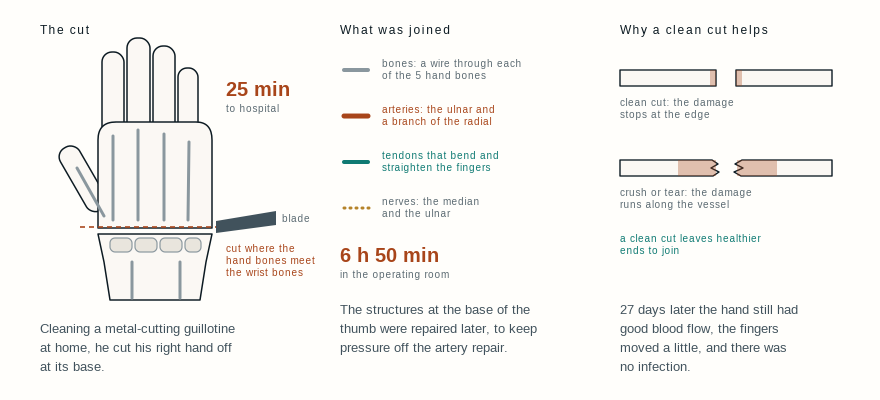
Everything that crosses the wrist, joined again
He was taken for urgent replantation under general anaesthesia. The operation lasted 6 hours and 50 minutes. The surgeons first dissected and identified the structures they would need, in both the separated hand and the stump.
The skeleton was fixed with Kirschner wires, thin steel pins, passed backwards through each of the five metacarpals, the long bones of the hand, into the wrist bones. Blood supply was restored by joining two arteries: the ulnar artery and a branch of the radial artery. Several of the tendons that bend the fingers and several of those that straighten them were repaired, and the two main nerves of the hand, the median and the ulnar, were stitched back together.
One part was deliberately left. The structures at the base of the thumb, in the hollow known as the anatomical snuffbox, lie over the radial artery. Repairing them straight away could have pressed on the fresh artery join, so they were reconstructed in a later operation. No complications were recorded during the surgery.
The cost of bringing a hand back
In the first days the replanted hand stayed pink, and when the fingertips were pressed, the colour came back quickly. The team checked this repeatedly, kept the hand raised above the level of his heart and protected it in a splint.
On the first day after surgery, his blood tests showed the effects of blood loss and an injury to his kidneys. The authors describe the kidney injury as having more than one cause, with concern for reperfusion injury: when blood flows back into a large amount of tissue that has been without it, substances released from that tissue can harm the kidneys. With medical treatment and monitoring, both problems improved.
Alive, and starting to move
When he went home, the wound was closed without infection, and all five fingers had a good blood supply. He could bend and straighten them a little, and some feeling had returned. He was told to keep wearing the splint, clean the wound daily, keep the hand raised and come back for follow-up.
At the clinic 27 days later, the hand still had good blood flow. Its movement was limited, and a patch of dead skin on the back of the hand was separating from the healthy tissue beneath, with no sign of infection. An X-ray showed the bones still lined up and the wires holding.
The report ends there. The authors note that no formal measure of hand function was recorded, so how much use he eventually regained is not known.
Why a guillotine is the better injury to replant
A hand that has been cut off can only survive if blood flows through it again, which means joining arteries only a few millimetres across. How well that works depends heavily on how the hand came off. The authors point out that a sharp, guillotine-type cut generally does better than a crush or a tear: the vessel walls are damaged over a much shorter distance, and less of the surrounding tissue is destroyed, so there is healthy vessel to join.
Time matters more for a whole hand than for a fingertip. A hand contains muscle, and muscle tolerates loss of blood supply poorly, so the longer the delay, the greater the risk of tissue death and of the reperfusion injury this patient had. This patient reached hospital within 25 minutes.
The authors also stress that survival of the hand is not the same as success. The goal of replantation is a stable hand with feeling that is actually useful, and that usually takes months of rehabilitation and often further operations. Replants at the wrist and hand level tend to recover better than those higher up the arm, but each decision has to weigh the injury, the patient's health and what the patient wants.
What this case teaches
A 69-year-old man cut off his right hand at its base while cleaning a metal-cutting guillotine at home. He reached hospital in 25 minutes, and in an operation of almost seven hours surgeons wired the five hand bones to the wrist, joined two arteries, and repaired the tendons and the two main nerves. His kidneys were strained by the blood loss and the return of blood to the hand, and recovered with treatment. A month later the hand was alive, with good blood flow and some early movement. The clean edge of the cut and the speed of his arrival gave the surgeons the best possible chance; how useful the hand becomes depends on the long rehabilitation that follows.
Was this case worth your time? Buy the next one a coffee ($3), or support MedicaseHub monthly.
Next case · MC-010 Replanting an arm: the clock, and the harder questionSix hours of viability, and a decision about whether to reattach a limb the patient removed himself.Read it →
Want the next case like this?
When a new case is written up, it comes to your inbox: the story, the diagram and what it teaches. No schedule and no filler. Unsubscribe in one click.
Free · no spam · your address is never shared · built with KitRead the original paper: doi.org/10.1016/j.radcr.2026.05.052
Adapted from Solano Vázquez JG, Aparicio Muñoz JA, Zepeda Torres JM, Jiménez Caprielova Y, Avilés Palomares KS and Hernández Torón JC, “Major hand replantation at the carpometacarpal level: a case report,” Radiology Case Reports 2026;21(9):3745-3750. The injury, the findings on arrival, the operation, the postoperative course and the 27-day follow-up are as reported there, summarised in the author’s own words; the points on clean cuts, ischaemia time and functional goals are those the authors make in their discussion, and the anatomical explanations are from standard references. The paper is published under a Creative Commons Attribution-NonCommercial-NoDerivatives licence (CC BY-NC-ND 4.0), so its photographs and radiographs are not reproduced here; they can be seen in the original article. The diagram is original to MedicaseHub, is simplified, and may be reused freely under CC BY 4.0. This article is not medical advice. Read the full disclaimer.
Related cases
- Replanting an arm: the clock, and the harder questionThe same race against time, one level higher up the arm.
- They operated on the hand before they operated on himAnother hand that needed its blood supply back within hours.
- His arm was hanging on by a strip of skin when he reached the operating roomA limb saved after a machine injury, followed over seven months.