For 40 years a growth of veins took over his face. In 2010, surgeons removed it.
José Mestre's venous malformation began to grow on his lip when he was 14. It spread until it covered most of his face, took his left eye and made every meal bleed. For decades, no one operated.
- Specialty
- Craniofacial and plastic surgery
- Patient
- José Mestre, a former traffic guard from Portugal, 53 at the time of surgery
- Condition
- Venous malformation of the face, present from birth, growing from age 14
- Effects
- Left eye destroyed; mouth and tongue invaded; bleeding when eating; difficulty breathing and sleeping
- Why untreated
- Conflicting advice in several countries; his family's faith excluded blood transfusion
- Surgery
- St. Joseph Hospital, Chicago, 2010: removal of about 12 lb (5.4 kg), then reconstruction
- 40 years
- Living with the growth
- After
- Out of the house every day; not expected to grow back
- age 14the growth
- 2008a stranger
- 2010Chicago
- aftergoing out
A malformation that would not stop
José Mestre was born in Portugal with a venous malformation, an abnormal tangle of veins that forms before birth. Such malformations are not cancers, and many stay small. His started growing on his lip when he was 14, the age at which these lesions often enlarge, and it did not stop.
Over the following decades it spread across most of his face. It destroyed his left eye. It grew into his mouth, so that eating made his tongue and gums bleed, and it made breathing and sleeping difficult. By the time he reached surgeons it weighed about 12 pounds, roughly 5.4 kg, and the surgeon who removed it said he had never seen a facial tumour as dramatic.
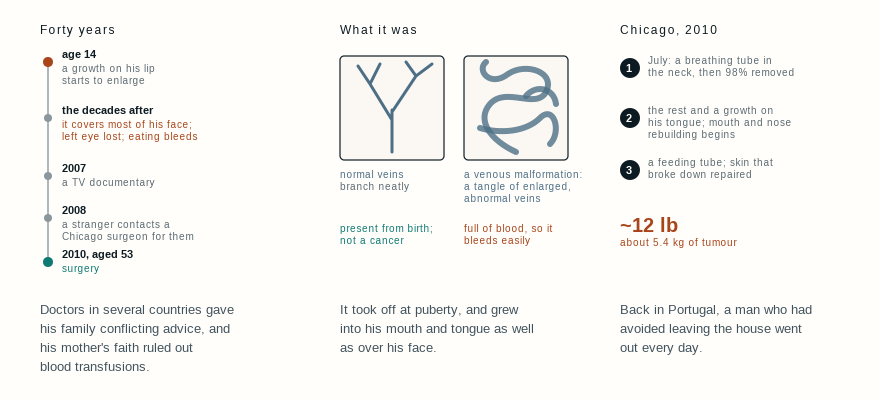
Why was something so visible left for so long? His mother took him to doctors in Portugal and at centres in Spain, Germany and England, and the family received conflicting diagnoses and treatment plans. And his mother was a Jehovah's Witness, a faith that rejects blood transfusion, and she wanted her son to follow it. A malformation made of blood vessels bleeds heavily when it is cut. His surgeon later put his dilemma plainly: he would eventually have to choose between dying from the repeated bleeding of a growing tumour, or giving up his faith and accepting definitive surgery.
In Portugal, doctors had given up hope of operating, and he had come to believe that he would die of it. In 2007 his story was told in a television documentary that made him known around the world as the man with no face.
A tourist in Lisbon
After his mother died, his younger sister Edith, a hairdresser, became his guardian and began pushing harder for treatment.
The opening came from a stranger. A British tourist who had watched documentaries about facial surgery at St. Joseph Hospital in Chicago saw José on the streets of Lisbon. Known to the doctors only as Peter, he arranged an introduction by email to Dr McKay McKinnon, a craniofacial plastic surgeon there, who examined José while giving a presentation in Portugal in 2008. The family called him their angel. The doctors never heard from him again.
It still took time. By 2010, the hospital said, the tumour had become so life-threatening that Edith told her brother he was going to die anyway, so he should die trying. The Portuguese national health system agreed to pay.
McKinnon also discussed a face transplant with them, and advised against it. Standard surgery by an experienced team, he said, was still the better path: a transplant means lifelong drugs to suppress the immune system, a risk of rejection, infection and cancer, and few options if it fails.
Taking it off without taking the face
The first operation, in July 2010, began with a tracheostomy, a breathing tube placed through the front of the neck, so that his airway would stay safe while surgeons worked on a tumour that filled his mouth. They then removed 98 percent of the tumour.
A second operation took out the small part that remained and a separate growth on his tongue, and began rebuilding his mouth and nose. In a third, he was given a feeding tube to keep up his nutrition, and the surgeons repaired skin that had broken down after the first two operations. McKinnon explained that the skin had a good arterial supply, but the veins were not draining it well enough.
The hospital described the work to a local television station in October 2010 as one long operation to remove the growth and three to reconstruct his face, over about three months in Chicago. Another surgeon on the team said it might be the largest such tumour ever removed, and that the difficulty was doing it without deforming the face.
A face that still had to heal
He returned to Portugal with his sister in the autumn of 2010. His new facial skin still looked raw, more like a burn survivor's than a normal face, and McKinnon warned that colour, texture and shape take a long time to return. Further reconstruction in Portugal, and possibly minor surgery to his gums or tongue, might follow.
But McKinnon considered the operation a success. The tumour was not expected to grow back, and he was no longer in danger of dying from it. The change in his life was immediate: a man who had never wanted to leave the house, the hospital said, now went out every day, singing.
The harder recovery, McKinnon said, was psychological. Someone who has lived with a condition like this for forty years, and been told by doctors he would die of it, finds it hard to let go of, and that may take years.
Why a benign growth could kill him
A venous malformation is benign in the sense that matters to a pathologist: it does not spread to other organs. But it is made of blood vessels, and in his face it kept enlarging, distorting everything around it. It bled every time he ate. It made breathing and sleeping difficult. Left alone, its repeated bleeding was what his surgeon expected to kill him.
The same feature made surgery frightening. Cutting through a mass of abnormal veins can mean heavy blood loss, and for a family that would not accept transfusion, that risk was not only medical. Add years of conflicting opinions from different countries, and a patient who had been told he would die, and it is easier to see how a visible, treatable problem was left for four decades.
The turning points in his story were not medical inventions. They were a sister who decided to push, a stranger who sent an email, and a surgeon willing to take on what others had declined.
What this case teaches
José Mestre was born with a venous malformation that began growing on his lip at 14 and, over forty years, covered most of his face, destroyed his left eye and made eating bleed. Conflicting medical advice and his family's refusal of blood transfusion left it untreated. After a stranger connected his family with a Chicago surgeon, he had surgery in 2010 at 53: about 12 pounds of tumour removed, then reconstruction of his mouth, nose and skin. The tumour was not expected to return, and a man who had hidden at home began going out every day.
Was this case worth your time? Buy the next one a coffee ($3), or support MedicaseHub monthly.
Next case · MC-003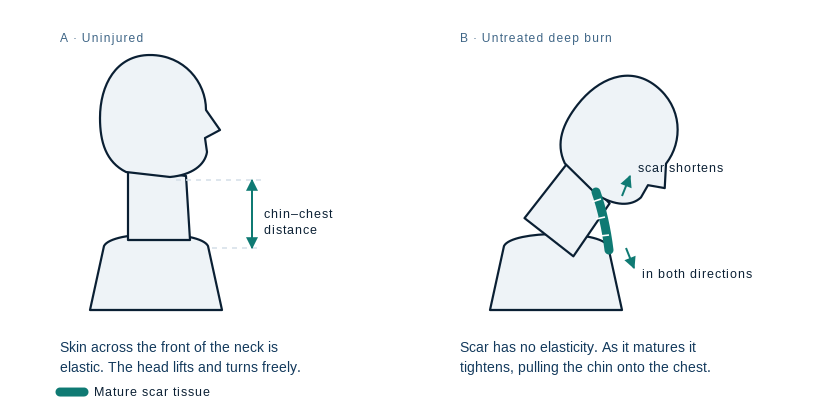 Burn scar contracture: face healed to the chestTen months without a surgeon turned a survivable burn into a disfigurement that took twelve operations to reverse.Read it →
Want the next case like this?
When a new case is written up, it comes to your inbox: the story, the diagram and what it teaches. No schedule and no filler. Unsubscribe in one click.
Free · no spam · your address is never shared · built with KitMain source: ABC News, “12-pound tumor swallows man's face,” February 2011
Based on published reporting: Susan Donaldson James, ABC News (February 2011), including interviews with Dr McKay McKinnon and St. Joseph Hospital; ABC7 Chicago, “12-lb. tumor removed from man's face” (October 2010), including Dr Ramsen Azizi; and the Wikipedia entry for José Mestre for the 2007 documentary. The reports differ on the size of the tumour and on how the operations are counted: ABC News describes three procedures, the hospital told ABC7 Chicago of one removal and three reconstructions, and Wikipedia gives the tumour as 5 kg and 40 cm. Where they differ, both versions are given here. The account is summarised in the author’s own words, and the explanation of venous malformations is from standard references. No photographs of the patient are reproduced. The diagram is original to MedicaseHub, is simplified, and may be reused freely under CC BY 4.0. This article is not medical advice. Read the full disclaimer.
Related cases
- Burn scar contracture: face healed to the chestAnother face changed by years without treatment, and rebuilt by a surgeon abroad.
- He lived with it for 20 years. It weighed 20 kilograms.Another benign growth left for decades before surgery.
- The tumour covered half her face. Surgeons rebuilt it from the tumour's own skin.A large facial tumour removed and the face reconstructed.