Bark-like growths covered his hands. Surgeons cut them off 25 times, and they kept coming back.
Abul Bajandar, a rickshaw puller from Bangladesh, became known around the world as the "tree man". After a year of operations, doctors believed he might be the first person cured of his condition. They were wrong, and the reason is in his skin's response to a common virus.
- Specialty
- Plastic surgery, dermatology
- Patient
- Abul Bajandar, a former rickshaw puller from Khulna, Bangladesh, in his late twenties
- Condition
- Epidermodysplasia verruciformis ("tree-man syndrome")
- Effects
- Hard, bark-like growths on hands and feet, reported at up to 11 lb (5 kg); unable to work or use his hands
- Treatment
- Repeated surgical removal at Dhaka Medical College Hospital, free of charge
- Operations
- 16 in the first year; 25 by January 2019
- Jan 2017
- Hands and feet "almost fine"
- Jan 2019
- About 40% of the growths back
- 2016the tree man
- 2017almost fine
- 2018growing back
- 2019the 26th operation
Hands that had turned to bark
Abul Bajandar lived in Paikgachha, in the Khulna region of Bangladesh, and pulled a rickshaw for a living. For about ten years, hard, greenish-grey growths had been spreading over his hands and feet. They grew into gnarled protuberances, long and thick enough to look like tree bark, and they took away the use of his hands. He could no longer work.
He was admitted to Dhaka Medical College Hospital, the country's leading hospital, on 30 January 2016. His case became national news, and then world news. Reports described him as one of only a handful of people in the world known to have the condition, epidermodysplasia verruciformis, and one with a particularly aggressive form. The government ordered that he receive the best care, and the hospital treated him free of charge.
Sixteen operations, and a hand to hold his daughter
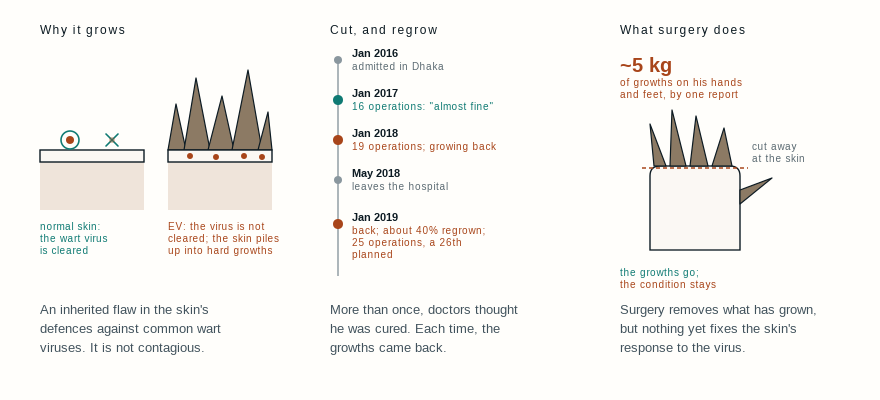
His first operation came in February 2016. The plastic surgeons cut the growths away from his hands and feet, operation after operation. Reports put their weight at up to 11 pounds, about 5 kg.
By January 2017, after 16 operations in a year, the surgeon coordinating his care said his hands and feet were almost fine. A few small operations on his hands remained, and he was expected to go home within weeks. Doctors suggested that, if the growths stayed away, he could be the first person known to be cured of the condition. He told reporters he felt much better, and could at last hold his daughter in his lap and play with her.
Two years in a hospital room
He did not go home. A year later, in January 2018, he was still living in a two-bed room at the hospital, with his young daughter in the second bed. He had had 19 operations. The doctors had removed all the growths, but new ones had appeared, and the team planned to keep him there so they could monitor him.
Six months earlier, after what he believed was his last operation, he had been able to eat by himself with a spoon. Now he was in pain again, could not bend his fingers, and needed his wife or mother to feed him. His wife said that although they paid for nothing, the family was suffering from the long stay.
In May 2018, as the growths appeared on parts of his body that had been clear, he left the hospital without telling the staff and went back to his village, having given up hope of a full recovery.
Back where he started
He came back in January 2019. The growths on his hands were now about an inch long, he could no longer hold anything properly, and the pain kept him awake at night. He said leaving had been a mistake. Of the growths removed earlier, he said, about 15 percent had not returned.
The head of plastic surgery estimated that around 40 percent of the growths had come back since May, and conceded that his case was more complicated than first thought. He had had 25 operations since 2016, and an emergency medical panel scheduled a 26th. More tests were ordered. He said he still believed that someday he would live like a normal man.
The reports we found end in 2019, so we do not know how his condition has developed since.
Why cutting it off was never going to be enough
Epidermodysplasia verruciformis is an inherited condition. Most people carry human papillomaviruses, the family of viruses that cause ordinary warts, and their skin keeps them in check. In this condition, an inherited defect means the skin cannot control certain types of the virus. Infected skin cells keep multiplying, and in rare, severe cases like his the result is thick, horn-like growths.
Surgery removes the growths, but the skin underneath still carries the virus and still cannot control it, so new growths can form, in the same places or new ones. That is why he could be described as almost cured one year and be back in hospital the next. The condition also carries a raised risk of skin cancer on sun-exposed skin, which is one reason doctors watch these patients for life.
His story is often told as a medical miracle that failed. It is more accurately a reminder of what surgery can and cannot do: it can give someone the use of their hands back, sometimes for months at a time, but it does not change the biology that made the growths in the first place.
What this case teaches
Abul Bajandar, a rickshaw puller from Bangladesh, had epidermodysplasia verruciformis, an inherited inability to control common wart viruses, which covered his hands and feet with bark-like growths. Surgeons at Dhaka Medical College Hospital removed them in 16 operations over a year and believed he might be the first person cured. The growths returned. After 25 operations, a period in which he left the hospital, and a return with about 40 percent of the growths back, a 26th operation was planned in 2019. Surgery gave him back the use of his hands for a time, but it could not change the skin's response to the virus.
Was this case worth your time? Buy the next one a coffee ($3), or support MedicaseHub monthly.
Next case · MC-069 For 40 years a growth of veins took over his face. In 2010, surgeons removed it.José Mestre's venous malformation started on his lip at 14 and grew until it covered his face. His family's faith ruled out blood transfusion, and for decades no one operated.Read it →
Want the next case like this?
When a new case is written up, it comes to your inbox: the story, the diagram and what it teaches. No schedule and no filler. Unsubscribe in one click.
Free · no spam · your address is never shared · built with KitMain source: Agence France-Presse, “Bangladeshi ‘Tree Man’ dreams of cure as rare skin disease returns,” January 2019
Based on published reporting: Agence France-Presse (January 2019, via the Philippine Daily Inquirer); The Daily Star, Dhaka, “‘Tree-man’ returns to DMCH for treatment” (January 2019); IANS via Khaleej Times, “Bangladesh ‘tree man’ trapped in hospital for two years” (January 2018); and Fox News, “‘Tree Man’ undergoes life-changing surgery to remove 11 pounds of warts” (2017), citing AFP and Barcroft Media. Operation counts and the weight of the growths are as those reports give them. The account is summarised in the author’s own words, and the explanation of epidermodysplasia verruciformis is from standard references. No photographs of the patient are reproduced. The diagram is original to MedicaseHub, is simplified, and may be reused freely under CC BY 4.0. This article is not medical advice. Read the full disclaimer.
Related cases
- For 40 years a growth of veins took over his face. In 2010, surgeons removed it.Another growth that made a man famous, and the surgery that finally came.
- Keloid vs hypertrophic scar: fifteen years untreatedAnother skin condition where removing it is not the same as curing it.
- Thirty-five operations could not stop the tumour. A new face did.Another patient who needed operation after operation for a condition that kept growing.