A crash almost tore her arm off at the elbow. Four thin nails held it together.
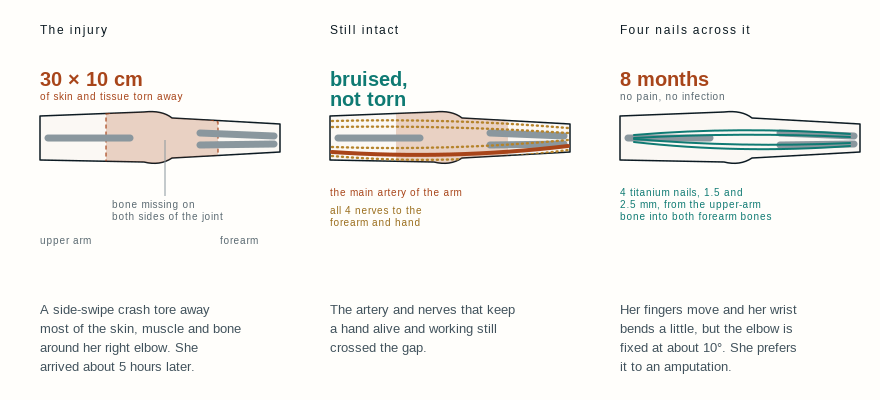
A side-swipe crash took most of the skin, muscle and bone around a woman's right elbow. What it had not torn was the artery and the nerves to her hand, and that changed what the surgeons could try.
- Specialty
- Orthopaedic trauma surgery
- Patient
- Woman aged 54; the injured arm was her dominant right arm
- Injury
- Near-total amputation at the elbow in a side-swipe road accident; about 30 × 10 cm of skin and soft tissue lost; bone missing on both sides of the joint
- On arrival
- About 5 hours after the crash; conscious, oriented and stable; no other injuries
- Still intact
- The main artery of the arm and all four nerves to the forearm and hand, bruised but not torn
- Surgery
- Cleaning and an external frame; then four titanium nails across the elbow; skin grafts
- 3 weeks
- Plaster off; arm in a sling
- 8 months
- No pain, no infection; fingers moving; elbow fixed at about 10°
- 5 hthe crash
- surgerywhat was left
- the nailsfour across the joint
- 8 monthswhat she can do
An arm hanging at the elbow
The woman, 54, was hurt in a side-swipe road accident that struck her right arm, the one she used most. She reached the emergency department about five hours later. She was conscious, knew where she was, and her pulse and blood pressure were stable. A full trauma check found no injury to her head, chest or abdomen, and no other broken bones.
The damage was all in one place. Around the lower upper arm and the upper forearm, roughly 75% of the skin and soft tissue had been torn away over an area of about 30 by 10 centimetres, mostly on the back and outer side of the elbow. The wound was heavily contaminated, with bone fragments and muscle exposed. The arm was almost completely severed at the elbow joint.
X-rays showed fractures with bone missing on both sides of the joint: from the humerus, the upper-arm bone, and from the top ends of the radius and ulna, the two forearm bones. Muscle had been lost too. The surgeons graded it a Gustilo-Anderson type IIIB open fracture: one with so much soft-tissue loss that bone is left exposed.
The parts that mattered were still there
In the operating room the surgeons cut away all the dead and contaminated tissue. The olecranon, the bony tip of the elbow, was gone, and the triceps, the muscle that straightens the elbow and attaches there, was torn from its insertion.
Then they explored the vessels and nerves. The brachial artery, the main artery of the arm, was bruised but intact. So were all four nerves that run past the elbow to the forearm and hand: the median, ulnar, radial and musculocutaneous nerves. Despite everything else that was lost, the hand still had its blood supply and its nerves.
The injury scored more than 7 on the Mangled Extremity Severity Score, a scale used to judge whether a badly injured limb can be saved; scores this high are usually taken as a sign of a very severe injury. The authors point out that the score is less reliable in the arm than in the leg, and that saving an arm is often attempted because even partial function is worth a great deal compared with an amputation. For now, the arm was held still in an external fixator, a metal frame outside the skin spanning the elbow, so the wound could be looked after.
Bridging a gap with flexible nails
With bone missing at the joint, a contaminated wound and the triceps attachment destroyed, the usual options were poor. The authors considered plates, keeping the external frame for longer, fusing the elbow or replacing it, and judged that the state of the wound and the missing bone ruled them out.
Instead they used titanium elastic nails, thin flexible rods normally used to fix children's fractures. Four were passed across the elbow in a spanning arrangement, from inside the humerus down into the radius and the ulna: two 1.5 mm nails and two 2.5 mm nails, sized to fit the hollow centre of each bone. Inside the bones they act as internal splints. The construct kept the arm in line and stable even with bone missing, and needed little further disturbance of the damaged tissue.
The skin was closed loosely at first, because there was not enough healthy tissue to close it properly. Some of it died, and was cut away in repeated sessions with regular dressings until the wound was clean and healing. It was finally covered with split-thickness skin grafts, thin layers of skin taken from elsewhere on the body; no flap was needed.
A pain-free arm, and a stiff elbow
After surgery the arm was held in a plaster slab above the elbow and she was given broad-spectrum antibiotics, with the wound checked regularly. At three weeks the plaster came off and she wore a sling. Physiotherapy began gradually once the soft tissue had healed.
At eight months she had no pain and no deep infection, and there were no problems with the nails. Blood flow to the hand was good, with a pulse at the wrist. Wrist movement, which had been absent after the injury, had partly returned: she could bend her wrist about 20 degrees, but could not lift it back. Her fingers moved and some hand function had returned, but her grip was weak.
The elbow itself was fixed at about 10 degrees of bend, with almost no movement. She could hold a bottle with help from her other hand, and hold a pen, though not write with it. She told the team she was satisfied that her arm had been kept, and preferred it to an amputation.
Why surgeons try so hard to keep an arm
For a badly mangled leg, a well-fitted prosthesis can restore walking remarkably well, and surgeons are more willing to amputate. An arm is different. Artificial arms and hands still fall well short of a living hand, and even a hand that only grips weakly and helps the other one is useful. That is why upper-limb salvage is often attempted in injuries that look unsalvageable, as the authors note.
What decides whether it can work is often not the bone. Bone can be bridged, held with frames or nails, and grafted later. Skin can be grafted. What cannot be replaced easily is the blood supply and the nerves to the hand. In this case they had survived, bruised but continuous, and that is why there was still a living hand at the end of the arm to work with.
The result was not a normal arm. Her elbow does not bend, she cannot lift her wrist back, and her grip is weak. But she has no pain, no infection, a hand that can hold things, and an arm she preferred to keep.
What this case teaches
A side-swipe crash almost severed a 54-year-old woman's right arm at the elbow, tearing away a large area of skin and muscle and taking bone from both sides of the joint. The main artery and all four nerves to her hand were bruised but intact. Surgeons cleaned the wound, held the arm in an external frame, then bridged the gap with four flexible titanium nails normally used for children's fractures, and covered the wound with skin grafts. Eight months later her arm was pain-free and free of infection, her fingers moved and her wrist bent a little, though her elbow was fixed and her grip weak, and she preferred it to an amputation.
Was this case worth your time? Buy the next one a coffee ($3), or support MedicaseHub monthly.
Next case · MC-061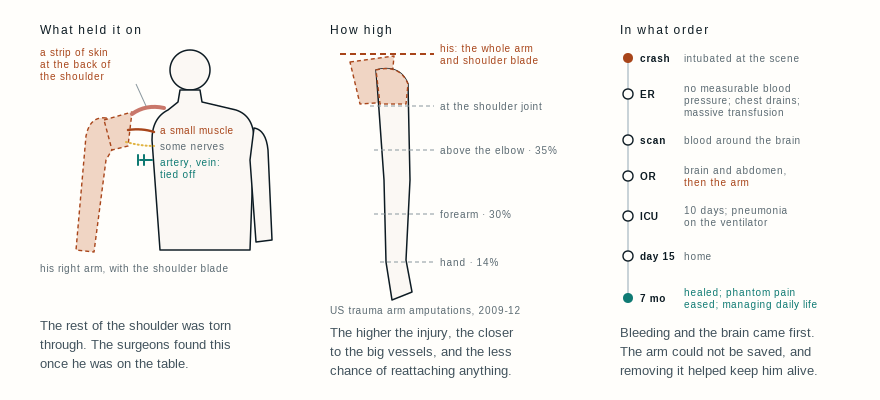 His arm was hanging on by a strip of skin when he reached the operating roomAfter a rollover crash, a 26-year-old's right arm was held on by skin, one muscle and some nerves. Surgeons removed it with the shoulder blade.Read it →
Want the next case like this?
When a new case is written up, it comes to your inbox: the story, the diagram and what it teaches. No schedule and no filler. Unsubscribe in one click.
Free · no spam · your address is never shared · built with KitRead the original paper: doi.org/10.13107/jocr.2026.v16.i11.8390
Adapted from Abdulla A, Deshpande M, Patil DU, Mamgain P, Lawande NN and Kenkre AD, “Limb salvage in near-total traumatic elbow amputation with bone loss using spanning titanium elastic nails: a case report,” Journal of Orthopaedic Case Reports 2026;16(11):67-73. The injury, the findings at surgery, the fixation, the wound care and the 8-month follow-up are as reported there, summarised in the author’s own words; the points on the severity score, the fixation options and the value of upper-limb salvage are those the authors make in their discussion, and the anatomical explanations are from standard references. The paper is published under a Creative Commons Attribution-NonCommercial licence (CC BY-NC 4.0), so its photographs and radiographs are not reproduced here; they can be seen in the original article. The diagram is original to MedicaseHub, is simplified, and may be reused freely under CC BY 4.0. This article is not medical advice. Read the full disclaimer.
Related cases
- His arm was hanging on by a strip of skin when he reached the operating roomAnother arm that was almost completely severed, and saved.
- The bone plate was screwed on outside his legAnother unconventional use of a fixation device when the usual one would not work.
- He cut his hand off cleaning a guillotine. Surgeons spent almost seven hours putting it back.A hand cut off cleanly at the wrist, and reattached.